
Bitcoin ETF Outflows Reach $82.2M as Fed Decision Pressures Investor Demand

0
0

Bitcoin ETF outflows have highlighted a divided response among investors as US spot Bitcoin ETFs adjust to changing market conditions and a new Federal Reserve policy environment. The latest movement shows that investors are reassessing their Bitcoin exposure, but the reaction has varied across different exchange-traded products.
The shift came after the Federal Reserve’s June 17 policy meeting, which influenced sentiment across risk assets. The same day, US spot Bitcoin ETFs recorded net outflows, creating a test of investor demand after the central bank adjusted its outlook for future rates. Bitcoin is trading near $62,629.67, down 2.81% over 24 hours, with a market capitalization of around $1.25 trillion and market dominance of 58.2%.
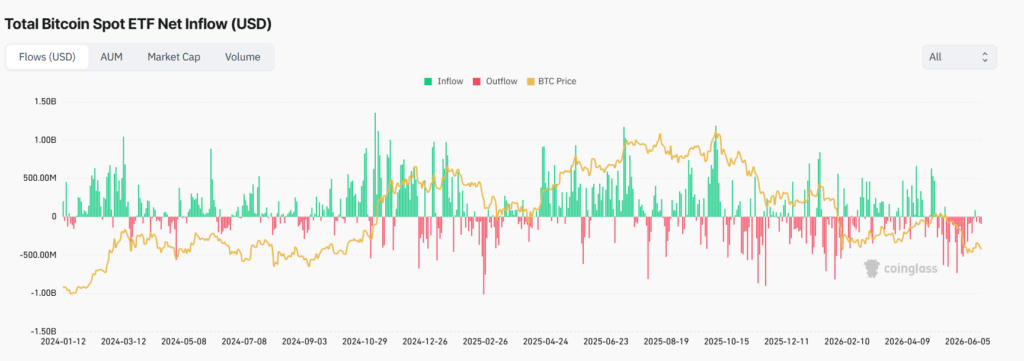
Per Farside Investors, US spot Bitcoin ETFs recorded $82.2 million in net outflows on June 17. However, the fund-level breakdown showed a mixed picture, with some products facing withdrawals while others continued to attract capital.
What do Bitcoin ETF outflows reveal about investor demand?
Bitcoin ETF outflows show that investor activity is becoming more selective, with different funds experiencing different levels of demand. Per Farside Investors’ flow table, US spot Bitcoin ETFs saw total net outflows of $82.2 million on June 17. ARKB recorded the largest withdrawal at $43.5 million, followed by IBIT with $30.8 million in outflows.

GBTC saw $15.5 million leave the fund, while BTCO recorded $6.4 million in withdrawals and HODL reported $4.1 million in outflows. At the same time, some funds attracted new capital. Fidelity’s FBTC recorded $14.0 million in inflows, while MSBT added $4.1 million.
The difference between funds suggests that the market is not showing a single trend. The movement could represent investors shifting between ETF products based on factors such as liquidity, account access, or product preference. However, wider and repeated withdrawals across the category could point toward broader demand weakness.
How did the Federal Reserve’s policy shift reshape the outlook for Bitcoin ETFs?
The Federal Reserve’s June 17 policy decision created a new backdrop for Bitcoin ETFs as investors adjusted expectations around interest rates. The meeting marked Kevin Warsh’s first meeting as Chair. The central bank kept the federal funds target range unchanged at 3.50% to 3.75% and stated that inflation remained elevated compared with its 2% goal.
The updated projections showed the median 2026 federal funds rate expectation rising to 3.8% from 3.4% in March. The median 2026 PCE inflation projection also increased to 3.6% from 2.7%. The shift indicated that expectations for rapid monetary easing had become less certain. Since Bitcoin ETFs connect cryptocurrency exposure with traditional investment accounts, changes in rate expectations can influence demand for risk assets.
Why did Bitcoin ETF products show different flow patterns?
The latest Bitcoin ETF outflows indicate that investors are evaluating individual products rather than treating the entire category in the same way. Fees are one factor, but they do not fully explain the split. GBTC’s 1.50% fee remains relevant when discussing long-term fund competition, but lower-fee products such as IBIT and ARKB also recorded outflows while FBTC and MSBT attracted inflows.
This suggests that other elements, including liquidity, platform availability, investor preferences, and product structure, may also influence daily ETF movements. A single trading session can provide useful information, but daily flows can also be affected by short-term positioning. A repeated pattern across multiple sessions offers a clearer view of whether investors are rotating between products or reducing exposure.
Do Bitcoin ETF outflows mean immediate Bitcoin selling?
Bitcoin ETF outflows do not automatically mean that the same amount of Bitcoin has been sold in the spot market. ETF flow numbers measure changes in investor positions through exchange-traded products. The relationship between ETF redemptions and underlying Bitcoin transactions depends on how issuers manage their operations.
The SEC’s approval of in-kind creation and redemption mechanisms for crypto exchange-traded products in July 2025 means redemptions may not require same-day spot Bitcoin sales. However issuers can still sell Bitcoin when their own operational process requires it. Because of these mechanics ETF flows should be viewed as an indicator of investor positioning rather than a direct measure of immediate changes in Bitcoin supply.
How does the latest ETF movement compare with previous outflows?
The Bitcoin ETF outflows came after earlier periods of heavier withdrawals making the duration of the trend important for market observers. Previous multi-day outflows, including an approximately $648.6 million period in May referenced in market analysis, showed that sustained withdrawal patterns can provide more meaningful signals than a single-day move.
The latest session stands out because the overall negative result was accompanied by inflows into some products. This difference makes issuer-level performance an important factor when assessing whether the market is seeing rotation or broader selling pressure.
What could future Bitcoin ETF flows indicate for investors?
Future ETF flows will help determine whether the latest movement reflects a temporary adjustment or a wider change in investor demand. If products such as FBTC and MSBT continue attracting capital while withdrawals remain concentrated in certain funds the market may be showing a preference shift between ETF providers.

However if outflows begin spreading across more issuers, it could suggest increasing caution toward Bitcoin exposure as a whole. The latest data shows a market balancing changing macro conditions with continued interest in selected Bitcoin investment products.
Conclusion
Bitcoin ETF outflows highlight a period of uncertainty as investors respond to changing monetary expectations and weaker Bitcoin price conditions. The latest flow data points to a divided market as investor demand varied across different Bitcoin ETF products. Data from Farside Investors showed that the $82.2 million net outflow reflected withdrawals from several major funds even as FBTC and MSBT recorded fresh inflows.
The key takeaway is that issuer-level trends currently provide more detail than the overall outflow figure alone. The next set of ETF flow figures will show whether demand stays with a few funds or if selling pressure starts affecting more products
Glossary
Spot Bitcoin ETF- ETF backed by actual Bitcoin.
Net Outflows- More money leaves than enters a fund.
Federal Reserve (Fed)- The US central banking system.
Interest Rates- The cost of borrowing money.
Monetary Policy- Central bank actions that guide the economy.
Frequently Asked Questions About Bitcoin ETF Outflows
How much did Bitcoin ETFs lose on June 17?
Bitcoin ETFs recorded net outflows of $82.2 million on June 17.
Which Bitcoin ETF had the largest outflow?
ARKB had the largest outflow with $43.5 million withdrawn.
Why did investors pull money from some Bitcoin ETFs?
Investors adjusted their positions after the Federal Reserve’s policy update.
What did the Federal Reserve decide on June 17?
The Federal Reserve kept interest rates unchanged at 3.50% to 3.75%.
How can interest rates affect Bitcoin ETFs?
Higher rate expectations can reduce demand for risk assets like Bitcoin ETFs.
Sources-
Read More: Bitcoin ETF Outflows Reach $82.2M as Fed Decision Pressures Investor Demand">Bitcoin ETF Outflows Reach $82.2M as Fed Decision Pressures Investor Demand
0
0


 Manage all your crypto, NFT and DeFi from one place
Securely connect the portfolio you’re using to start.


0
0
