
OKX Europe Enables USDT-to-MiCA USDC Swaps for Traders

0
0
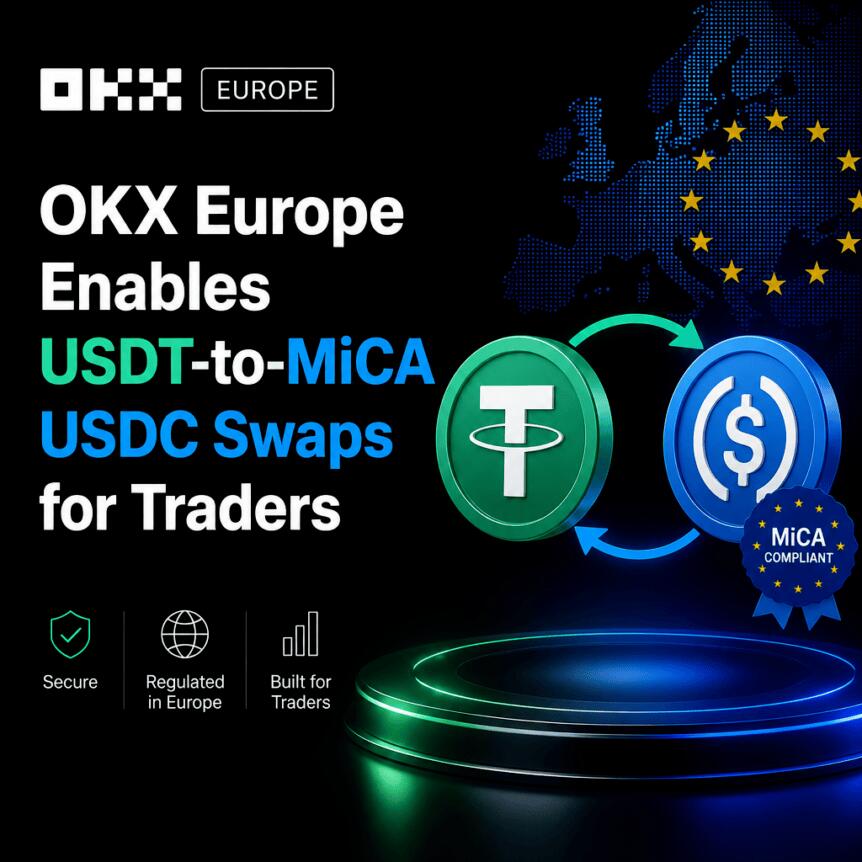
OKX Europe has introduced a “one-way conversion” tool that lets customers deposit Tether’s USDT and convert it into Circle’s MiCA-compliant USDC. The feature is aimed at clients who can no longer keep USDT supported on their accounts as European Union stablecoin rules tighten.
In an announcement shared with Cointelegraph, OKX Europe said the process is customer-controlled: users can deposit USDT into their OKX Europe account and convert it into USDC at their discretion, rather than being forced through a platform-imposed deadline. The exchange said the tool is meant to support customers whose existing venues no longer accept USDT or who plan to move balances automatically to compliant alternatives.
Key takeaways
- OKX Europe now supports conversion from USDT into MiCA-compliant USDC, without requiring a two-way transfer option.
- The feature targets customers affected by MiCA implementation, when many EU-facing platforms reduced USDT availability.
- OKX Europe positions the update as a migration path for users who want to preserve value continuity while shifting to USDC.
- Tether has not pursued MiCA authorization for USDT, which is central to why some platforms restrict or delist USDT in the EU.
- USDT remains the largest stablecoin by market share, according to DefiLlama, even as compliance-driven changes accelerate in Europe.
How OKX Europe’s one-way migration works
According to OKX Europe’s announcement, the new conversion feature allows customers to deposit USDT—Tether’s USDt—into their OKX Europe account and convert those tokens into USDC. USDC is described as one of the major stablecoins that fits the EU’s Markets in Crypto-Assets (MiCA) framework.
The “one-way” aspect matters: the workflow is designed to move balances toward a MiCA-aligned stablecoin rather than enabling conversion in both directions. OKX Europe also emphasized that conversions can be completed at the customer’s discretion instead of via a strict cutoff determined by the exchange.
OKX Europe operates under its MiCA license across 30 EU and European Economic Area countries, positioning the feature as a practical bridge for users navigating where USDT is no longer supported.
MiCA rollout forces stablecoin support to change
The timing aligns with the EU’s stablecoin regulatory rollout. Tether has not obtained authorization to issue USDT under MiCA, a status that has led many European platforms to restrict deposits, remove trading pairs, or convert client balances into compliant alternatives as MiCA rules took full effect on July 1.
That regulatory friction is not marginal. DefiLlama data cited in the report shows Tether accounts for about 59% of the roughly $310 billion stablecoin market, with USDT market capitalization around $184 billion. Circle’s USDC is much smaller by comparison, at about $73 billion, but still one of the largest compliant options for EU-based platforms.
For investors and traders, these shifts can change liquidity and execution. When a major venue restricts deposits or delists pairs, users who depend on a stablecoin—whether for trading, hedging, or moving between exchanges—can face friction even if the underlying stablecoin remains available elsewhere outside the EU.
Tether’s stance on MiCA authorization
Tether has defended its decision not to pursue MiCA authorization for USDT, and the approach has shaped the behavior of European market operators. Cointelegraph previously reported that Tether CEO Paolo Ardoino has criticized MiCA, arguing that reserve requirements could introduce unnecessary risk by requiring part of reserves to be held with European credit institutions.
Ardoino has also suggested that the regulatory tradeoffs are not favorable for stablecoin issuers. In a May 2025 interview with Cointelegraph, he characterized MiCA’s approach as “very dangerous when it comes to stablecoins,” noting Tether’s choice not to seek authorization despite expectations that USDT could lose support on European exchanges.
More recently, in a July 2025 post on X, Ardoino said Tether would reconsider pursuing MiCA authorization only “when MiCA becomes safer for consumers and stablecoin issuers.” The messaging indicates Tether sees no near-term reason to change course—an implication reinforced by the continuing migration efforts from EU-facing exchanges and other service providers.
Broader industry response: from exchanges to retail apps
OKX Europe’s conversion tool reflects a wider trend across Europe: when MiCA restricts USDT access, platforms often re-route customers toward compliant stablecoins or withdrawal pathways.
One example highlighted in the same material is Revolut, a digital banking platform that said it will stop supporting USDT for customers in the European Economic Area and Switzerland. Revolut reportedly gave users until Aug. 31 to sell or withdraw their holdings, with any remaining balances expected to be automatically converted into the base currency.
These actions underscore a key asymmetry for USDT holders in Europe. While USDT remains globally dominant, users in MiCA-regulated jurisdictions may experience forced transitions—either by changing what can be deposited and traded on exchanges or by shifting stablecoin exposure within retail financial interfaces.
For traders, this can affect strategy execution. Stablecoin pairs tied to USDT liquidity may shrink, and conversion paths could introduce operational steps or timing variability. For users focused on custody or settlement, the migration choice also becomes a matter of which compliant stablecoin is supported on the platform they use day to day.
What to watch next for EU stablecoin migration
As MiCA compliance keeps reshaping which stablecoins are usable on EU-facing platforms, customers should watch whether more exchanges adopt similar “migration” features and whether USDT support continues to narrow to withdrawals and conversions rather than active trading. The next turning point will likely be how quickly the market’s liquidity consolidates around MiCA-approved alternatives like USDC—and whether Tether’s position evolves if regulatory conditions change.
This article was originally published as OKX Europe Enables USDT-to-MiCA USDC Swaps for Traders on Crypto Breaking News – your trusted source for crypto news, Bitcoin news, and blockchain updates.
0
0


 Manage all your crypto, NFT and DeFi from one place
Securely connect the portfolio you’re using to start.

0
0

0
0

0
0

0
0