
Orbition Network Ecosystem: Features, OBN Token and Roadmap

0
0
A Closer Look at the Orbition Network Ecosystem
A new AI-themed blockchain project is picking up traffic on crypto social media, and the name attached to it is Orbition Network. Readers keep finding this project through airdrop lists, tokenomics threads, and presale pages, but the full picture is scattered across a website, a docs portal, and scraps of X commentary.
This article pulls the Orbition Network ecosystem together in one place — what the network is, how OBN fits into it, and what the roadmap actually says versus what's still just a stated plan. It's an early-stage project, so a lot of what's out there hasn't been independently verified yet.
What Is the Orbition Network Ecosystem?
Orbition Network describes itself as an AI-oriented, EVM-compatible Layer-1 blockchain. Its own documentation frames the project around participation, ecosystem expansion, and Solidity-compatible application development.
The core purpose, according to the project, is to build infrastructure where data, AI activity, and blockchain coordination work together. The stated problem it's trying to solve is familiar in crypto AI pitches: useful data mostly sits with a small number of large tech companies, which limits access and raises privacy concerns. Orbition frames itself as a response to that concentration. That's the project's own framing, not an independently confirmed market gap.
A public testnet is live, with an RPC endpoint, block explorer, and faucet listed in the docs. That part is checkable. How much of the full mainnet vision described in the whitepaper is actually built, versus still on paper, isn't yet clear from public information.
How Does Orbition Network Work?
The project's technical documentation describes a Delegated Proof-of-Stake (DPoS) consensus model. Validators are selected to produce and confirm blocks, which is generally faster than older Proof-of-Work systems but relies on a smaller validator set for security.
EVM compatibility is a central design choice. Orbition supports the Ethereum Virtual Machine, meaning developers who already build with Solidity and Ethereum-style tooling can deploy on Orbition with little rework. The docs also mention SVM and zkEVM compiler support, aimed at modular code deployment across different virtual machine types.
On architecture, Orbition's public GitHub repository states that the project has drawn code and design ideas from Solana, Polygon zkEVM, Cosmos WASM, and Velas. Combining a Solana-style throughput approach with EVM compatibility is a more technically ambitious combination than most single-token projects attempt this early — worth watching for follow-through, but not yet something readers can fully verify without a live mainnet.
Inside the Orbition Network Ecosystem
The stated ecosystem spans a few different pieces, based on what's currently public:
AI infrastructure. The project's long-term goal, per its own materials, is decentralized AI infrastructure — a network where AI activity and data access aren't controlled by a handful of centralized players. This remains a roadmap goal rather than a shipped product today.
dApps and Web3 applications. Because Orbition is EVM-compatible, the project's documentation points to Ethereum-style decentralized apps and DeFi protocols as being able to run on the network with minimal changes. This capability is tied to the testnet and future mainnet, not a large existing app ecosystem yet.
Nodes and staking. The docs include guides for running validators, setting up RPC nodes, and delegating stake. Orbition's own site states that the network is "evolving toward deeper network participation through node operation, staking, and future validator infrastructure" — language that signals this is still developing rather than fully live.
Developer ecosystem. Orbition provides a faucet, CLI tools, and a bridge between Orbition and existing EVM chains, aimed at lowering the barrier for developers already working in the Ethereum ecosystem. A migration guide is also listed for teams moving dApps over from other EVM chains.
OBN Tokenomics: Supply, Allocation and Vesting
OBN is the network's native token. According to the project, it's meant to be used for transactions, fees, and supporting Proof-of-Stake consensus as the network matures. The project also says OBN is "designed to become" the core asset for future staking, utility access, and decentralized AI infrastructure activity — note that this is forward-looking language, not a description of current utility.
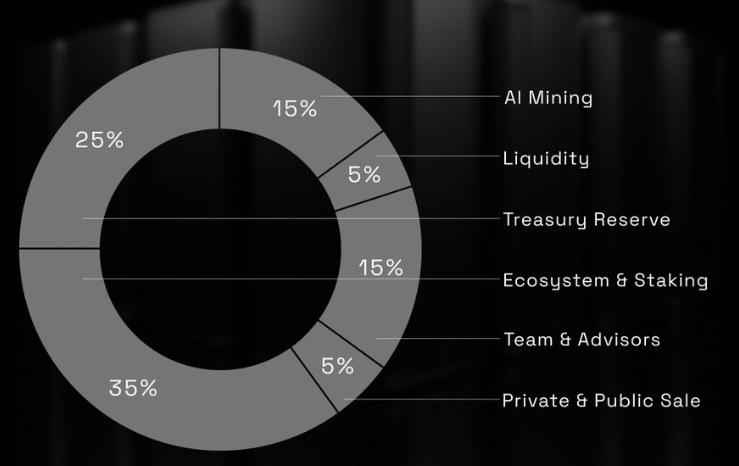
Per publicly circulated tokenomics figures, OBN has a fixed total supply of 10,000,000,000 tokens, with no built-in ongoing inflation. Six categories divide that supply:
Allocation | Percentage | Stated Purpose |
Ecosystem and Staking | 35% | Network growth, staking rewards, infrastructure |
Treasury Reserve | 25% | Partnerships, exchange growth, long-term operations |
Team and Advisors | 15% | Core team and advisor allocation |
AI Mining | 15% | Rewards for early contributors and miners |
Private and Public Sale | 5% | Presale and public sale participants |
Liquidity | 5% | Exchange listings and market making |
A few details stand out. Team and Advisor tokens reportedly carry a 24-month cliff before any vesting starts, followed by a 36-month linear release — longer than what many comparable projects use. AI Mining allocations reportedly unlock 10% at TGE, with the rest spread across 12 monthly releases.
Based on these figures, initial circulating supply at TGE would sit around 11.5% of total supply, combining the 5% sale allocation, 5% liquidity, and roughly 1.5% from the first AI Mining unlock. A lower initial float generally limits how much supply can hit the market immediately, though it says nothing about future demand.
On network fees, the project's documentation states OBN is used for transaction and gas-style fees on the network, similar to how native tokens function on other EVM chains.
What Is the Orbition Network Roadmap?
Orbition's own site lays out its roadmap as three named stages, without attaching calendar dates to any of them. That's worth flagging on its own — some comparable AI and Layer-1 projects publish quarter-by-quarter timelines, while Orbition's public roadmap currently reads as sequential milestones rather than a dated schedule.
Current development stage:
Official OBN tokenomics framework release
AI Mining claim process opening for eligible users
Token Generation Event and initial OBN listing
OBN distribution and claim structure activation
Utility Activation stage:
OBN expanding into core ecosystem utility
Staking participation beginning phased activation
Mobile ecosystem experience moving into development
Node-related infrastructure planning expanding
Ecosystem Growth stage:
Orbition's utility layers continuing to expand
Mobile experience and ecosystem features progressing
Node-related participation entering deeper rollout
Long-term decentralized AI infrastructure growth continuing
Right now, the project sits in the first stage — the testnet, AI Mining airdrop program, and public sale page are live, but the tokenomics framework, AI Mining claims, and TGE itself hadn't been marked complete on official channels as of this research date.
Community commentary on social media has floated a Q3 2026 or early-September TGE target. That date hasn't appeared on Orbition's official channels as a confirmed commitment, so it should be treated as speculation, not a project-stated deadline.
What Makes Orbition Network Different?
The combined pitch — AI-and-data focus, Solana-style throughput, and EVM compatibility for easy developer onboarding — is a broader technical scope than most single-token AI projects attempt at this stage. Multi-VM support (EVM, SVM, zkEVM) is the most notable claim worth tracking for follow-through.
On scalability, the project positions itself against the classic blockchain trilemma of scalability, security, and decentralization, saying its architecture is built to outperform many existing platforms. That's a project claim, not an independently benchmarked result.
On developer accessibility, EVM compatibility and a bridge for migrating existing dApps are concrete, checkable features already reflected in the docs — arguably the strongest evidence of technical follow-through so far.
Key Risks and Challenges of Orbition Network
Early-stage ecosystem: No mainnet token, confirmed exchange listing, or third-party audit has been publicly verified as of this research date.
Adoption risks: A live testnet and airdrop-driven sign-ups don't guarantee real developer or user adoption once a mainnet and TGE arrive.
Competition: Orbition is entering a crowded field of AI-themed and EVM-compatible Layer-1 projects, many of which are further along in mainnet development or exchange listings.
Documentation gaps: Portions of the public docs currently reuse generic developer-course content, limiting how much technical detail can be independently checked.
Unconfirmed timelines: Community-sourced TGE dates aren't the same as an official announcement, and presale terms can change without notice.
Conclusion
The Orbition Network ecosystem is an early-stage, AI-themed Layer-1 project built around EVM compatibility, a DPoS consensus model, and a fixed 10 billion OBN supply. A live testnet, developer tooling, and an active public sale confirm the project is functioning in some form today.
What stands out is the vesting structure behind OBN tokenomics, which leans toward gradual release over fast unlocks. What remains uncertain is how much of the broader AI-infrastructure and staking vision is actually built versus still planned, and when a confirmed TGE date will arrive. Readers should check Orbition's official website and docs directly, confirm current presale terms before participating, and treat community-sourced dates as unverified until the project confirms them itself.
Disclaimer
This article is for informational purposes only and does not constitute financial or investment advice. Cryptocurrency projects, especially early-stage ones, carry significant risk, including total loss of funds. Always do your own research before making any financial decisions.
0
0
 Manage all your crypto, NFT and DeFi from one place
Securely connect the portfolio you’re using to start.