
Thailand SEC Drafts Rules for Bitcoin & Ether ETFs and Custodians

0
0
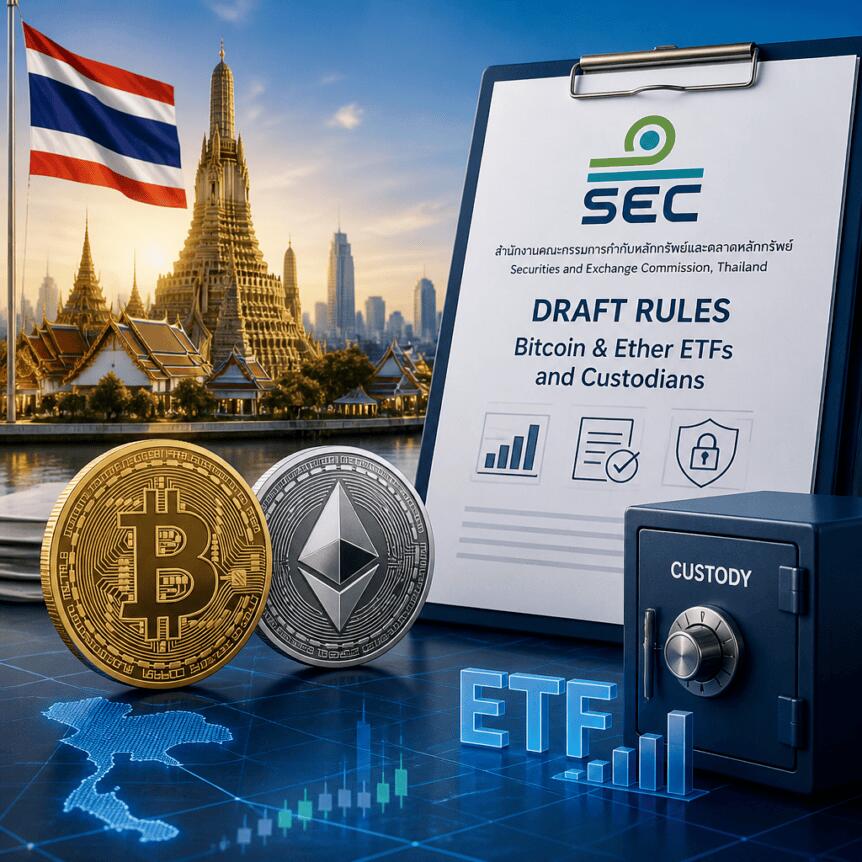
Thailand’s Securities and Exchange Commission (SEC) is moving closer to a formal regulatory pathway for spot Bitcoin and Ether exchange-traded funds (ETFs), shifting from high-level concepts to draft rules and inviting public feedback. In parallel, the regulator is revising how it approaches the use of foreign digital-asset custodians for funds that invest in crypto.
According to the Thai SEC, the agency is seeking comments on two separate consultation papers. One outlines draft regulations for Thai-listed spot crypto ETFs, while the other sets out the qualification principles for foreign digital-asset custodians used by mutual and private funds investing in digital assets. The consultation period runs until Sept. 20.
Key takeaways
- Draft Thai ETF rules would initially limit eligible underlying assets to Bitcoin and Ether only.
- Spot Bitcoin and Ether ETFs would trade exclusively on the Stock Exchange of Thailand (SET).
- ETFs would need to maintain an average net exposure of at least 80% of net asset value to the tracked crypto asset over each accounting year.
- The SEC’s revised custody approach keeps onshore custodians as the default in early stages, while allowing qualified foreign custodians only when the SEC deems it necessary and appropriate.
Draft spot Bitcoin and Ether ETF framework heads to consultation
In its Monday announcement, the SEC said it is progressing the framework for locally listed spot Bitcoin and Ether ETFs from earlier proposed principles to draft regulatory text. The draft ETF regulations build on an April consultation covering the broader framework, the SEC noted, saying most respondents supported the overall direction but raised concerns—particularly around custody arrangements.
Under the proposed structure, each Thai-domiciled ETF would track a single crypto asset—meaning a product tied to Bitcoin would be different from one tied to Ether. During the initial phase, the SEC would not allow alternative crypto-linked products that reference foreign ETFs, such as depositary receipts tracking them.
For investors, the emphasis on single-asset tracking is designed to keep the fund’s exposure focused and easier to monitor against the relevant benchmark. The SEC’s exposure requirement—minimum 80% average net exposure to the referenced asset over each accounting year—also signals that the regulator expects the funds to behave like straightforward spot trackers rather than multi-asset or structurally complex vehicles.
Where Thai ETFs would trade and how funds could access them
The draft rules specify that Bitcoin and Ether ETFs would trade exclusively on the Stock Exchange of Thailand (SET). This point matters for market participants because it concentrates secondary trading under a single venue and aligns the product with the mechanics of Thailand’s established exchange infrastructure.
The SEC also clarified how crypto ETFs could be used by other local investment vehicles. The draft rules would allow mutual funds and private funds to invest in Thai-domiciled crypto ETFs, in addition to foreign crypto ETFs that these funds are already permitted to hold under existing investment limits.
However, the SEC drew a boundary around what counts as eligible exposure during the opening phase. Even if foreign ETF access is otherwise permitted through existing rules, the SEC said it would not allow products based on foreign crypto ETFs—specifically including depositary receipts that track them—at least at the start.
Revised stance on foreign custody for mutual and private funds
The second consultation paper addresses custody, and the SEC’s wording reflects a more cautious approach than some market participants may have expected. The regulator said the revised approach would keep onshore digital-asset custodians as the primary custodians for crypto ETFs during the initial phase.
“Under the revised approach, crypto ETFs will continue to be primarily required to use onshore DA [digital asset] custodians, while the SEC may permit the use of qualified foreign DA custodians when necessary and appropriate in light of prevailing circumstances,” the SEC said.
That “necessary and appropriate” language effectively gives the SEC room to evaluate specific custody situations rather than automatically allowing foreign custodians. It also suggests the regulator is trying to balance institutional needs for operational flexibility with Thailand’s preference to anchor high-stakes crypto safeguards within its own regulatory perimeter—at least early on.
For mutual and private funds, the SEC’s separate foreign-custodian proposal adds additional requirements. Foreign custodians used for these funds would need to be supervised by a regulatory authority with legal powers. They would also have to operate under regulatory and investor-asset protection standards that the SEC considers adequate.
In practice, the SEC is setting a qualification test rather than a blanket approval system. This matters because custody is often the operational bottleneck for regulated crypto investment products: investors may accept a new regulatory wrapper for spot exposure, but they require credible safeguarding and compliance structures behind the scenes.
Why Thailand’s approach matters for institutions
Thailand’s SEC is positioning the ETF framework as part of the country’s ambition to become a global digital asset hub for institutions. The consultations show that the SEC’s priority is not only launching ETFs, but structuring them in a way that addresses the concerns most frequently raised in early stages of crypto product regulation: custody standards, product design, and limits on how crypto exposure can be packaged.
Notably, the SEC’s draft regulations also reflect lessons from the April feedback cycle. The regulator said most respondents supported the framework’s general direction, but custody-related comments pushed it to revise its approach—an important sign that investor protection remains the central theme as Thailand formalizes spot ETF rules.
Market participants should watch how commenters respond to the SEC’s custody stance. If the industry pushes for broader acceptance of foreign custodians, regulators may respond with clarifications on what “necessary and appropriate” will mean in practice and what evidence custodians must provide to meet Thai SEC adequacy expectations.
With both consultation papers open until Sept. 20, the next phase will determine how the SEC finalizes the ETF rulebook and what flexibility—if any—extends beyond Thailand-based custodians as product launches approach. Readers should focus on the custody requirements and how the exposure limits and product eligibility rules evolve in response to public submissions.
This article was originally published as Thailand SEC Drafts Rules for Bitcoin & Ether ETFs and Custodians on Crypto Breaking News – your trusted source for crypto news, Bitcoin news, and blockchain updates.
0
0

 Manage all your crypto, NFT and DeFi from one place
Securely connect the portfolio you’re using to start.


