
Vitalik Buterin Unveils Ethereum Quantum-Resistance Roadmap

0
0
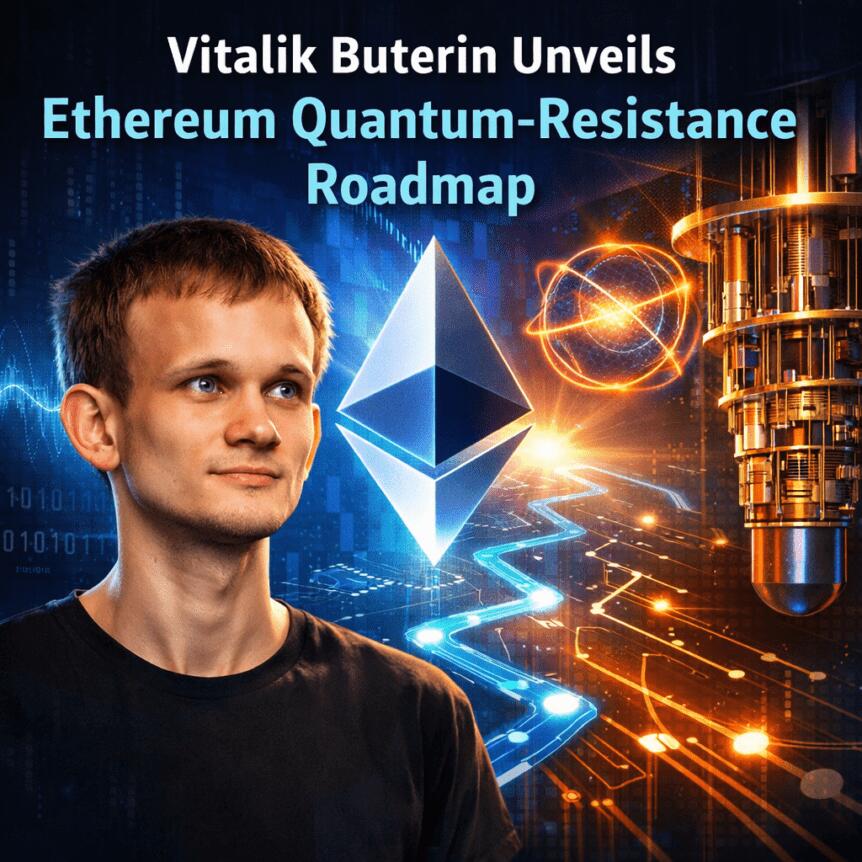
Vitalik Buterin has outlined a four-pronged plan to harden Ethereum against quantum threats, identifying four areas most vulnerable: validator signatures, data storage, user account signatures, and zero-knowledge proofs. As headlines spotlight quantum risk across crypto, including discussions around Bitcoin (CRYPTO: BTC) and other chains, the Ethereum co-founder argues that a careful, long-horizon upgrade path is essential. In a Thursday post, he described a roadmap that hinges on selecting a post-quantum hash function for all signatures—an issue that could determine the network’s security stance for years. The discussion echoes prior proposals, including Justin Drake’s Lean Ethereum idea proposed in August 2025.
Key takeaways
- Buterin identifies four pillars for quantum resistance: validator signatures, data storage, user account signatures, and zero-knowledge proofs, framing a holistic upgrade rather than piecemeal fixes.
- The plan contemplates replacing the current BLS signatures with lean, quantum-safe hash-based signatures, with the choice of hash function carrying long-term implications for the network.
- Data storage would transition from KZG to STARKs, a move that aims to preserve verifiability while enhancing quantum resistance, albeit with significant engineering work ahead.
- User accounts would shift from ECDSA toward signatures compatible with lattice-based, quantum-resilient schemes, though heavier gas costs are a concern.
- A long-term solution centers on protocol-layer recursive signatures and proof aggregation to keep on-chain verification costs in check, potentially enabling vast scalability for quantum-resistant proofs.
- The conversation nods to ongoing research, including ETHresearch discussions on recursive-STARK approaches and the broader Strawmap effort to accelerate finality and throughput.
Sentiment: Neutral
Market context: The push toward quantum-resistant primitives sits against a backdrop of ongoing network upgrades and a broader move toward scalable zero-knowledge proofs, with developers weighing security, efficiency, and long-term viability as they plan multi-year transitions.
Why it matters
The four-pronged approach to quantum resistance is more than a theoretical exercise; it signals how Ethereum intends to preserve user trust as quantum threats loom on the horizon. If effective, a hash-based signature layer could become the de facto standard for post-quantum security, shaping how users interact with wallets, smart contracts, and validator participation for years to come. The decision on the hash function is particularly consequential: once a standard is chosen, it tends to anchor the protocol for a generation, influencing tooling, hardware requirements, and compatibility with future cryptographic advances.
On data storage, the plan to replace KZG with STARKs reflects a subtle shift in cryptographic assumptions. STARKs are lauded for being quantum-resistant and transparent, but integrating them into Ethereum’s data availability and verification stack would demand substantial engineering effort, optimization, and rigorous security audits. Buterin has framed it as “manageable, but there’s a lot of engineering work to do.” The move would balance the need for robust post-quantum guarantees with the practical realities of a live, globally used network.
Account signatures represent another frontier. Ethereum currently relies on ECDSA, a staple of today’s cryptographic ecosystem. Moving to a system that can accommodate lattice-based or other quantum-safe schemes may impose heavier computational loads and gas costs in the near term. Yet the long‑term payoff could be a network that remains secure even as quantum computing capabilities grow. Buterin points to a longer-term fix—protocol-layer recursive signature and proof aggregation—that could dramatically reduce gas overheads by verifying many signatures and proofs within a single frame. If realized, that approach could unlock scalable, quantum-resistant transactions without sacrificing usability.
A central theme across the discussion is the balance between immediate practicality and enduring security. Quantum-safe signatures are not a cosmetic upgrade; they alter core data paths, from how validators validate blocks to how users sign transactions and how proofs are verified. The blockchain community increasingly recognizes that a “one-size-fits-all” cryptographic choice may not suffice; instead, a layered strategy—where traditional primitives coexist with post-quantum alternatives and where recursive techniques optimize verification—could define Ethereum’s security posture for years to come.
Beyond the cryptographic specifics, the conversation is anchored in ongoing academic and developer experiments. For example, researchers have explored recursive-STARK concepts to compress bandwidth and computation, including discussions on a bandwidth-efficient mempool that leverages recursive proofs. This line of inquiry mirrors Ethereum’s broader push toward scalable, verifiable computation that remains tenable in a post-quantum world. The discussion also nods to real-world upgrade planning, such as Lean Ethereum, which Justin Drake proposed in August 2025 as a pragmatic framework for accelerating quantum readiness without destabilizing current operations.
In parallel, governance and roadmap conversations continue to unfold within the Ethereum Foundation and the wider developer community. Buterin’s own posts have highlighted expectations that progress on “Strawmap” could yield progressive decreases in both slot time and finality time, signaling a more agile path to security without sacrificing decentralization or user experience. The architecture changes under consideration—ranging from signature schemes to data verification protocols—must harmonize with these operational expectations to minimize disruption while maximizing resilience against quantum-era threats.
What to watch next
- Updates on Lean Ethereum: Any formal milestones or testnet deployments that demonstrate practical quantum-ready components in action.
- Hash-function selection for post-quantum signatures: The criteria, security proofs, and network-wide implications of choosing a long-term standard.
- Progress toward STARK-based data storage: Engineering roadmaps, performance benchmarks, and on-chain verification strategies.
- Adoption of lattice-based or alternative signatures for user accounts: Changes to wallets, client libraries, and tooling compatibility.
- Implementation of recursive signatures and proof aggregation: Realistic timelines, gas impact assessments, and potential protocol changes needed to support such a paradigm.
Sources & verification
- Vitalik Buterin’s quantum-resistance roadmap post and related discussions: https://x.com/VitalikButerin/status/2027075026378543132
- Lean Ethereum proposal by Justin Drake: https://cointelegraph.com/news/justin-drake-proposes-lean-ethereum
- Headlines about quantum threats to Bitcoin: https://cointelegraph.com/news/saylor-says-quantum-threat-to-bitcoin-is-more-than-10-years-out-expects-coordinated-global-upgrade-if-risk-emerges
- Quantum-resistant data storage and STARKs vs KZG discussion: https://cointelegraph.com/news/vitalik-details-roadmap-for-faster-quantum-resistant-ethereum
- Ethereum Foundation quantum gas‑limit priorities and protocol considerations: https://cointelegraph.com/news/ethereum-foundation-quantum-gas-limit-priorities-protocol
- Strawmap and related timing expectations: https://cointelegraph.com/magazine/bitcoin-7-years-upgrade-post-quantum-bip-360-co-author/
- Recursive-STARK mempool concept: https://ethresear.ch/t/recursive-stark-based-bandwidth-efficient-mempool/23838
Ethereum’s quantum resilience roadmap: four frontiers and the road ahead
Ethereum’s path to quantum resistance, as articulated by Buterin, centers on four pivotal domains: validator signatures, data storage, user account signatures, and zero-knowledge proofs. The proposal calls for replacing the current Boneh-Lynn-Shacham (BLS) consensus signatures with a lean, hash-based, post-quantum alternative. The selection of the hash function is underscored as a long-term decision, potentially locking in an approach for years to come. This shift aims to preserve the integrity of validator operations while mitigating the risk that quantum computers could break current signatures used to attest to blocks and transactions.
In parallel, the data layer would transition away from KZG-based storage to STARKs, a move designed to maintain verifiability under quantum pressure. Buterin notes this is a technically manageable transition, yet it requires substantial engineering effort to integrate seamlessly with Ethereum’s existing data availability and verification mechanisms. If realized, the change would address a core vulnerability by ensuring that data proofs remain verifiable even in a quantum era, without compromising network performance.
On user accounts, the plan envisions a broader compatibility with signature schemes beyond ECDSA, including lattice-based approaches that resist quantum attacks. The practical challenge here is gas consumption: quantum-safe signatures tend to be heavier to compute, which could elevate gas costs in the near term. The longer-term payoff, though, would be a network able to function securely even when advanced quantum hardware becomes capable of breaking traditional cryptographic keys. To counterbalance the added computational load, Buterin points to a protocol-layer solution—recursive signature and proof aggregation—that could dramatically reduce on-chain gas overhead by consolidating verification work into master frames that validate thousands of signatures or proofs at once.
Quantum-resistant proofs pose another cost hurdle, motivating the same aggregation strategy. Instead of individually verifying every signature and proof on-chain, a single, compiled structure—an overarching validation frame—would authorize thousands of sub-validations in a single operation. This approach could reduce the per-transactions verification burden to near-zero costs in practice, enabling a scalable model for post-quantum proof workloads. The narrative echoes ongoing research, including discussions around a recursive-STARK-based bandwidth-efficient mempool, which envisions more efficient data flow and validation under heavy workloads.
Finally, the Strawmap discussions hint at a broader tempo for the network upgrade. Buterin and researchers anticipate incremental improvements in slot times and finality, signaling a measured cadence for upgrading cryptographic primitives without triggering disruptive forks. The convergence of these threads—signature upgrades, data storage shifts, and aggregation-based efficiency—paints a future where Ethereum (ETH) remains secure and usable as quantum capabilities advance. The dialogue around these topics reflects a mature, evidence-based approach to governance and engineering, balancing theoretical security with the practicalities of a live, billions-of-dollars ecosystem.
This article was originally published as Vitalik Buterin Unveils Ethereum Quantum-Resistance Roadmap on Crypto Breaking News – your trusted source for crypto news, Bitcoin news, and blockchain updates.
0
0


 Manage all your crypto, NFT and DeFi from one place
Securely connect the portfolio you’re using to start.
 Where will Bitcoin trade next?
Live Polymarket and Kalshi odds on Bitcoin price targets, compared side by side.
See Bitcoin price odds


