
BitMEX Canary Fund Proposal Reshapes Bitcoin Quantum Risk

0
0

BitMEX canary fund emerges as a measured alternative in Bitcoin’s growing quantum security debate, presenting a conditional response rather than an immediate protocol shift. The proposal, introduced by BitMEX Research, outlines a mechanism that delays any disruptive action unless a quantum computing threat is proven in real-world conditions.
It enters an already tense governance discussion where developers and stakeholders remain divided on how far Bitcoin should go to defend itself against future cryptographic risks. The development underscores a deeper question around who decides when a theoretical risk becomes a protocol-level emergency.
What is the BitMEX canary fund and why does it matter?
The BitMEX canary fund is designed as a trigger-based safeguard instead of a preemptive restriction. It introduces a special on-chain address that acts as a live signal for quantum breakthroughs. If funds from this address are ever moved, it would serve as verifiable proof that quantum systems have successfully broken Bitcoin’s ECDSA cryptography.

Only then would a broader protocol response, such as a coin freeze, activate. This approach shifts the decision-making process. It avoids acting on theoretical risks and instead waits for observable evidence. That distinction has placed the proposal at the center of Bitcoin’s governance debate.
How does the mechanism actually function?
At the core of the BitMEX canary fund is a specially generated Bitcoin address built using a Nothing-Up-My-Sleeve Number system. This ensures that no individual or entity knows its private key. The address is monitored through a soft fork. It effectively becomes a tripwire embedded in the blockchain. The proposal also allows users to contribute funds to this address, effectively turning it into a bounty pool.
Participants can structure contributions through a 1-of-2 multisignature setup, retaining the ability to withdraw funds while still supporting the incentive model. If a transaction ever spends from the canary address, it signals that a quantum computer has cracked the cryptographic standard in practice.

Why is a 50,000-block safety window included?
The BitMEX canary fund introduces a 50,000-block delay, roughly 345 days, after any trigger event before a full freeze takes effect. This window is not just a buffer. It acts as an incentive mechanism. BitMEX Research stated that if one entity demonstrates quantum capability, others may follow quickly.
This competitive pressure could expose the threat faster rather than allowing it to spread quietly. During this period, legitimate holders are given time to migrate funds. However, the delay also introduces risk, as malicious actors could exploit the same window.
How does it differ from BIP-361?
The BitMEX canary fund directly challenges BIP-361, a proposal merged into the Bitcoin Improvement Proposal repository on April 15, 2026. BIP-361 outlines a phased approach. It first bans transactions to quantum-vulnerable addresses three years after activation. Then, two years later, it freezes legacy coins entirely.
A speculative Phase C also proposes zero-knowledge proof-based recovery linked to seed phrases, though its feasibility remains unresolved. Proponents of BIP-361 argue that its structured timeline reflects growing urgency. Research from institutions such as Google Quantum AI and Caltech has suggested that practical quantum risks could emerge between 2027 and 2030.
Under that scenario, a significant portion of exposed Bitcoin public keys could become vulnerable, making early intervention necessary to prevent silent exploitation. In contrast, the BitMEX canary fund avoids immediate restrictions. It allows normal operations to continue unless a threat is proven on-chain, prioritizing certainty over probability.
What are experts and developers saying?
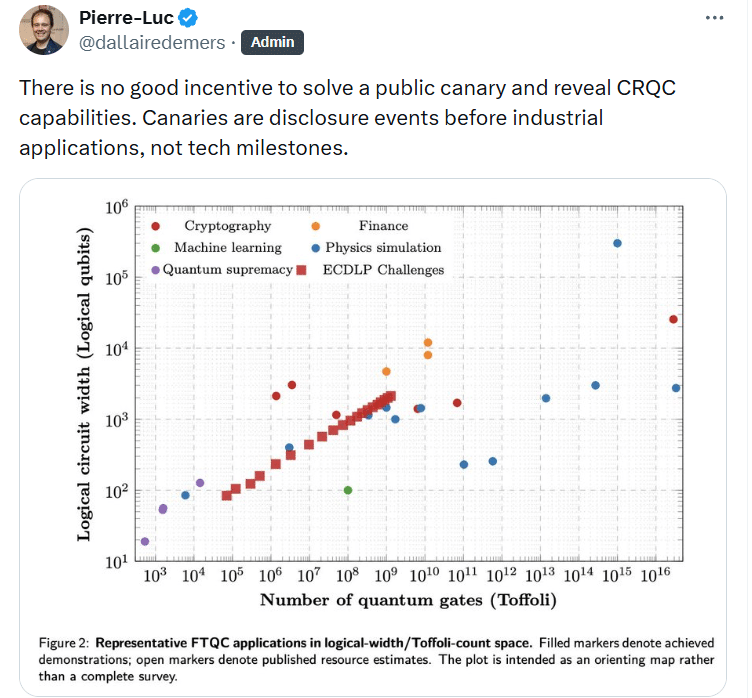
The proposal has drawn mixed reactions across the developer community. Pierre-Luc Dallaire-Demers stated, “There is no good incentive to solve a public canary and reveal CRQC capabilities,” questioning whether advanced actors would willingly expose their capabilities. BitMEX Research stated that the approach “adds complexity and risk,” but argued that reducing the disruption of a forced freeze could justify the trade-off.
On the other side, voices aligned with BIP-361 have emphasized urgency. Some researchers linked to the proposal have indicated that even a modest probability of a breakthrough within the next decade could justify preemptive safeguards, describing such odds as “unacceptably high” for a system securing global value.
Does this approach fully protect Bitcoin?
The BitMEX canary fund does not offer complete protection. It does not secure funds already exposed through public keys. It does not prevent early-stage quantum attacks before detection. Instead, it functions as a detection and response system.
It prioritizes evidence over anticipation. This creates a critical gap. Between the first successful quantum attack and the activation of the canary, funds could still be at risk. This gap mirrors the trade-off seen in BIP-361 where preemptive disruption is accepted to reduce the chance of silent losses.
What lies ahead?
The BitMEX canary fund now sits at a conceptual stage, but its future depends on developer engagement and potential formalization as a counter-BIP. Its significance extends beyond technical design. It reflects a broader philosophical divide within Bitcoin.

One side supports evidence-based intervention, while the other leans toward timeline-driven precaution. Upcoming activity on developer mailing lists and whether the proposal evolves into a formal counter-BIP will indicate if this model gains traction.
Conclusion
BitMEX canary fund represents a cautious but complex path in Bitcoin’s quantum security debate. It delays a coin freeze until a quantum threat is proven. It avoids immediate disruption but delays action until proof appears.
In contrast competing approaches prioritize early action based on projected timelines rather than confirmed events. As discussions continue the BitMEX canary fund highlights a central tension. Bitcoin must choose between acting on probability or waiting for proof a decision that will shape its long-term security model.
Glossary
BitMEX Canary Fund: Activates only after a proven quantum threat
BIP-361: Plan to restrict and freeze quantum-vulnerable Bitcoin
Quantum Computing Threat: Advanced tech risk to Bitcoin security
ECDSA: Encryption securing Bitcoin transactions
Coin Freeze: Blocks spending of selected Bitcoin funds
Frequently Asked Questions About BitMEX Canary Fund
How does the canary fund work?
It uses a special Bitcoin address, and if money moves from it, it shows a quantum break has happened.
Why is the canary fund important?
It helps Bitcoin avoid strong actions until there is real proof of danger.
How is the canary fund different from BIP-361?
The canary fund waits for proof, while BIP-361 acts early without proof.
What happens after the canary fund is triggered?
There is a delay period before any freeze, so users have time to act.
Who decides what happens next in Bitcoin?
Bitcoin developers and the community decide changes through discussion and agreement.
Sources:
Read More: BitMEX Canary Fund Proposal Reshapes Bitcoin Quantum Risk">BitMEX Canary Fund Proposal Reshapes Bitcoin Quantum Risk
0
0


 Manage all your crypto, NFT and DeFi from one place
Securely connect the portfolio you’re using to start.

0
0


