0
0

China’s digital yuan entered a new era on January 1, 2026, as wallet balances began accruing interest at demand deposit rates.
The move marks a decisive break from the prevailing global consensus that central bank digital currencies should remain non-interest-bearing. The European Central Bank, Federal Reserve, and Bank for International Settlements have long championed this principle as essential to financial stability.
The global CBDC community has largely coalesced around a core principle: retail CBDCs should function as digital equivalents of physical cash, not as interest-bearing savings instruments.
The ECB has been explicit on this point. Its FAQ states unequivocally: “As with cash in your wallet, no interest would be paid on digital euro holdings.” The goal: prevent the digital euro from becoming a savings vehicle that drains bank deposits.
The Federal Reserve has expressed similar concerns. Its 2022 discussion paper warned that an interest-bearing CBDC could fundamentally change the US financial system. The key problem is bank disintermediation. Households might shift deposits to the central bank, reducing banks’ ability to lend.
The BIS and IMF have reinforced this framework, noting that interest-bearing CBDCs could accelerate bank runs during financial stress, as depositors flee to the perceived safety of central bank money.
China’s decision effectively repositions the digital yuan from a pure M0 instrument—equivalent to cash in circulation—toward something more akin to M1, the broader money supply that includes demand deposits.
The policy stems from the PBOC’s “Action Plan for Strengthening Digital Yuan Management and Financial Infrastructure.” It applies to verified wallets—categories 1-3 for individuals and corporate accounts. Interest follows demand-deposit rules, with quarterly settlement on the 20th of each quarter’s final month. Anonymous fourth-category wallets remain excluded.
Notably, China has also revised the official definition of digital yuan to explicitly include “the related payment system”—a semantic shift that acknowledges e-CNY’s evolution beyond a simple cash substitute.
Guoxin Securities analyst Wang Jian characterized the transition as moving from “digital cash 1.0” to “deposit currency 2.0,” describing it as “a new type of bank account” that combines traditional payment efficiency with innovative contract capabilities.
China’s decision reflects several strategic calculations that may not apply—or apply differently—in Western economies.
First, deposit insurance inclusion provides a safety net. The PBOC confirmed that digital yuan wallets are now covered by deposit insurance. They receive the same protection as traditional bank deposits. This addresses one key concern about interest-bearing CBDCs: that they might be seen as “safer” than bank deposits during crises.
Second, adoption incentives matter in a competitive market. By November 2025, the e-CNY had 230 million wallets and cumulative transactions totaling 16.7 trillion yuan. Still, it faces competition from deeply entrenched mobile payment platforms like Alipay and WeChat Pay. Interest payments provide a modest but meaningful incentive for users to hold e-CNY balances rather than treating it as a pass-through payment rail.
Third, China’s dual-layer architecture keeps commercial banks as the primary user interface. This may ease the disintermediation fears that trouble Western central bankers. The PBOC issues digital yuan to operating institutions, which then distribute it to the public, preserving banks’ customer relationships.
China’s move raises uncomfortable questions for central banks elsewhere.
The ECB, which plans to launch its digital euro by 2029, has committed to a non-interest-bearing model with strict holding limits to prevent it from competing with bank deposits. The EU Council recently backed caps on digital euro holdings specifically to “avoid it being used as a store of value.”
Yet academic research increasingly challenges the zero-interest orthodoxy. A 2025 CEPR analysis found that “significant welfare improvements” could be achieved when countries set CBDC interest rates at “either 0% or at 1% below the current policy rate, whichever is higher.” The IMF has also acknowledged that an interest-bearing CBDC could “increase the economy’s response to changes in the policy rate.”
China’s approach may show that the trade-offs Western central bankers fear—particularly deposit flight and credit contraction—can be managed through careful design choices such as holding limits, tiered remuneration, and deposit insurance.
What’s emerging is not a single model for retail CBDCs but a diverging landscape shaped by different monetary traditions, financial structures, and strategic priorities.
The United States has moved in the opposite direction entirely—becoming the only country to formally ban a retail CBDC, according to the Atlantic Council. In January 2025, President Trump signed an executive order prohibiting federal agencies from developing or promoting CBDCs. Congress followed through during “Crypto Week” in July, passing the CBDC Anti-Surveillance State Act as one of three landmark crypto bills—alongside the GENIUS Act for stablecoins and the CLARITY Act for market structure. The anti-CBDC bill, which passed the House 219-210, is now pending in the Senate.
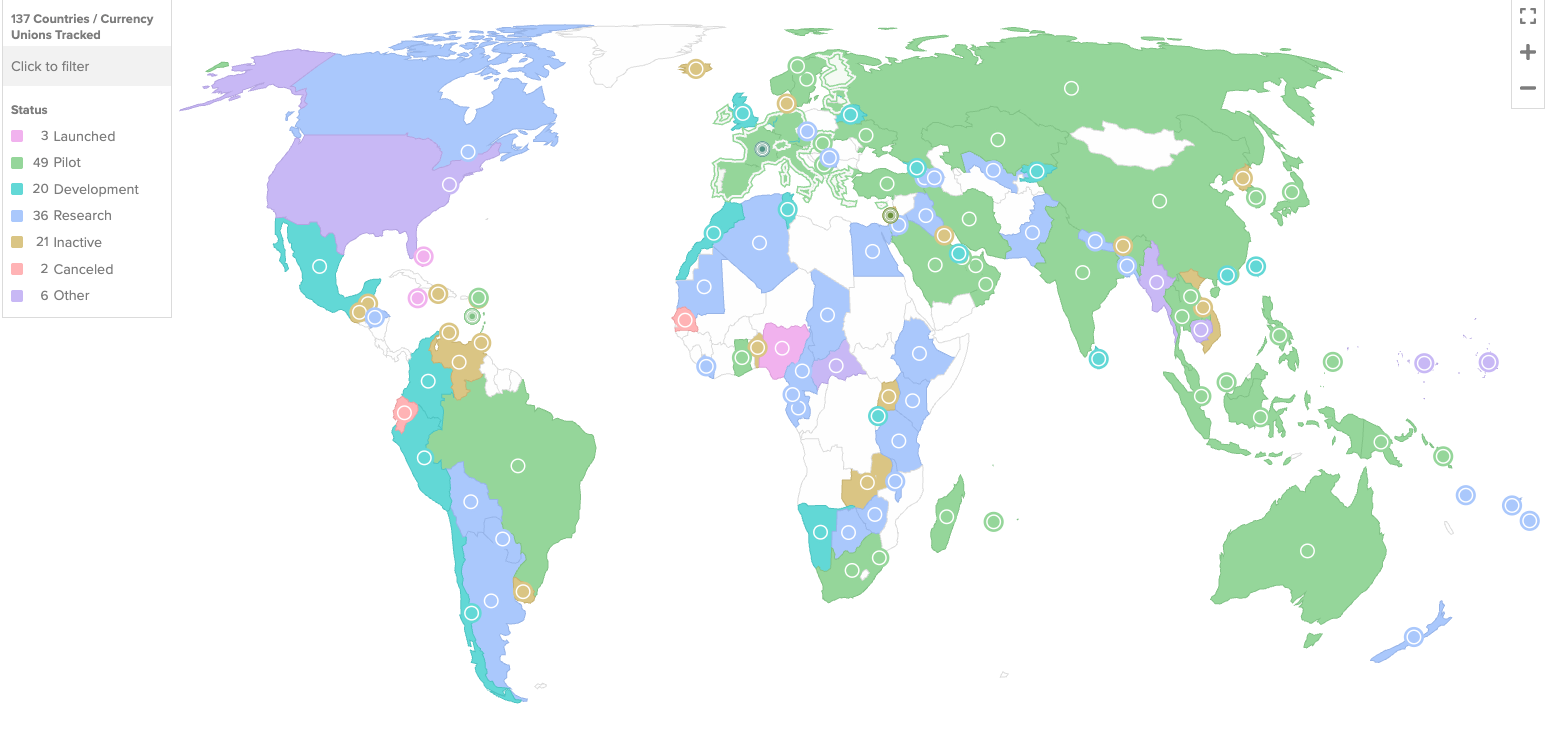 137 countries representing 98% of global GDP explore CBDCs. Source: Atlantic Council CBDC Tracker
Europe appears committed to CBDCs as a payment infrastructure—efficient, inclusive, but deliberately unattractive as a savings vehicle. China is betting that a more deposit-like CBDC can coexist with its banking system while offering users genuine utility beyond mere transactions. Meanwhile, the US has rejected the concept altogether—leaving the global CBDC landscape fractured along ideological and geopolitical lines.
As 137 countries representing 98% of global GDP explore CBDCs, China’s experiment with interest-bearing digital currency will be closely watched. If successful, it could force a reconsideration of assumptions that have guided CBDC design worldwide.
The question is no longer simply whether to issue a CBDC, but what kind of money it should be.
0
0
 Manage all your crypto, NFT and DeFi from one place
Securely connect the portfolio you’re using to start.

0
0


0
0