
Polygon Hard Fork and Algorand’s Expansion: APEMARS Targets the June 8 Wave With Over 30.5B Tokens Sold as the Best Crypto Presale to Buy Now

0
0
Crypto markets are entering another major transition phase. Institutional participation continues rising, Bitcoin trades above $77,000, and new regulated products are preparing to enter the market. The upcoming CME Nasdaq Crypto Index Futures launch on June 8 has become one of the most discussed events across trading communities. Many analysts believe this launch could inject new liquidity into large-cap cryptocurrencies before profits rotate toward smaller, high-momentum ecosystems.
That shift already appears visible across infrastructure-focused projects. Polygon recently completed a hard fork designed to improve scalability and network performance. At the same time, Algorand gained fresh market attention after Robinhood expanded ALGO trading access into New York. Both developments highlight how established blockchain ecosystems continue preparing for broader adoption during the next market cycle.
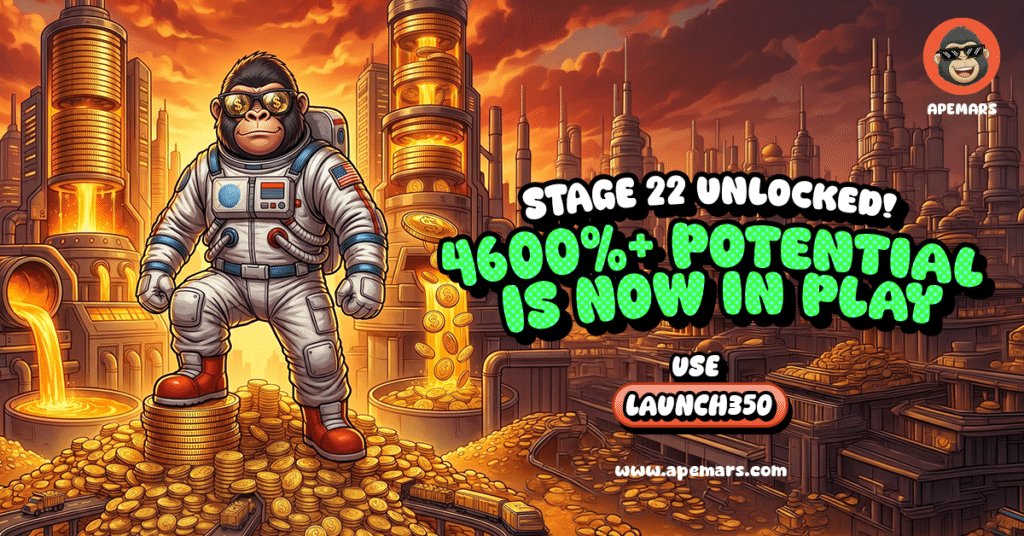
APEMARS, the best crypto presale to buy now, has now surpassed 30.5 billion tokens sold, attracted 1,809 holders, and raised roughly $488,000 during its ongoing presale. The project’s Stage 22 price currently sits at $0.000482480, while the intended listing price remains $0.0055. This transparent gap between presale and listing pricing has become central to its growing visibility across speculative crypto discussions ahead of the June 8 institutional timeline.
APEMARS Stage 22 Is Racing Against the June 8 Institutional Timeline
While large-cap ecosystems build infrastructure and regulatory access, many traders continue searching for earlier-stage opportunities capable of benefiting from broader liquidity expansion. That search has intensified discussions around APEMARS and its ongoing Stage 22 presale.
The project currently prices tokens at $0.000482480 during Stage 22. Its intended listing price remains $0.0055, creating a visible pricing gap of roughly 1039% based on current presale levels. This structure reflects how stage-based presales typically function. Earlier participants access lower prices, while pricing gradually increases as later stages unlock.

The timing narrative has become especially important. June 8 now represents a symbolic deadline across many crypto discussions due to the CME Nasdaq Crypto Index Futures launch. Traders increasingly speculate that institutional liquidity entering Bitcoin and large-cap crypto products could later rotate into higher-risk ecosystems, including meme coins and early-stage presales.
Unlike many anonymous meme launches, APEMARS publicly displays stage progression, token sale data, and participation metrics. The project has already sold more than 30.5 billion tokens while surpassing 1,809 holders. Transparent fundraising structures often help projects maintain credibility during increasingly cautious market conditions.
LAUNCH350 Could Turn a $2,000 Stage 22 Entry Into a Massive Token Position Before June 8
One of the most discussed parts of the APEMARS presale remains its LAUNCH350 bonus structure. At the current Stage 22 price of $0.000482480, a $2,000 participation level would equal approximately 4,145,250 tokens before bonuses. Using the intended listing price of $0.0055, those tokens would theoretically equal roughly $22,798.87 if listing valuation targets are achieved.
The LAUNCH350 bonus changes the discussion significantly. A 350% token bonus would increase the allocation dramatically, pushing total holdings to roughly 18.65 million tokens. Using the intended listing price, that expanded allocation would represent a theoretical valuation exceeding $102,000 before market fluctuations.
This pricing structure explains why many speculative traders continue monitoring Stage 22 closely. Presale models reward earlier participation because later stages gradually reduce pricing advantages. Once public trading begins, market pricing becomes fully dependent on open exchange activity rather than fixed presale stages.
Still, market risks remain substantial. Meme ecosystems often experience extreme volatility after exchange listings. Liquidity conditions, macroeconomic news, regulatory developments, and broader market sentiment can rapidly affect pricing. Structured participation does not eliminate risk, and investors continue facing unpredictable market conditions even during strong momentum cycles.
Why Community Momentum Still Matters in Modern Crypto Cycles
Community activity now plays a major role across crypto ecosystems. Technical infrastructure remains critical, but attention has become equally valuable during modern market cycles. Networks with strong social traction often outperform slower ecosystems during speculative phases because visibility itself creates liquidity.
Polygon benefits from developer adoption and Ethereum scalability demand. Algorand benefits from accessibility and growing retail exposure. APEMARS benefits from viral community participation and early-stage positioning narratives. These ecosystems represent very different segments of the same evolving market structure.
The broader market environment also supports increased speculation around smaller-cap ecosystems. Institutional participation through regulated futures products may strengthen confidence across digital asset markets generally. Historically, stronger Bitcoin cycles often lead traders toward smaller ecosystems in search of higher volatility and larger percentage moves.
That does not guarantee success for any individual project. Crypto markets remain highly speculative and deeply sensitive to liquidity conditions. Smart contract vulnerabilities, exchange failures, regulatory shifts, and macroeconomic uncertainty continue creating meaningful risks across the entire sector.
Polygon’s Hard Fork Signals Infrastructure Competition Is Accelerating Again
Polygon remains one of Ethereum’s largest scaling ecosystems. The network processes lower-cost transactions through Layer-2 infrastructure while helping decentralized applications reduce congestion on the Ethereum mainnet. According to Polygon network statistics, the ecosystem processed roughly 1.4 billion transactions during 2025, showing continued developer and user activity despite broader market volatility.
The recent Polygon hard fork focused heavily on scalability improvements and network efficiency. POL traded near $0.09 following the update and continued holding above key support levels around $0.08. Market participants viewed the upgrade as another attempt to strengthen Polygon’s position against competing Layer-2 ecosystems.
Supply-side mechanics also continue influencing sentiment. Polygon completed a 100 million POL token burn earlier this year, permanently reducing available supply. Token burns remove assets from circulation forever, similar to a company repurchasing shares in traditional finance. Reduced supply can affect scarcity dynamics when network demand increases.
Institutional developments also matter here. The upcoming CME Nasdaq Crypto Index Futures launch could increase exposure to large-cap digital assets tied to major blockchain infrastructure. If broader institutional liquidity enters crypto markets through regulated products, infrastructure ecosystems like Polygon may receive early inflows before capital rotates into speculative ecosystems and presales.
Algorand’s Robinhood Expansion Reignites Retail Accessibility Momentum
Algorand has quietly returned to trader watchlists after months of relatively muted price activity. The network gained renewed momentum after Robinhood expanded ALGO trading support into New York, one of the strictest crypto regulatory jurisdictions in the United States.
Expanded exchange access often matters more than headlines alone. Broader availability improves visibility, increases liquidity access, and lowers friction for retail traders. Historically, many altcoins experience stronger market participation after gaining access to regulated or mainstream trading platforms.
Derivatives data also reflected growing interest around Algorand. Futures trading volume reportedly climbed more than 77% within 24 hours, while open interest increased roughly 6.5%. Rising open interest alongside increasing price activity often signals new capital entering the market rather than existing traders exiting positions.
Technically, ALGO continues trading within an accumulation range between roughly $0.09 and $0.11. Analysts continue monitoring the $0.125 to $0.13 resistance zone. A decisive breakout above this area could expose higher resistance levels closer to $0.18 and potentially beyond. Still, market volatility remains high across all altcoins, and regulatory conditions continue affecting long-term adoption patterns.
ParaWin Joins the Conversation as High-Risk Crypto Traders Hunt for Momentum Before June 8
While attention remains fixed on Polygon’s hard fork upgrades and Algorand’s Robinhood-fueled momentum, another trend is growing fast across crypto-native communities. Traders are increasingly exploring high-engagement platforms that combine entertainment, gamified participation, and digital asset ecosystems. That shift has pushed ParaWin into wider market discussions alongside speculative crypto narratives heading into the June 8 institutional liquidity timeline.
Unlike older betting platforms that relied on slow systems and limited token integration, ParaWin has positioned itself around fast onboarding, crypto compatibility, and aggressive promotional activity. Many traders now treat these ecosystems as part of the broader Web3 attention economy, where meme culture, speculative trading, and online engagement often overlap. As liquidity rotates through Bitcoin, Ethereum, and large-cap altcoins, high-risk participants historically move toward faster-moving ecosystems searching for asymmetric upside.
This behavior matters because liquidity cycles often follow a familiar pattern. Institutional capital typically enters Bitcoin and large-cap infrastructure first. Profits then spread into mid-cap ecosystems like Polygon and Algorand before eventually reaching speculative micro-cap projects and viral platforms. That pattern is one reason many traders are now discussing APEMARS and ParaWin within the same market cycle narrative, especially as June 8 approaches and CME-linked crypto exposure expands.
Conclusion
Polygon and Algorand continue showing how infrastructure-focused ecosystems adapt during changing market conditions. Polygon’s hard fork highlights the ongoing Layer-2 scalability race, while Algorand’s Robinhood expansion demonstrates how accessibility still drives trader participation and liquidity growth.
At the same time, APEMARS reflects another side of the market entirely. Early-stage presales continue attracting attention because traders seek positioning before broader exposure arrives. Stage-based pricing models reward earlier access through lower entry levels while creating urgency as later stages approach.
The June 8 CME Nasdaq Crypto Index Futures launch has now become a major market narrative. If institutional liquidity enters crypto markets more aggressively, many traders believe profits could eventually rotate beyond Bitcoin and Ethereum into smaller ecosystems and high-momentum presales.
Whether that rotation materializes remains uncertain. However, the growing overlap between institutional adoption, retail speculation, infrastructure development, and community-driven presales shows how rapidly crypto markets continue evolving in 2026. The Best Crypto to Buy Now platform provides insights of the market in May.
For More Information:
Website: Visit the Official APEMARS Website
Telegram: Join the APEMARS Telegram Channel
Twitter: Follow APEMARS ON X (Formerly Twitter)
FAQs About the Best Crypto Presale to Buy Now
What is driving Polygon’s recent market attention?
Polygon recently completed a hard fork focused on scalability improvements. The network also continues benefiting from Ethereum Layer-2 adoption trends.
Why did Algorand gain momentum recently?
Algorand received renewed attention after Robinhood expanded ALGO trading access into New York. Futures trading activity also increased significantly.
What is APEMARS Stage 22 pricing?
APEMARS Stage 22 currently prices tokens at $0.000482480 with an intended listing price of $0.0055.
Why are traders discussing the June 8 liquidity wave?
The CME Nasdaq Crypto Index Futures launch may increase institutional crypto participation, potentially affecting broader market liquidity.
Does a presale guarantee future returns?
No. Cryptocurrency markets remain highly volatile. Presales involve substantial risk, including liquidity uncertainty and price fluctuations.
Article Summary
The article explored how two major developments, Polygon’s recent hard fork and Algorand’s expanded Robinhood trading access, are helping revive broader crypto market momentum ahead of a potentially significant institutional liquidity event tied to CME Nasdaq Crypto Index Futures on June 8. Polygon’s scalability improvements and token burn strategy were presented as signs of long-term infrastructure growth, while Algorand’s stronger retail accessibility and rising derivatives activity highlighted renewed trader interest around accumulation zones.
The piece then connected these market catalysts to the growing conversation around APEMARS, which many speculative traders now view as one of the best crypto presale to buy now during the current cycle. The article explained how institutional liquidity historically flows from Bitcoin and large-cap assets into smaller high-momentum sectors, creating conditions where early-stage projects can attract significant attention during bullish periods.
A major focus remained on the APEMARS Stage 22 presale structure. The article detailed how the current Stage 22 price of $0.000482480 compares to the intended listing price of $0.0055, creating a transparent pricing gap through the stage-based model. It also highlighted the project’s community traction, including over 30.5 billion tokens sold, 1,809 holders, and roughly $488K raised so far.
The article further examined how the upcoming June 8 liquidity narrative could affect speculative market behavior. It framed APEMARS as a project positioned around timing, structured participation, roadmap clarity, and transparency rather than unrealistic guarantees. The CLARITY Act and evolving U.S. crypto regulation narrative were also discussed as factors that may improve confidence around transparent presale structures.
Read More: Polygon Hard Fork and Algorand’s Expansion: APEMARS Targets the June 8 Wave With Over 30.5B Tokens Sold as the Best Crypto Presale to Buy Now">Polygon Hard Fork and Algorand’s Expansion: APEMARS Targets the June 8 Wave With Over 30.5B Tokens Sold as the Best Crypto Presale to Buy Now
0
0


 Manage all your crypto, NFT and DeFi from one place
Securely connect the portfolio you’re using to start.

0
0

0
0


0
0