
Tether Bitcoin mining dispute cuts power to $120M Uruguay sites

0
0
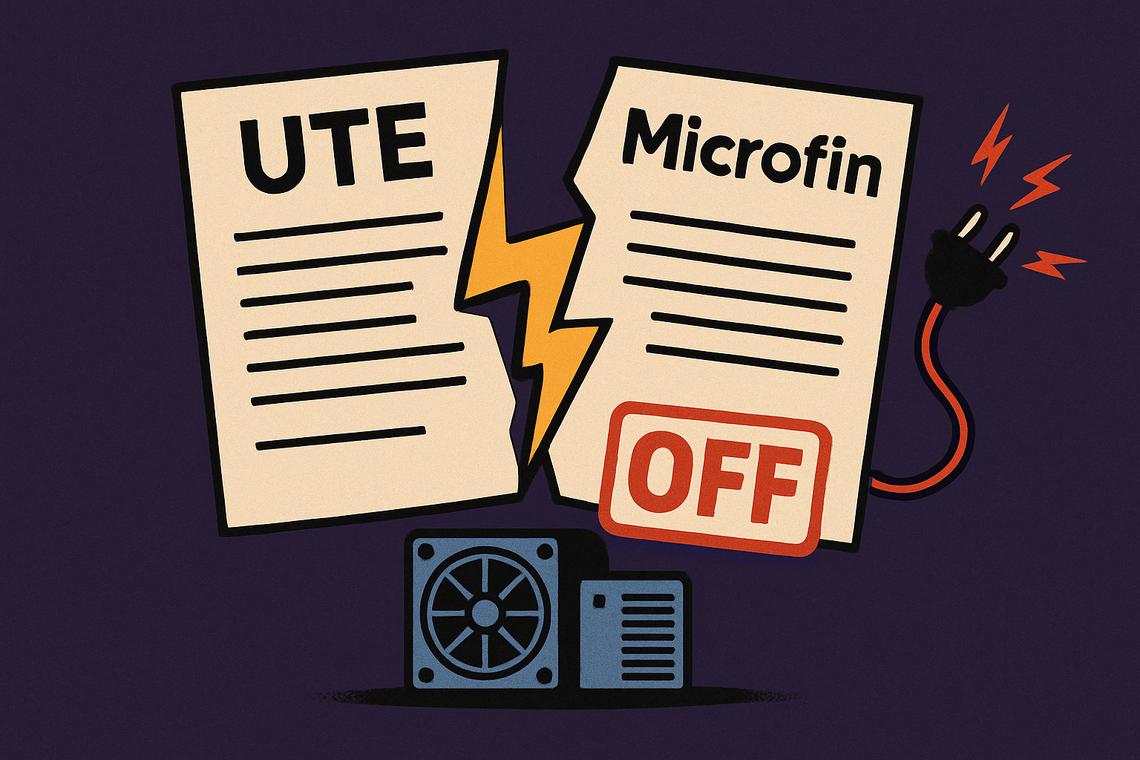
A power dispute in rural Uruguay just wiped out one of Tether’s boldest bets outside the stablecoin business. According to a Reuters investigation, the company behind USDT poured roughly $120 million into two Bitcoin mining sites in Uruguay’s Florida department, only to shut them down after a Tether Bitcoin mining dispute with the state-owned utility spiraled into unpaid bills, a total power cutoff, and dozens of layoffs. The episode, corroborated by The Block, offers a rare look at how quickly a clean-energy mining project can collapse when contract terms and electricity pricing go unresolved.
Key takeaways
- Tether invested about $120 million across two Bitcoin mining sites in Uruguay’s Florida department, roughly $60 million each.
- The project collapsed after a contract dispute with UTE, Uruguay’s state power company, over how much electricity the sites were entitled to receive.
- UTE cut electricity to the sites on July 25, 2025, after Microfin, Tether’s local entity, racked up nearly $5 million in arrears.
- The shutdown eliminated 30 of the company’s 38 local jobs.
- Uruguay generates 98% of its electricity from renewable sources, mostly hydropower and wind, yet power costs remained too high to keep the mining operation competitive.
Tether’s $120 Million Bitcoin Mining Bet in Uruguay
Tether entered Uruguay in May 2023, framing the country as an ideal launchpad for its mining ambitions thanks to its renewable-heavy grid and stable political environment. The company said it would invest in energy production and run sustainable Bitcoin-mining operations through a locally licensed entity, though it shared few financial specifics at the time.
Reuters, citing a former contractor’s assessment, put the total investment at approximately $120 million, split evenly between two sites in the rural Florida department. Tether never publicly disclosed the size of the bet. To put that figure in perspective, it would represent about 6% of Uruguay’s entire annual foreign direct investment, which Reuters estimated at around $2 billion. According to The Block’s reporting, a former contractor described Uruguay as a planned “first step” before Tether expanded mining operations into Brazil, Paraguay, and Argentina.
Operations initially ran smoothly and generated revenue, according to former contractors interviewed by Reuters. That early success is part of what makes the eventual breakdown notable: the sites weren’t failing on technical or operational grounds. The trouble started with paperwork.
Power Contract Dispute and Its Impact on Operations
At the center of the collapse was a basic disagreement over what a single number in the electricity contract actually meant. Tether read the figure as a minimum power allocation that could be raised later as demand grew; UTE treated the same number as a hard ceiling that could not be exceeded. That gap in interpretation turned out to be the fault line that eventually broke the entire arrangement.
As electricity demand at the mining facilities increased, the sites sometimes went without adequate power for days at a stretch, according to Reuters. The disagreement was already underway by November 2024, but it intensified after President Yamandú Orsi’s left-leaning government took office in March 2025 and installed new leadership at UTE. A former contractor told Reuters that the utility’s new directors took a harder line in negotiations, though Tether and Microfin did not respond to requests for comment on the contract terms.
Matters escalated quickly from there. Microfin, Tether’s Uruguayan legal entity, stopped paying its electricity bills in May 2025 and communicated to UTE the subsequent month its intention to end the contracts. UTE approved revised contract documents in an attempt to salvage the project, but Tether representatives did not show up for the signing, according to meeting notes reviewed by Reuters.
With the revised agreement unsigned and bills still unpaid, UTE cut electricity to both mining sites on July 25, 2025. Local outlet El Observador reported that Microfin’s arrears had reached nearly $5 million, with a monthly power bill of about $2 million, and that the debt had surpassed the guarantee the company had posted.
Consequences of the Mining Shutdown
Tether notified Uruguay’s labor authorities on November 25 that it would cease operations entirely. The closure eliminated 30 of the company’s 38 local jobs, according to Teledoce. UTE later told Reuters that Microfin settled its outstanding debts in December, closing out the financial side of the dispute even as the mining sites themselves went dark for good.
Why this matters: for a company that reported more than $10 billion in profit in 2025 and holds a proprietary investment portfolio exceeding $20 billion, the $120 million loss is financially minor. But it exposes real execution risk in Tether’s push to diversify beyond stablecoins into energy, mining, and infrastructure — sectors where local regulatory relationships and contract enforcement matter just as much as capital.
Renewable Energy Context and Ongoing Mining Strategy
Uruguay looked, on paper, like a near-perfect fit for a mining operation built around clean power. Renewable sources supplied 98% of the country’s electricity generation in 2025, led by hydroelectricity and wind, according to Uruguay’s Ministry of Industry, Energy and Mining. That statistic is exactly the kind of pitch Tether used when it first entered the market in 2023.
But abundant renewable generation doesn’t automatically translate into cheap power. Bitcoin miners compete primarily on their ability to secure continuous, low-cost electricity, since specialized mining rigs run around the clock. Industry specialists cited by Reuters noted that Uruguay’s reliable grid and strong connectivity come at a price premium that makes it less competitive for mining than neighboring markets.
Those cost pressures have only intensified since Bitcoin’s April 2024 halving, which cut mining rewards in half and pushed operators toward more efficient machines, cheaper power regions, or a pivot toward artificial intelligence and high-performance computing workloads. The Uruguay retreat lands squarely inside that broader industry squeeze, where margin, not electricity source, ultimately decides whether a site survives.
Despite the setback, Tether has kept building elsewhere in the region. The company has continued promoting Bitcoin mining as part of its diversification strategy, pointing to deployments including El Salvador, and has taken a 70% stake in renewable energy producer Adecoagro to use its surplus power for mining. It has also released an open-source operating system for mining operations, acquired an 8.2% stake in mining finance firm Antalpha, and begun developing modular mining systems with Canaan and ACME Swisstech. Tether’s USDT stablecoin, meanwhile, continues to lead the market with roughly $183 billion in circulation.
The Uruguay experience leaves a clear lesson for anyone eyeing renewable-rich markets for crypto mining: access to clean electricity alone doesn’t guarantee a viable project. Price, contracted volume, and how clearly those terms are defined on paper can decide whether the investment ever pays off — a lesson Tether appears to be carrying into its next mining ventures across South America and beyond.
FAQ
Why did Tether’s Bitcoin mining project in Uruguay fail?
The project failed primarily due to a dispute with Uruguay’s state power company UTE over electricity contract terms, leading to unpaid bills and power cutoffs.
How much did Tether invest in the Uruguay mining operations?
Tether invested approximately $120 million across two mining sites in Uruguay’s Florida department.
What role did renewable energy play in Tether’s investment strategy in Uruguay?
Uruguay’s 98% renewable electricity generation initially attracted Tether, aiming to link Bitcoin mining with sustainable energy, but high power costs diminished the project’s competitiveness.
Is Tether continuing Bitcoin mining despite the Uruguay setback?
Yes, Tether continues to pursue Bitcoin mining in other regions, including El Salvador, and has kept expanding its broader energy and mining investments across South America.
Article produced with the assistance of artificial intelligence and reviewed by the editorial team.
0
0


 Manage all your crypto, NFT and DeFi from one place
Securely connect the portfolio you’re using to start.


