
Treasury hits Iran-linked BitBank as sanctions target crypto rails

0
0

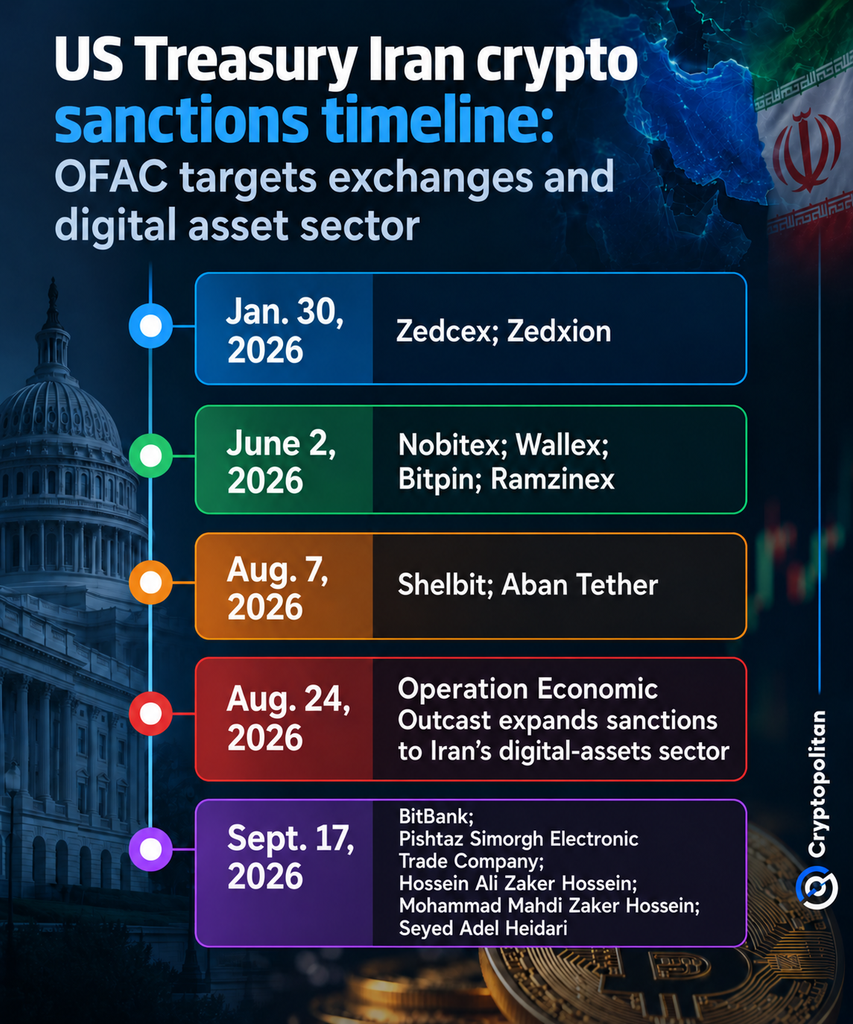
The U.S. Treasury imposed sanctions on September 17 against BitBank, the cryptocurrency exchange, which they say is owned by Babak Zanjani, who is also under U.S. sanctions. The Treasury states that between June and July, Zanjani used BitBank to send hundreds of millions of dollars in Bitcoin to the Islamic Revolutionary Guard Corps (IRGC).
This move signals a broader shift for crypto firms operating outside the US: Washington is moving beyond individuals’ wallets to companies providing the service to the sanctioned parties.
Targeting the rails, not just the wallets
The list of sanctions made by the Office of Foreign Assets Control (OFAC) also included Pishtaz Simorgh Electronic Trade Company, the developer of BitBank, and several associates of Zanjani. Secretary of the Treasury Scott Bessent emphasized that the actions of the agency are a warning that crypto infrastructure is also subject to OFAC.
“Today’s designations of Iranian digital asset infrastructure make perfectly clear that efforts to finance the Iranian regime using cryptocurrencies are not beyond OFAC’s reach.” — Treasury Secretary Scott Bessent
Bessent followed with an even sharper warning on X:
“The Department of the Treasury will sanction you.”
Zanjani is already well known to sanctions officials. The Institute for Financial Integrity describes him as a twice-sanctioned financier who rebuilt a UK-registered crypto exchange operation after his death sentence was commuted. The operation used a fictitious executive created from stock photography and moved an estimated $1 billion in IRGC-linked value before regulators caught up with it. Treasury says Zanjani later built a wider network of digital-asset companies used partly to launder money for the IRGC.
A whole sector, not a single exchange
The sanction on BitBank is part of a bigger initiative called Operation Economic Outcast. This initiative was launched on August 24 and has already identified almost 60 entities, individuals, and vessels that are linked to Iran. It also issued five specific orders under Executive Order 13902 addressing the fields of digital assets, technology, gold, aviation, and shipping, according to TRM Labs.
The determination made concerning digital assets marks a big change in the operations of OFAC. Chainalysis states that foreign individuals who conduct operations in Iran’s digital-asset sector may now face sanctions without the need to find any connection with terror organizations, proliferation, or sanctioned party. The stakes thus become higher for exchanges, OTC desks and infrastructure providers supporting the sector.
The escalation is a continuation of past efforts. Cryptopolitan noted that OFAC sanctioned Zedcex and Zedxion in January, Nobitex and other exchanges in June, and Shelbit and Aban Tether on August 7.
Why non-U.S. intermediaries are exposed
OFAC issued a caution against foreign financial institutions and other non-US persons who are engaging with the listed exchanges such as Wallex, Nobitex, Aban Tether, and Ramzinex, as they may face sanctions. The sanctions are applicable to foreign banks as well and they may be prohibited from operating with U.S. correspondent accounts in the event that they clearly carry out transactions for designated exchanges from Iran.
This fact is important because Iran’s sanctions-evasion schemes include more than just crypto. The Institute for Financial Integrity says that there are schemes involving the usage of family members’ accounts, shell companies, exchange houses, shadow tankers, and crypto exchanges. If the compliance team relies on screening wallets alone, they will be missing the whole financial system operating behind.
Where the pressure could push the money
Stronger enforcement may redirect flows rather than eliminate them. Chainalysis found that IRGC-associated addresses accounted for more than half of value received in Iran’s crypto economy in the fourth quarter of 2025, with volumes exceeding $3 billion for the year.
TRM Labs’ 2026 Crypto Crime Report points to a wider migration pattern: nearly 95% of inflows to sanctioned entities and jurisdictions in 2025 came through stablecoins. From 2024 to 2025, flows involving centralized exchanges fell nearly 30%, while flows involving high-risk/no-KYC and decentralized services rose more than 200%.
Global enforcement also remains uneven. The FATF’s 2026 update found that 83% of 109 responding jurisdictions had passed Travel Rule legislation, but 60% of the 91 with legislation had yet to issue findings or directives or take Travel Rule-focused supervisory or enforcement action. Those gaps leave room for sanctioned activity to migrate toward weaker jurisdictions, offshore intermediaries and harder-to-monitor services even as U.S. pressure intensifies.
The smartest crypto minds already read our newsletter. Want in? Join them.
0
0

 Manage all your crypto, NFT and DeFi from one place
Securely connect the portfolio you’re using to start.


