
TRON USDT Supply Climbs to $87.9B as Q2 Transfers Hit $2.1T, Messari
0
0
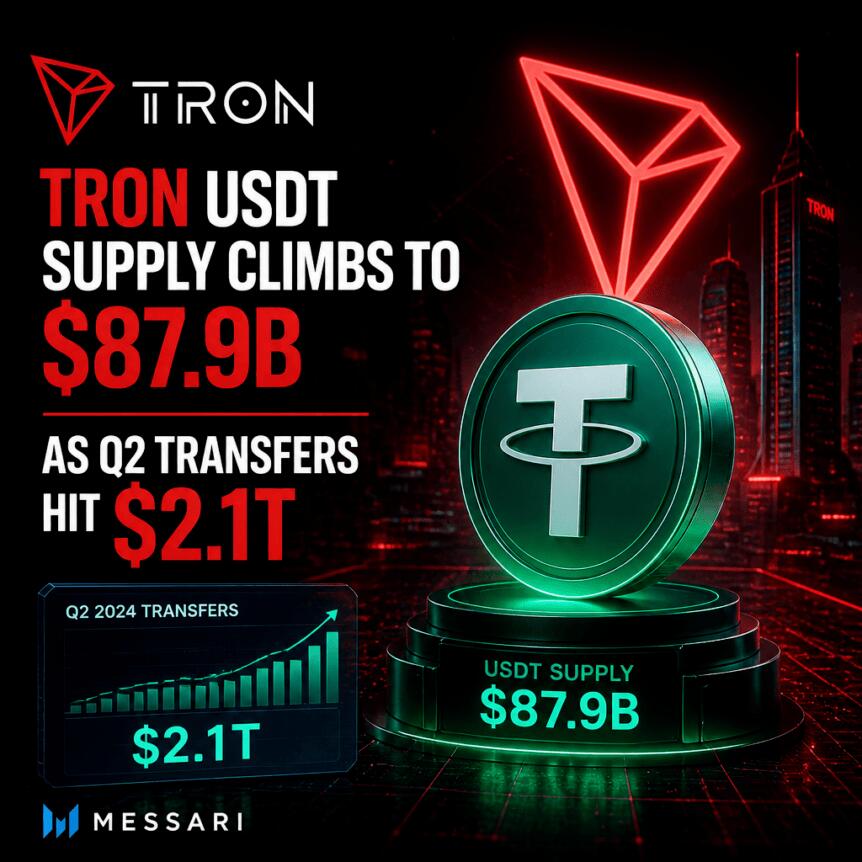
TRON ended the second quarter with a major stablecoin milestone: it recorded $87.9 billion in circulating USDT, putting it ahead of Ethereum on the same metric, while processing $2.1 trillion worth of USDT transfers over the quarter. The figures underscore how deeply USDT liquidity has embedded itself in TRON’s rails, even as parts of the ecosystem show softer momentum elsewhere.
According to a Messari report on the network’s second-quarter performance, USDT represented 98.5% of TRON’s stablecoin market. Stablecoin supply on TRON also rose, climbing 4.1% quarter-over-quarter to a record $89.2 billion. After a drop in Q1, average daily USDT transfer volume resumed growth, increasing 4.3% to $22.8 billion.
Key takeaways
- TRON led on USDT circulation in Q2, reaching $87.9B and processing $2.1T in USDT transfers during the quarter.
- Stablecoin dominance remained extreme, with USDT making up 98.5% of TRON’s stablecoin supply.
- Network usage hit new highs, including 14.6M transactions on June 15 and record-level daily activity.
- Fees reversed direction, rising 15.9% to $699.4M, the first quarterly increase after a prior governance change.
- DeFi activity cooled even as payments grew, with DeFi TVL down 1.9% and DEX volumes falling for a fourth straight quarter.
USDT expansion drives TRON’s transaction growth
Messari attributes TRON’s improved throughput to stronger day-to-day demand for USDT transfers. The network averaged 11.8 million daily transactions in Q2, up 8.7% from the prior quarter. Active usage also improved: average daily active addresses increased 11.7% to 3.6 million. The report also highlights the peak day, when TRON processed 14.6 million transactions on June 15.
From an investor and market-structure perspective, this matters because USDT activity often translates into consistent utilization of on-chain infrastructure. Even when broader on-chain applications fluctuate, stablecoin transfer volume can sustain network demand—particularly on chains where stablecoins are heavily concentrated.
Fees recover after an earlier governance shift
Beyond transaction counts, the report notes that TRON’s fee environment changed as well. Network fees rose 15.9% to $699.4 million in Q2, described as the first quarterly increase since an August 2025 governance change reduced the network’s energy unit price. In other words, Q2’s fee growth appears tied not only to higher activity, but also to a longer arc in TRON’s fee mechanics after that policy adjustment.
Still, the relationship between network fees and usage can be nonlinear when protocol parameters change. Traders and builders watching TRON may want to pay close attention to whether future fee levels keep rising with demand or whether they plateau as the impact of the earlier energy-unit pricing adjustment stabilizes.
DeFi softens while supply growth continues
Despite the payment-heavy momentum, parts of TRON’s on-chain ecosystem showed uneven performance. Messari reports that DeFi TVL fell 1.9% to $4.4 billion during the quarter. Decentralized exchange activity also cooled: average daily DEX volume dropped 21.7% to $49.3 million, marking a fourth consecutive quarterly decline.
This divergence—strong stablecoin transfer volume alongside weaker DeFi engagement—suggests that Q2’s growth may have been driven more by utility and circulation than by risk-taking or trading depth on TRON’s DeFi venues. For users, this can affect liquidity conditions and token execution quality on DEXs; for developers, it may signal that ecosystem growth is currently being led by transfers rather than by on-chain lending, borrowing, and trading.
Meanwhile, the report indicates that TRX supply remained inflationary. Even with higher activity, circulating supply increased by 87 million tokens during the quarter, with issuance continuing to outpace burns. That dynamic is notable because it can influence long-term expectations around token supply pressure, particularly when network usage is improving but supply reduction mechanisms aren’t yet keeping up.
Institutional access expands through tokenization and custody
While on-chain metrics show clear usage trends, institutional infrastructure around TRON also advanced during the quarter. Messari highlights that Securitize launched Hamilton Lane’s tokenized Senior Credit Opportunities Fund on TRON—its first TRON-issued asset. The fund reportedly started with about $4.3 million under management.
Broader institutional interest also included token listing and potential product developments. Grayscale reportedly added TRX to its list of assets under consideration. Separately, a proposed staked TRX exchange-traded product from Canary Capital remained in registration.
On the market-access side, TRX trading availability improved across venues. Bitnomial launched spot TRX trading in the United States, while OKX Europe introduced MiFID-regulated TRX expiry perpetuals. The quarter also saw Binance.US restore trading in the token.
The institutional push continued after Q2 ended. Earlier coverage noted Anchorage Digital adding native TRX staking and custody for TRC-20 assets in July, enabling institutional clients to stake TRX directly from its custody platform. For market participants, custody-and-staking workflows can be a critical step toward deeper institutional adoption, as they reduce operational friction compared with self-custody or manual transfer processes.
Read together, TRON’s Q2 pattern looks less like a pure “DeFi rally” and more like a chain consolidating stablecoin circulation and steadily improving institutional plumbing. The key question for the next quarter is whether stronger USDT throughput can translate into renewed DeFi demand—particularly DEX volumes and TVL—or whether TRON will remain primarily a stablecoin settlement venue while trading and application activity lag behind.
This article was originally published as TRON USDT Supply Climbs to $87.9B as Q2 Transfers Hit $2.1T, Messari on Crypto Breaking News – your trusted source for crypto news, Bitcoin news, and blockchain updates.
0
0


 Manage all your crypto, NFT and DeFi from one place
Securely connect the portfolio you’re using to start.


0
0