
AAVE Governance Crisis Deepens as DAO and Aave Labs Clash Ahead of Key Vote

0
0
This article was first published on The Bit Journal. A deepening Aave governance dispute has pushed the $52 billion decentralized lending protocol into one of the most consequential internal battles in its history, raising fundamental questions about who ultimately controls decentralized finance’s largest institutions.
What began as a dispute over about 10 million dollars yearly interface revenue has quickly escalated into all-out war between the Aave decentralized autonomous organization (DAO) and Aave Labs, the development company behind the protocol, also called Avara. The current Aave governance dispute is no longer a fee-related one, but owns the core of the protocol in terms of soft assets such as trademarks, domain names, and social media accounts.
Snapshot Vote Sparks Aave Governance Controversy
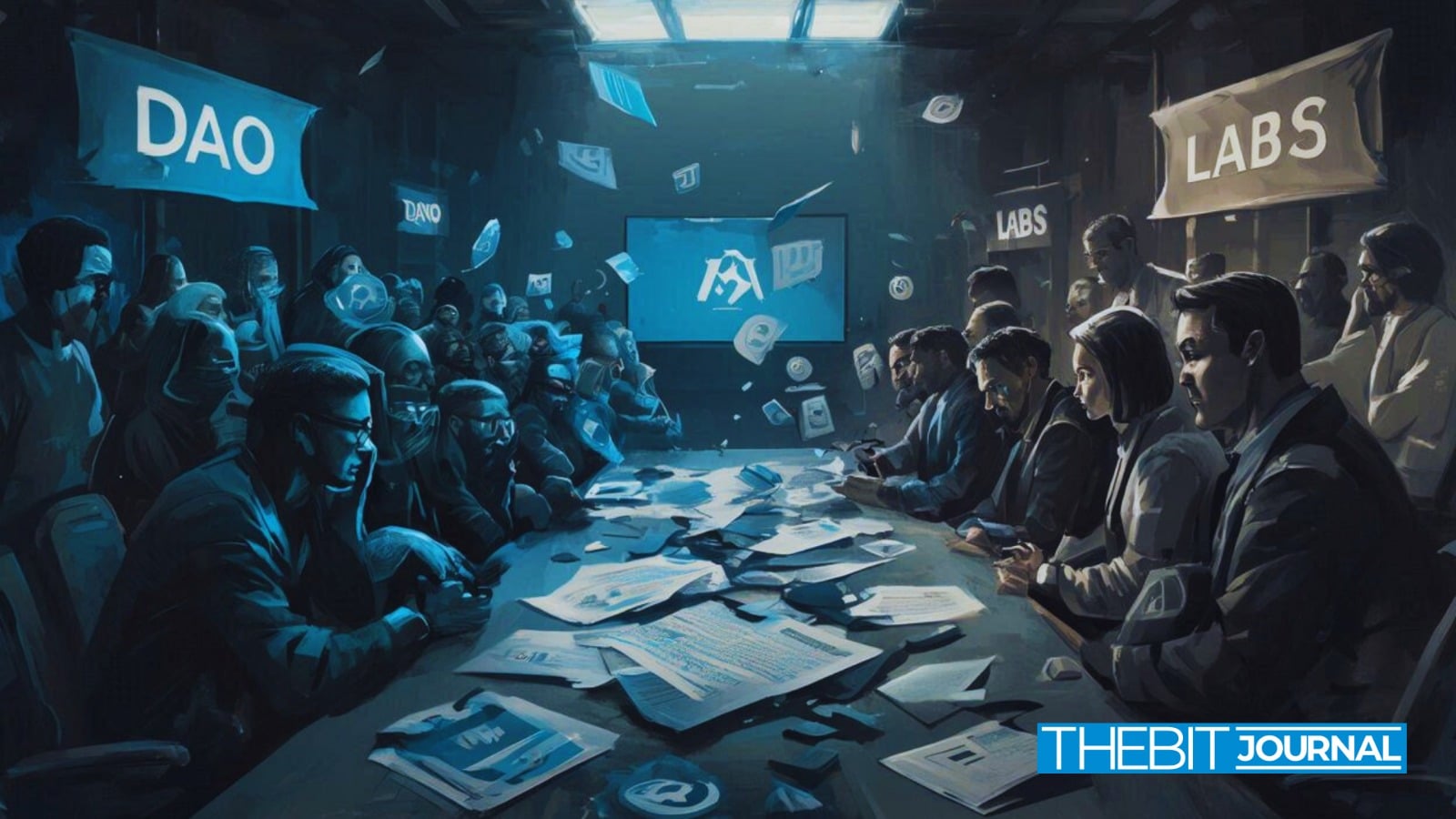
The core of the disagreement is a Snapshot vote that is to take place between Dec. 22-26. The proposal involves moving the ownership of such assets out of Aave Labs to the DAO and, practically, to the tokenholders. The proponents claim that this would enhance Aave governance because it would align value creation with tokenholder ownership.
However, there was controversy as to the manner in which the proposal came to the ballot. The vote was also made by Aave Labs itself, even though it is the same entity that the proposal seeks to regulate, which attracts accusations of procedural abuse and governance overreach.
Boado Denies Role in Controversial Proposal
The above-mentioned author, Ernesto Boado, the co-founder of the BGD Labs, one of the key contributors to the technical infrastructure of Aave, denied responsibility in developing the proposal. According to Boado, the proposal was also advanced without his approval and without the conclusion of community deliberations and he termed the maneuver as a disregard of the traditional Aave governance norms. Boado stated:
“To be very clear: This is not, in ethos, my proposal. Aave Labs has (for whatever reason) unilaterally submitted my proposal to vote in a rush, with my name on it, and without notifying me at all. If asked, I would not have approved it.”
To be very clear:
– This is not, in ethos, my proposal. Aave Labs has (for whatever reason) unilaterally submitted my proposal to vote in a rush, with my name on it, and without notifying me at all. If asked, I would not have approved it.
– It was not my intention to submit the… https://t.co/JTWoMMNcQc— Ernesto (@eboadom) December 22, 2025
Aave Labs Defends Vote as Necessary
Those concerns were promptly reflected by the governance leaders. According to the founder of the Aave Chan Initiative, Marc Zeller, the action was a hostile takeover effort, since it was a way of rushing the vote in middle of the holiday period, which did not favor fair participation. Zeller also points out:
“Official Aave communication channels relayed this debate only after escalation to Snapshot.”
Aave Labs and the founder, Stani Kulechov, have justified the decision as governance debates were ineffective and needed a definite vote by tokenholders. Kulechov rejected proceduralist critiques, saying that governance eventually has to do something and that endless discussion was making the Aave governance boards weary among community members. He said:
“People are tired of this discussion and getting into a vote is the best way to resolve, this is governance [at the] end of the day.”
Outside the voting mechanics, the controversy has sparked a wider industry discussion on the topic of decentralization versus execution. A number of DeFi veterans have come out publicly to defend Aave Labs by warning that collapsing the development company would weaken the operational capacity of the protocol.
The recent DAO alignment proposal has been moved to Snapshot after extensive discussion. We realize the community is very interested in a path forward and is ready to make a decision.
Time for tokenholders to weigh in and vote.https://t.co/QwoPeglhmU
— Stani.eth (@StaniKulechov) December 22, 2025
Execution Concerns Dominate Aave Governance Debate
Director of developer relations at EigenLayer, Nader Dabit, stated that the proposal was counterproductive and that the success of Aave was due to an intentional balance between decentralization and centralized execution of the DAO. The coordination of Aave, in his opinion, functioned well because Aave was governed by the DAO and Aave Labs was a narrow builder, a model that enabled Aave to beat other projects. He said:
“The recent proposal is framed as decentralization, but in practice it would handicap the entity most responsible for Aave’s success, and it looks almost like a coordinated power grab.”
Opponents of the proposal cite that DAOs find it challenging to operate in fast-moving software companies, in which delay due to governance processes can undermine competitive advantages. They also caution that the loss of interface revenue to Aave Labs may serve to undermine incentives to recruit engineering talent, which would eventually affect the results of Aave governance.
My thoughts on the recent Aave DAO discourse.
The recent proposal is framed as decentralization, but in practice it would handicap the entity most responsible for Aave's success, and it looks almost like a coordinated power grab.
A large part of why Aave became the largest…
— nader dabit (@dabit3) December 18, 2025
Aave Governance Vote Tests DAO Capabilities
The proponents of the DAO point to the fact that the protocol itself has value and thus it should manage its brand and revenue streams. They contend that Aave government should be reinforced by directly entrusting ownership to tokenholders and leaving Aave Labs as an impure service provider.
The implications of the vote are far-reaching and much more than Aave. The result may serve as a case study example of whether the decentralized groups are capable of operating the branding, revenue, and execution process at a scale.
Uncertainty in the market has already been introduced. AAVE has dropped approximately 20 percent in the last one week and was trading at around $147.72 at the time of writing, indicating the nervousness of the investors with the Aave governance struggle entering a crucial stage.
Conclusion
The future of Aave governance will be determined by the Snapshot vote, which will determine whether or not a multibillion-dollar protocol can be operated by a decentralized collective of decision-makers or whether the centralized skill of Aave Labs will be required. Both investors and the crypto community, in particular, are looking intently at the ramifications of both control and market stability.
Follow us on Twitter and LinkedIn, and join our Telegram channel to be instantly informed about breaking news!
Summary
- Aave faces a governance clash between its DAO and Aave Labs over $52 billion in assets.
- Controversy erupted after Aave Labs pushed the proposal without the author’s consent.
- Experts warn removing Labs’ assets could hurt efficiency; DAO argues tokenholders should own value.
- The Dec. 22–26 vote tests if decentralized governance can manage a multibillion-dollar platform.
Glossary of key terms
Aave: A $52 billion decentralized lending protocol for crypto lending and borrowing.
Aave Governance: Tokenholder and DAO decision-making system controlling protocol rules and assets.
DAO: Decentralized Autonomous Organization managing Aave without central authority.
Aave Labs (Avara): Development company building and maintaining the Aave protocol.
Snapshot Vote: Voting mechanism for Aave governance decisions, running Dec. 22–26.
Soft Assets: Intangible assets like trademarks, domain, and social media handles.
Interface Revenue: $10M yearly revenue from Aave’s interface and swap fees.
Frequently Asked Questions about Aave Governance
Q1: What is the Aave governance dispute?
A1: It concerns transferring Aave’s trademarks, domains, and social handles from Aave Labs to the DAO.
Q2: Why is the Snapshot vote controversial?
A2: Aave Labs submitted the proposal without the author’s consent, raising procedural abuse claims.
Q3: What are the arguments for and against?
A3: DAO wants tokenholders to own value; opponents warn removing Labs’ assets may hurt efficiency.
Q4: How is the market affected?
A4: AAVE’s price dropped ~20% as uncertainty over governance and control grows.
References
Read More: AAVE Governance Crisis Deepens as DAO and Aave Labs Clash Ahead of Key Vote">AAVE Governance Crisis Deepens as DAO and Aave Labs Clash Ahead of Key Vote
0
0


 Manage all your crypto, NFT and DeFi from one place
Securely connect the portfolio you’re using to start.

0
0

0
0

