
Tether Unveils Decentralized Local AI Platform With Foundation-Inspired Vision

0
0
The global crypto market is witnessing a sharp shift as Tether decentralized AI emerges as a major force in 2026. Built around decentralized computing and local execution models, this innovation signals a deeper fusion between blockchain and artificial intelligence. The announcement introduces a new direction for decentralized AI crypto, challenging centralized AI giants.
With rising demand for privacy-focused systems and distributed computing, Tether decentralized AI is being positioned as a transformative layer for next-generation digital infrastructure. Market participants are now closely watching how this development impacts both stablecoin ecosystems and AI-driven blockchain applications.
Tether Decentralized AI vs Centralized AI Systems
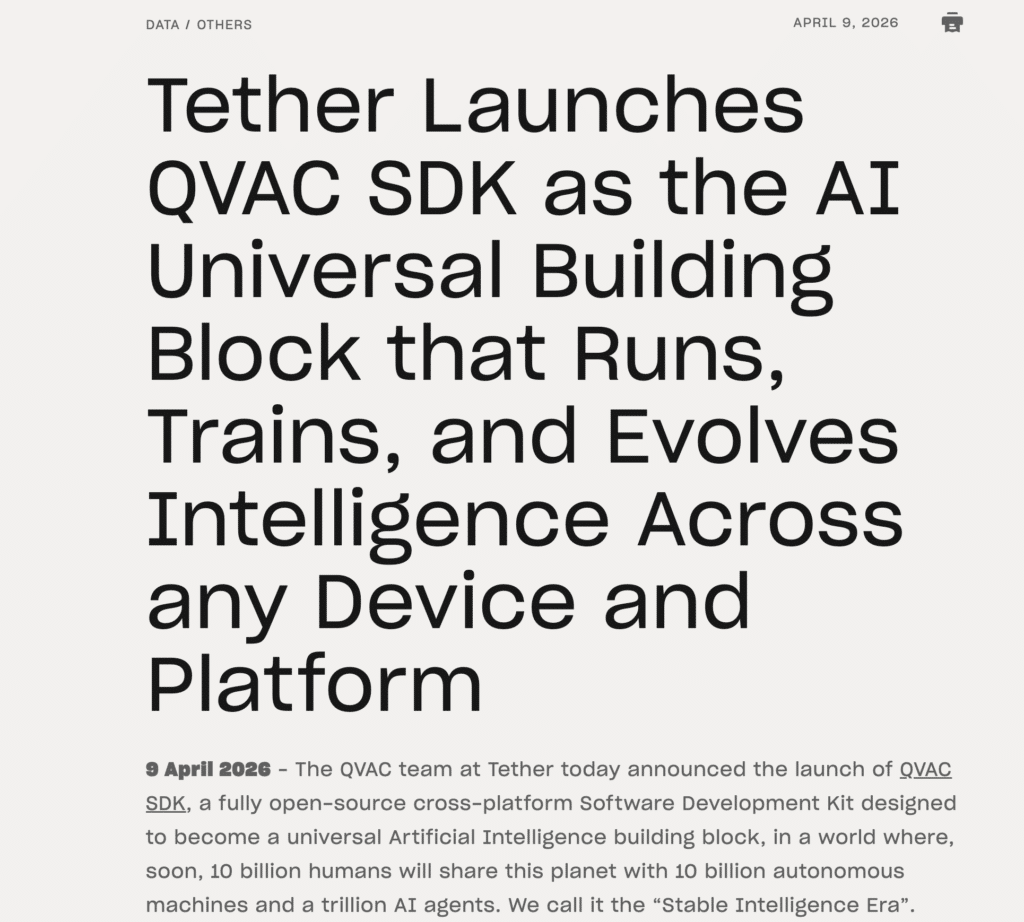
The rise of Tether decentralized AI introduces a strong contrast against traditional centralized AI models controlled by major tech firms. Unlike cloud-heavy systems, this approach emphasizes local execution and user-controlled data. The idea behind Tether local AI is simple yet powerful, keep intelligence closer to the user rather than distant servers.
This shift is closely tied to crypto AI infrastructure, where blockchain and AI merge to enhance transparency. As debates intensify around data privacy, Tether decentralized AI positions itself as a disruptive alternative that challenges centralized control and promotes distributed intelligence across networks.
Market Impact and USDT Ecosystem Strength
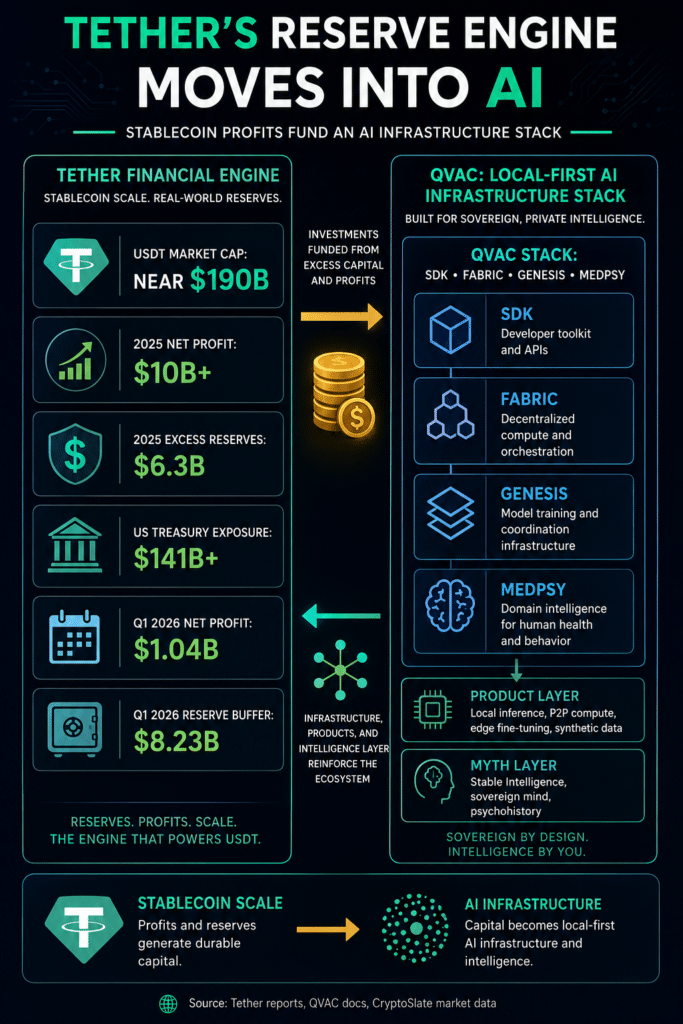
The broader Tether ecosystem remains dominant in stablecoin markets. The live Tether price today is $0.999596 USD with a 24-hour trading volume of $70,889,529,721 USD. Market capitalization stands at $189,753,588,183 USD, reflecting strong liquidity and demand. Even with slight fluctuations of -0.01% in 24 hours, the network maintains stability.
This financial strength supports the expansion of Tether decentralized AI, enabling deeper integration into blockchain services. The combination of stablecoin reliability and AI innovation strengthens confidence in the Tether AI project, making it a key player in both financial and technological ecosystems.
Tether QVAC AI and Psychohistory Inspiration
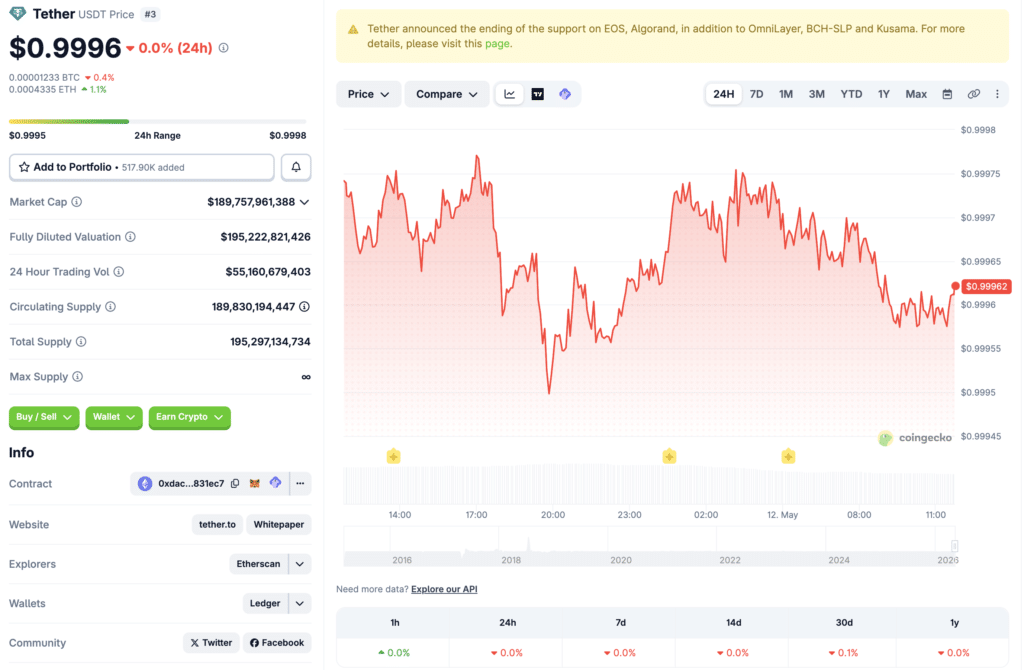
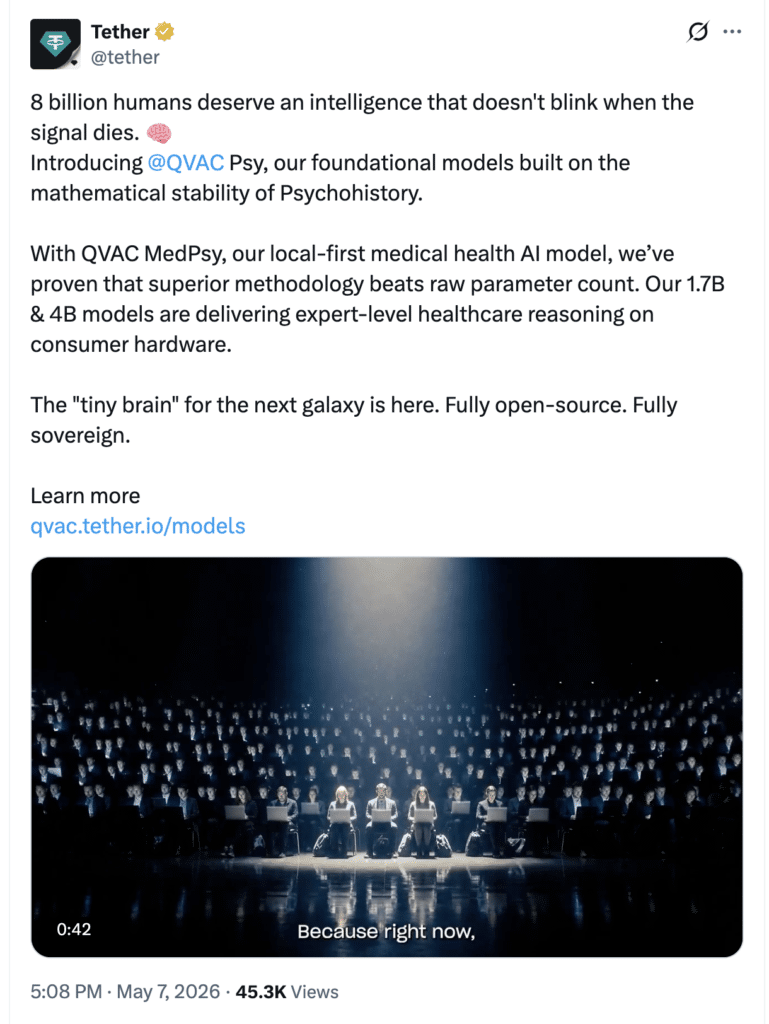
A central pillar of this innovation is Tether QVAC AI, a system inspired by advanced predictive modeling concepts. The design reportedly draws influence from Tether Psychohistory AI, referencing Isaac Asimov’s theoretical framework from the Foundation series. This connection gives rise to long-term forecasting models applied in digital ecosystems.
The idea behind Tether decentralized AI is not just automation but predictive intelligence at scale. Through Tether QVAC AI inspired by Psychohistory, the system attempts to simulate large-scale behavioral patterns, offering a futuristic approach to blockchain intelligence and decentralized decision-making frameworks.
Crypto AI Infrastructure and Local Device Computing
The foundation of this ecosystem lies in crypto AI infrastructure designed for distributed environments. Instead of relying on centralized servers, Tether decentralized AI leverages peer-to-peer architecture. This includes support for Tether AI infrastructure for local devices, allowing execution across mobile and desktop environments. The Tether open-source AI ecosystem launch further strengthens developer participation.
As interest grows in decentralized AI crypto, this model enhances scalability while reducing dependency on cloud providers. The Tether AI project inspired by Isaac Asimov Foundation series introduces a unique blend of science fiction concepts and real-world blockchain utility.

Paolo Ardoino’s Vision and AI Expansion Strategy
Leadership plays a critical role in shaping innovation direction. Under Paolo Ardoino AI initiatives, Tether is expanding beyond stablecoins into advanced technology sectors. The Tether AI project reflects a strategic shift toward long-term infrastructure development. Through How Tether is entering the AI industry, the company is positioning itself as a hybrid financial-technology powerhouse.
The introduction of Tether decentralized local AI platform demonstrates commitment to privacy-first systems. This evolution highlights a broader trend where blockchain firms are diversifying into artificial intelligence, reshaping competitive dynamics across both industries.
Future Outlook of Tether Decentralized AI
The long-term potential of Tether’s decentralized AI depends on adoption, scalability, and developer engagement. As interest grows in Tether peer-to-peer AI technology update, the ecosystem could redefine how AI applications operate within blockchain networks. The rise of Tether, a privacy-focused decentralized AI platform signals increasing demand for secure, user-controlled systems.
Market analysts suggest that Tether decentralized AI news 2026 may mark the beginning of a broader industry shift. If execution remains strong, this innovation could reshape both AI and crypto sectors over the next decade.
Conclusion
The evolution of Tether decentralized AI represents a major turning point in digital infrastructure. By merging blockchain stability with AI intelligence, the ecosystem introduces new possibilities for decentralized computing. The expansion of Tether decentralized AI highlights a growing demand for privacy, scalability, and distributed control.
As innovation continues, Tether decentralized AI may redefine how artificial intelligence integrates with financial systems. Industry observers should closely monitor upcoming developments as this technology moves from concept to global adoption, shaping the next era of crypto-driven AI transformation.
Appendix: Glossary of Key Terms
Decentralized AI Crypto: AI systems running on distributed blockchain networks rather than centralized servers.
QVAC AI: Tether’s AI framework designed for local and peer-to-peer execution.
Crypto AI Infrastructure: Combined systems integrating blockchain and artificial intelligence.
Psychohistory AI: Concept inspired by predictive large-scale behavior modeling.\
Local AI: AI that runs directly on user devices instead of cloud systems.
Frequently Asked Questions About Tether Decentralized AI
What is Tether decentralized AI?
It is a blockchain-based AI system designed for local execution and decentralized computing.
How does Tether QVAC AI work?
It uses peer-to-peer infrastructure to process AI tasks across distributed devices.
Why is Tether entering AI?
The goal is to expand beyond stablecoins into next-generation technology ecosystems.
Is Tether decentralized AI open-source?
Yes, the ecosystem supports open development and community-driven innovation.
What makes it different from traditional AI?
It reduces reliance on centralized servers and increases user data control.
References
Read More: Tether Unveils Decentralized Local AI Platform With Foundation-Inspired Vision">Tether Unveils Decentralized Local AI Platform With Foundation-Inspired Vision
0
0


 Manage all your crypto, NFT and DeFi from one place
Securely connect the portfolio you’re using to start.

0
0


0
0
