
Introducing Hooks: Programmable customization for Hedera entities
0
0
Hedera is consistently evolving to meet the demands of developers and enterprises seeking robust, scalable, and highly customizable distributed ledger infrastructure. From frictionless airdrop mechanisms in HIP-904 to custom monetization programmability in HIP-991, the network has progressively expanded the ways users, developers, and enterprises can tailor native network services to their specific needs.
Hooks, introduced in HIP-1195, represent the next step in this evolution. Hooks provide a programmable framework that allow users to attach custom logic directly to their entities — such as accounts and contracts — without requiring protocol-level changes for each new capability.
With hooks, developers and organizations can implement bespoke business rules that execute automatically when certain transactions occur or conditions are met. This article explores hooks and the practical implications of this upcoming functionality, examining what they signal for the future of programmable infrastructure on Hedera. Let’s dive in.
What are hooks?
The hooks framework consists of two layers: extension points and hooks.
- Extension points are fixed, protocol-defined integration points — specific moments during transaction processing where custom logic is allowed to run.
- Hooks are the programmable code that developers write and attach at those extension points.
The extension points themselves are not programmable; they are determined by the protocol. What’s programmable is the hook logic that executes within them. Rather than relying solely on the network’s default transaction logic, account and contract owners can attach hooks that execute custom code when specific operations are triggered while preserving end-user self-custody and native network performance.
Each hook is owned by a single entity and identified by a unique hook ID. There is no limit to the number of hooks an entity can create, though storage footprint — and associated rent — scales proportionally with usage.
The initial implementation focuses on EVM hooks, meaning developers can write hook logic in Solidity or any language that compiles to EVM bytecode. This provides a familiar development experience for those already building on EVM-compatible networks while leveraging Hedera’s native networks services and performance.
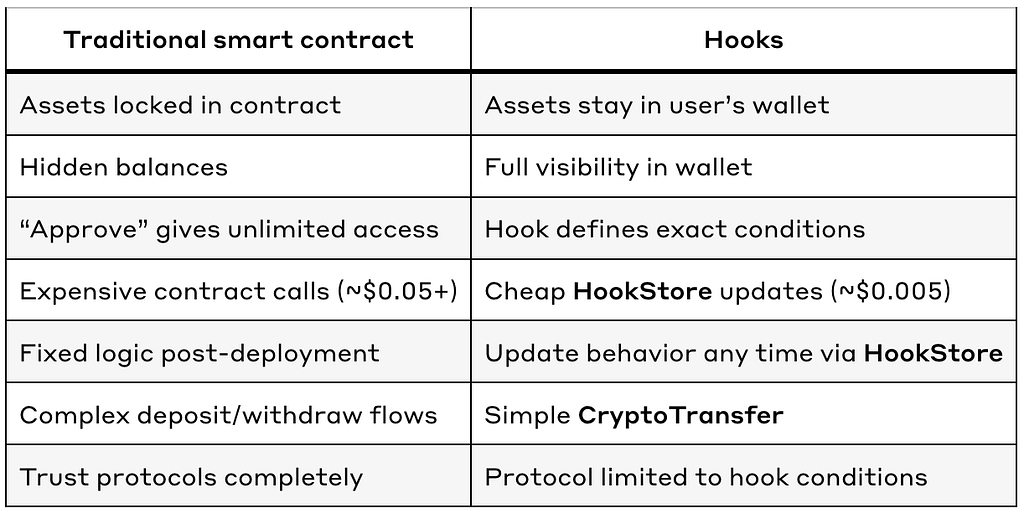
A key distinction between hooks and traditional smart contracts lies in ownership and state management. Smart contracts typically encapsulate trust guarantees for multiple parties and require contract calls to modify state. Hooks, by contrast, belong to a single owner who can update storage directly via a new HookStore transaction — offering lower overhead than a standard ContractCall and even less than a ConsensusSubmitMessage.
At launch, the first available extension point is the account allowance hook, which runs during CryptoTransfer operations. This means hooks today center on programmable control over when and how assets leave your account. Future HIPs will introduce additional extension points for other native services.
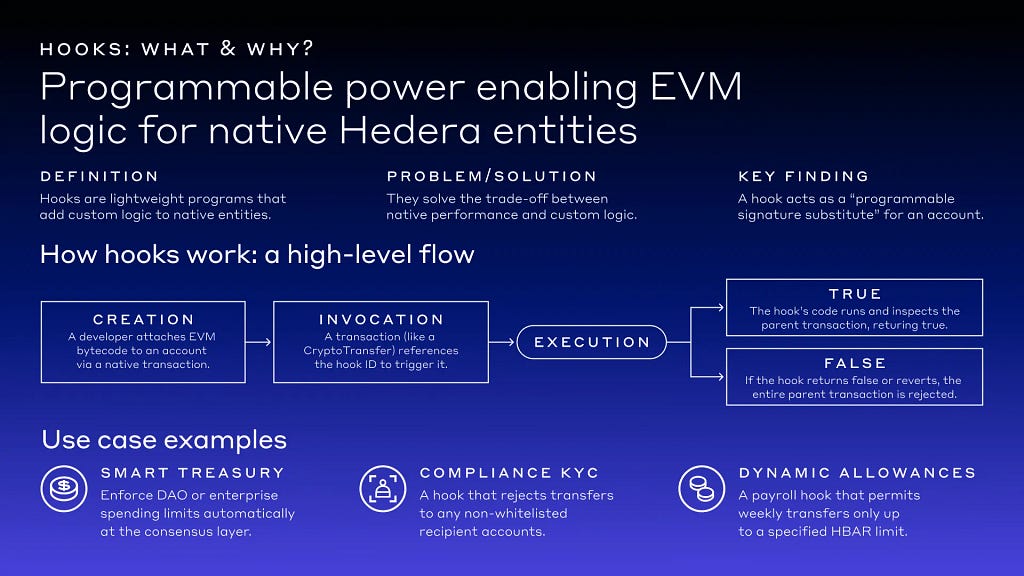
In short, hooks bring smart contract flexibility to native Hedera entities without sacrificing self-custody or performance. Let’s take a look at some of the ways hooks will transform how dApps and users can interact on Hedera.
Hooks in practice
Hooks unlock a broad spectrum of applications across decentralized finance, enterprise operations, and personal asset management. The underlying principle remains consistent: users can define precise conditions under which their assets may be accessed, all while maintaining self-custody and full visibility. The following examples illustrate both the depth and breadth of what becomes possible.
DEX Limit Orders Without Token Lockup
Decentralized exchanges typically require users to deposit tokens into protocol-controlled contracts to execute limit orders. Until orders fill or users withdraw, those assets remain outside personal wallets — exposed to smart contract risk and invisible to standard portfolio views.
Hooks introduce a fundamentally different model. With an account allowance hook, users can create limit orders where tokens remain in their own wallets until the exact moment a swap executes.
The hook encodes the order parameters: the token to sell, the quantity, the token to receive, and the minimum acceptable amount. Automated systems operated by the exchange monitor market conditions and, when the target price is reached, submit a CryptoTransfer that references the user’s hook.
At execution time, the hook validates that the proposed transfer matches the predefined conditions — correct token pair, correct quantities, and sufficient value received. If all conditions are satisfied, the hook returns true and the atomic swap proceeds. If not, the transaction fails and the user’s assets remain untouched.
The implications are significant. Users maintain custody of their assets throughout the order’s lifecycle. Cancellation requires either updating hook storage or deleting the hook — no withdrawal transaction, no gas fees for moving tokens back. Portfolio balances reflect true holdings rather than amounts “locked in contract.” And critically, a compromise of the exchange’s infrastructure does not grant attackers access to user funds, because those funds never left user-controlled accounts.
For exchanges building on Hedera, this model offers a compelling value proposition: the functionality of limit orders with materially reduced custodial risk, all while preserving compatibility with existing wallet infrastructure.
Business Treasury as Escrow
Traditional escrow arrangements require transferring funds to third-party contracts or custodial accounts. Capital remains locked, and balances held externally often fail to appear in standard financial reporting.
Hooks enable a single business treasury account to serve as its own escrow for multiple simultaneous deals, with each arrangement governed by a dedicated hook encoding specific release conditions.
Consider a supply chain scenario. A buyer creates an escrow hook designating the supplier as the authorized recipient, the payment amount, and the requirement for delivery confirmation from a trusted oracle. The supplier can verify the commitment via mirror node APIs. Upon confirmed delivery, the supplier submits a CryptoTransfer with the oracle’s signature. The hook verifies the recipient, amount, and proof; if all conditions are met, the transfer proceeds.
Funds remain in the business’s own account, visible in standard accounting systems. Multiple escrows run concurrently as different hook IDs on the same account. Release conditions are transparent and verifiable, yet control never leaves the organization.
For organizations seeking to streamline commercial transactions while maintaining custody and auditability, treasury-based escrow via hooks represents a meaningful operational improvement.
Additional Applications
- Puzzle-Based NFT Distribution: Projects can gate collectible releases behind interactive challenges, with hooks validating correct answers against stored hashes before authorizing transfers.
- Streaming Salary Payments: Employers commit to paying employees over time while funds remain in yield-generating accounts. Employees claim vested portions on their own schedule.
- Conditional Payment Acceptance: Businesses enforce invoice matching at the protocol level, automatically rejecting payments with incorrect amounts, unauthorized senders, or duplicate submissions.
- Crypto Inheritance: A dead man’s switch pattern allows beneficiaries to claim assets only after a timeout period elapses without owner activity — requiring no lawyers or custodians.
- Allowance Accounts for Dependents: Parents, caregivers, or employers grant controlled spending access with protocol-enforced limits that reset automatically each period.
In each case, the underlying value proposition remains consistent: programmable logic with self-custody, transparent conditions with instant adjustability, and smart contract flexibility without the associated custodial risks.
Looking ahead
Account allowance hooks represent the first extension point in what is designed to be an extensible framework. Future HIPs may introduce additional extension points — such as hooks for token transfers, topic access control, or other native service interactions — broadening the scope of programmable customization available to users.
The architecture also anticipates non-EVM programming models. While the initial implementation focuses on Solidity-compatible bytecode, the underlying design permits alternative languages and execution environments in subsequent proposals.
As adoption grows, widely-used hooks are expected to be published as application HIPs, establishing community-vetted standards supported by wallets and block explorers. This positions hooks as foundational infrastructure for Hedera’s continued evolution toward developer flexibility and enterprise-grade programmability.
Getting started with hooks
Hooks mark a significant step forward in Hedera’s programmability, enabling users to define custom logic for their entities without protocol-level changes. By preserving self-custody, reducing operational overhead, and maintaining compatibility with native services, hooks offer a powerful foundation for innovation across decentralized finance, enterprise operations, and beyond.
Developers and organizations interested in exploring hook design patterns can follow the ongoing implementation progress and contribute feedback through the Hiero GitHub repository.
Resources
Introducing Hooks: Programmable customization for Hedera entities was originally published in Hedera Blog on Medium, where people are continuing the conversation by highlighting and responding to this story.
0
0

 Manage all your crypto, NFT and DeFi from one place
Securely connect the portfolio you’re using to start.

1
0