
Binance Tokenized Stock Dividend Goes Live in a Crypto First

0
0
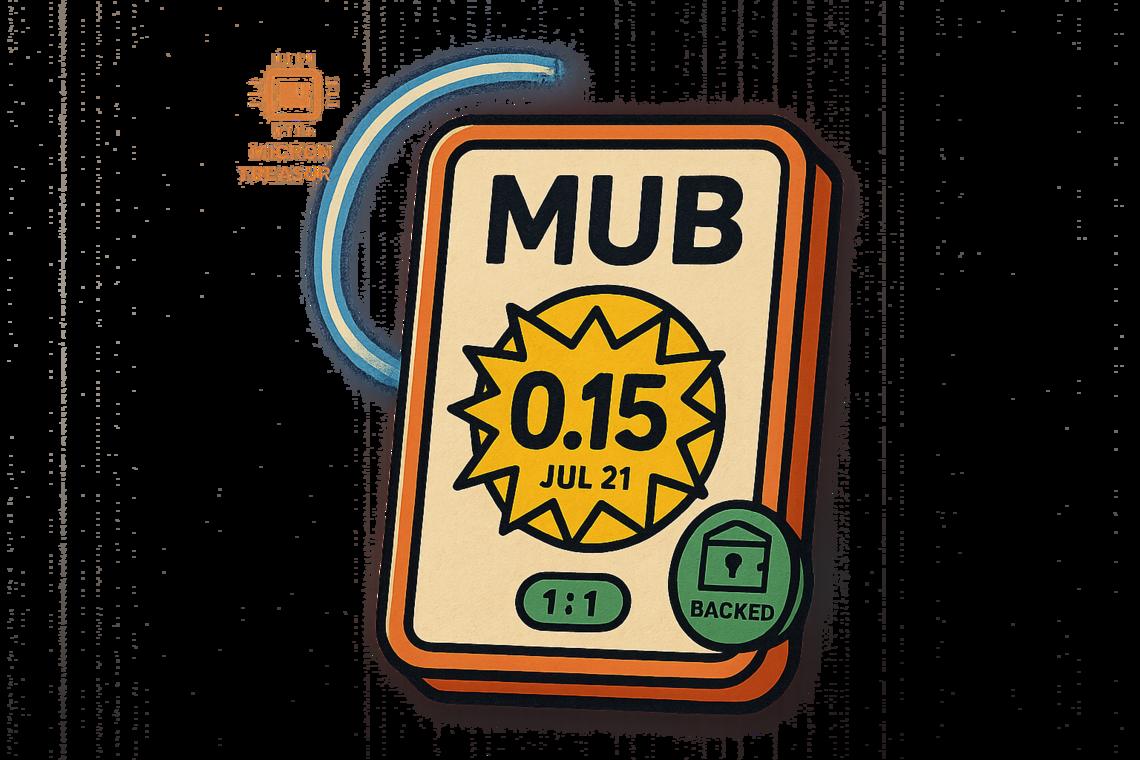
Something quietly significant happened in the world of tokenized equities this week. For the first time, holders of a blockchain-based stock token are about to receive a real corporate dividend — not a synthetic approximation, not a funding payment dressed up as yield, but an actual Binance tokenized stock dividend flowing from a corporate treasury to on-chain wallets. Micron Technology’s routine quarterly payout of $0.15 per share has become the first live test of whether tokenized equities can do everything a real stock does.
Key takeaways
- Micron Technology is paying a $0.15 quarterly dividend per share, with the record date set for July 6, 2026 and payment on July 21, 2026.
- Binance’s MUB token is a 1:1 tokenized version of Micron stock on BNB Chain, backed by actual shares held in regulated custody.
- Roughly 32,000 MUB tokens are in circulation, putting the total dividend payout at approximately $4,800 and the token’s market cap at around $30 million.
- Binance’s bStocks platform launched in June 2026, offering tokenized US equities including NVIDIA and Tesla alongside Micron.
- Tokenized securities remain in a regulatory gray area, requiring investors to trust Binance and its custodial partner rather than a traditional broker.
Micron’s Dividend Hits the Blockchain
Micron Technology’s $0.15 quarterly dividend is, by traditional standards, unremarkable. But the mechanics of how it reaches MUB token holders reveal something genuinely new about where financial infrastructure is heading.
MUB is Binance’s tokenized representation of Micron stock, issued on BNB Chain as part of the bStocks initiative. Each token is backed 1:1 by an actual Micron share sitting in regulated custody — which is precisely what makes a real dividend distribution possible. Binance will take a snapshot of MUB holdings at 00:00 UTC on July 6, 2026. Anyone holding MUB at that moment qualifies for the $0.15 per token cash payment, which lands on July 21, 2026. Classic ex-dividend mechanics, running entirely on a blockchain instead of through a brokerage’s back-office plumbing.
How the custody model makes it work
The 1:1 backing structure is not cosmetic. Because each MUB token corresponds to a real Micron share held in custody, Binance collects the dividend directly from the custodian and passes it through to token holders. There is no synthetic replication, no funding rate proxy. The process mirrors what a traditional brokerage does for equity holders — the difference is that settlement happens on-chain and the platform is a crypto exchange.
That distinction matters more than it might initially seem. It means the dividend isn’t discretionary. It flows because the underlying asset generates it, not because Binance chooses to offer yield as a marketing incentive. For token holders, that structural integrity is the whole point.
Market Impact and Scale of Binance’s Tokenized Stock Dividend
The numbers involved are small. With a circulating supply of approximately 32,000 MUB tokens, the total dividend distributed across all holders comes to roughly $4,800. That’s not a market-moving event. But the figure that deserves more attention is MUB’s market cap of around $30 million — an early but concrete benchmark for a category that barely existed twelve months ago.
MUB’s place in a fast-moving market
Binance launched the bStocks platform in June 2026, quickly expanding it to include tokenized versions of some of the most traded names in US equities — NVIDIA and Tesla among them. The timing was deliberate: the second week of June 2026 saw equity derivative trading volumes on crypto exchanges hit a record $11.6 billion, driven partly by Binance’s expansion into stock trading against the backdrop of major market events. Within weeks of launch, Binance’s equity-related products reportedly crossed $1 billion in assets under management.
The broader context is important. The tokenized real-world asset market has grown from roughly $5.4 billion at the start of 2025 to around $34 billion in 2026, with tokenized equities emerging as one of its most contested segments. Competitors are moving fast. Bitrue has launched 3x leveraged tokens on US stocks using BNB Chain infrastructure. Ondo Global Markets recently crossed $1 billion in total value locked for its tokenized equity products. Coinbase has announced plans to launch its own on-chain tokenized equities.
Against that backdrop, MUB’s first real dividend payout isn’t just an operational footnote — it’s a proof-of-concept moment. It demonstrates that a tokenized stock can generate and distribute income in a way that’s structurally indistinguishable from traditional equity ownership, even if the regulatory wrapper around it remains unresolved.
Why this matters for crypto-native investors
For investors who want equity exposure but face brokerage restrictions, foreign-exchange friction, or simply prefer to operate within a crypto-native environment, tokenized stocks with working dividend mechanics represent a meaningful step forward. The value proposition combines price exposure, passive income, and 24/7 liquidity — none of which a traditional brokerage account delivers simultaneously.
Early adoption data from Binance’s stock trading products suggests that more than 80% of its stock trading volume comes from younger demographics in emerging markets. These are users for whom opening a US brokerage account may be genuinely difficult, not merely inconvenient. A $0.15 dividend flowing to an on-chain wallet in a market with limited traditional financial access carries different weight than the same payment arriving in a US retail brokerage account.
Investor Implications and Regulatory Landscape
The operational case for tokenized equities is becoming harder to dismiss. The regulatory case remains genuinely complicated.
Binance and its tokenized securities face scrutiny across multiple jurisdictions. Tokenized stocks occupy an awkward position: they behave like securities, they now pay dividends like securities, but they trade on crypto exchanges that operate outside the regulated stock market infrastructure. That gap hasn’t been resolved by any major jurisdiction. It’s a structural tension, not just a compliance checkbox.
The trust question
Investors holding MUB are not traditional shareholders. They hold a token whose value and income depend on Binance maintaining its custody arrangements, correctly executing dividend distributions, and continuing to operate in their jurisdiction. That’s a different trust model than owning shares through a regulated broker-dealer with investor protection schemes in place.
That doesn’t make the product worthless — it makes the counterparty risk explicit. As the tokenized equity space matures, the platforms that survive regulatory scrutiny and build transparent custody structures will likely capture the long-term market. The ones that don’t will provide regulators with exactly the case studies needed to justify intervention.
What the MUB dividend event establishes is that the infrastructure works. The harder question — whether it will be allowed to keep working, and under what conditions — is one that no $4,800 dividend payout can answer on its own.
FAQ
How does the dividend payment for MUB token holders work?
Binance takes a snapshot of MUB holdings at 00:00 UTC on July 6, 2026 and distributes the corresponding $0.15 per token dividend on July 21, 2026. Only holders recorded at the snapshot time are eligible.
What backs the MUB token on Binance’s platform?
Each MUB token is backed 1:1 by an underlying Micron share held in regulated custody. This direct backing is what enables genuine dividend distributions rather than synthetic yield approximations.
What are some risks associated with holding tokenized stocks like MUB?
Key risks include regulatory uncertainty across jurisdictions, reliance on Binance and its custodial partner rather than a traditional regulated broker, and the legal gray area that tokenized securities currently occupy in most markets.
What other tokenized stocks are available on Binance’s bStocks platform?
The bStocks platform, launched in June 2026, includes tokenized versions of major US equities such as NVIDIA and Tesla, alongside Micron’s MUB token.
Article produced with the assistance of artificial intelligence and reviewed by the editorial team.
0
0
 Manage all your crypto, NFT and DeFi from one place
Securely connect the portfolio you’re using to start.