
Dogecoin price at $0.0929: why the 200-day line sits at $0.0878 and not at $0.093

0
0

Dogecoin price at $0.0929: the 200-day line sits at $0.0878
The starting position in figures, all based on data from CoinGecko on the morning of Sunday, October 4: dogecoin trades at $0.0929. Over 24 hours that is a gain of 0.01 percent, over the week a loss of 2.86 percent, over the month a gain of 6.37 percent. The all-time high of $0.7316 is 87.3 percent above the current price.
The same measurement across the larger assets: bitcoin stands at $84,978, up 0.70 percent over the week and up 4.74 percent over the month; ethereum at $2,692.97, up 0.11 percent and up 7.41 percent; solana at $120.89, up 0.59 percent and up 16.33 percent; XRP at $1.49, down 1.02 percent and up 2.88 percent. Dogecoin is therefore the only one of these five assets that has given back ground over the week. Over the month it sits in the middle of the field.
A 200-day moving average is the mean of the last 200 daily closing prices, and it shifts forward by one day with every new session. It smooths out the daily noise and shows where the average price level lies. The reason it is currently falling for dogecoin is mechanical: the high prices of the spring, when the coin still traded above $0.11, are dropping out of the window. Every day on which such an old value leaves the window pulls the average down, regardless of what happens today.
Recalculated from 366 daily closes: how the 200-day moving average is built
The calculation is set out in full so that you can follow it. The basis is 366 daily closing prices from CoinGecko covering October 5, 2025 to October 4, 2026. The mean of the last 200 of those values comes to $0.0878. The mean of the last 50 values, the shorter line, comes to $0.0875. Both lines run at practically the same level, and both sit below the current price.
The frequently quoted figure of $0.093 reflects the price level of recent days rather than the average. How the discrepancy arises cannot be established from the outside. Some providers calculate with hourly data, others with the closing prices of a single exchange, others again with an exponentially weighted average that gives more weight to recent days. For you as a reader the lesson is a simple one: a line quoted without its data basis is a claim rather than a measurement.
The most recent crossover came on September 22. On that day the price rose to $0.0998 and thus moved back above the line for the first time since September 10, when the average stood at $0.0878. It has not dropped below it since. In the 120 days before that, price and line crossed five times, among them on August 22, August 26, September 6 and September 10. A line that is crossed that often does not work as an alarm bell, and serves only as a rough description of the situation.
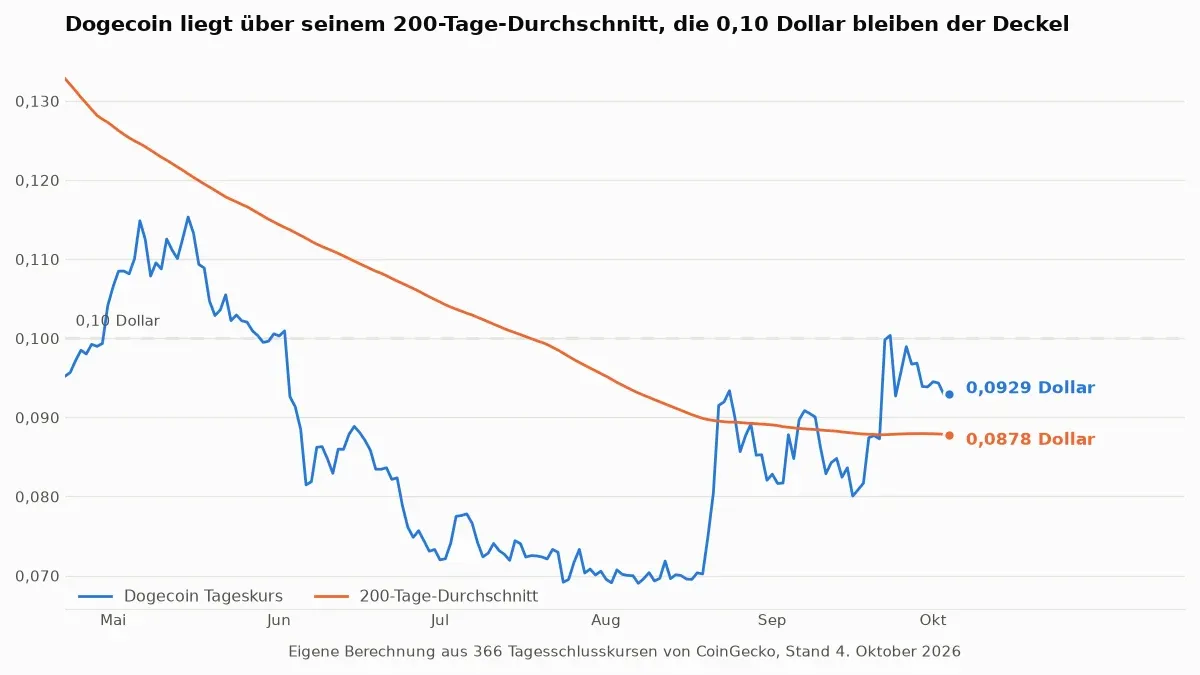
The $0.10 level: a single day above the threshold in 66 days since August 1
What is holding the price back is the round number above it rather than the line beneath it. Since August 1 there have been 66 days in the series. On exactly one of them did dogecoin close at or above $0.10, namely on September 23 at $0.1004. The low of the same period dates from August 7 at $0.0690. Between that low and the high lies 45 percent, and even so the price has touched the round figure only once.
Round numbers carry weight in markets because sell orders cluster there. An investor who bought at $0.11 or $0.12 in the spring and has been underwater ever since will often place an exit at precisely the next round mark. That supply has to be worked through before a breakout can hold. One day above the threshold in a little over two months says that it is still there.
Trading volume of $381 million against $969 million on the monthly average: turnover is thinning out
The second measure explains more than the price itself. On October 4, dogecoin worth $381 million changed hands. The 30-day average stands at $969 million, the 90-day average at $706 million. Current daily turnover therefore amounts to a little over 39 percent of the monthly average.
Part of that is the weekend, when trading on crypto exchanges is traditionally lighter. The rest is a loss of participation. Thin turnover means two things for you. First, smaller orders move the price more, the spread between bid and ask widens, and a market order for a larger sum costs more than it would on a Tuesday afternoon. Second, breakouts are less durable when trading is thin: a jump above $0.10 carried by only a few million dollars tends to fall back quickly.
Anyone moving larger amounts is better served placing a limit order rather than a market order on days like this. Which trading venues in Germany offer which order types and which fee models is set out in the crypto exchange comparison; the differences in execution weigh more heavily on small coins than on bitcoin.

BWOW converts all its dogecoin into cash on October 14, with payment following on October 22
Part of the missing turnover has a name. On September 10, Bitwise resolved to wind up its dogecoin fund BWOW. According to the filing with the US Securities and Exchange Commission, October 14 is the last day of trading on NYSE Arca. On that day the fund converts its dogecoin holdings into cash. No new shares will be issued before the market opens on October 15, and on October 22 the remaining shareholders receive the net asset value of their shares as of October 21 in cash. Bitwise cites the ongoing optimisation of its own product range as the reason.
Investors in Germany cannot buy this fund directly, because US spot products carry no key information document under the PRIIPs Regulation and are therefore not offered through regulated brokers. The episode is nonetheless instructive, for two reasons. For one, the fund takes a channel of demand with it that was weak in any case: fund assets had fallen below $1 million after the launch in November 2025. For another, the mechanics show what a product liquidation means for the holder.
And that is precisely the point that concerns holders of European products too: in a liquidation the provider determines the moment of sale, and the investor does not. Anyone holding a fund or a certificate that is being liquidated sells compulsorily on the day the issuer sets. In tax terms that date can fall very awkwardly, which is the subject of the next section.
The holding period under Section 23 of the Income Tax Act: the draft bill affects only purchases from January 1, 2027
A clear rule has applied to private investors in Germany so far. Anyone who holds crypto assets for longer than a year sells the gain free of tax under Section 23 of the German Income Tax Act, with no upper limit. Anyone who sells earlier pays income tax on the gain at their personal rate as soon as the total of all private disposal gains in a year reaches €1,000. That €1,000 is an exemption threshold and not a tax-free allowance: on a gain of €1,001, it is not €1 that becomes taxable but the full €1,001.
The Federal Ministry of Finance has sent a draft bill to the industry associations that would delete this one-year period for so-called exchange crypto assets. Gains would then fall under investment income and thus under the flat-rate withholding tax, irrespective of the holding period. The associations' consultation period ends on October 6, and the cabinet is scheduled to take up the draft on October 14. The decisive element is the cut-off date in the draft: the new rules are to apply exclusively to crypto assets acquired after December 31, 2026. For everything sitting in a securities account or a wallet by the end of the year, the existing legal position would remain.
A draft is not yet a law, and the federal government can move the cut-off date as the process continues. Even so, it raises a question you can check for yourself: if you intend to build a position over the coming months anyway, the calendar year of the purchase suddenly appears in a different light. Moving the acquisition into January may mean giving up a grandfathering that a purchase in December still captures. You should therefore document the acquisition data of every single tranche cleanly; which tools take that over is set out in the comparison of crypto tax software and portfolio trackers.
Crypto ETPs in Germany: without physical backing and a delivery claim, the flat-rate withholding tax applies
Many investors in Germany buy dogecoin through an exchange-traded product, an ETP or ETN, rather than directly. In tax terms that is not on a par with a direct purchase; it depends on how the note is constructed. Under the line taken by the tax authorities, physically backed products that grant the holder a claim to delivery of the coins are treated like a direct investment. The one-year period then applies, and a sale after twelve months remains free of tax.
If either of the two conditions is missing, the note falls under investment income. The flat-rate withholding tax of 25 percent then applies, plus the solidarity surcharge and church tax where relevant, regardless of how long you have held. You can verify this in the key information document and in the terms of issue of the product concerned. Two terms decide the matter: full physical backing, and a redemption or delivery claim held by the owner.
Alongside that sits the running fee. Annual management fees on dogecoin products in Europe are well above what is familiar from the ETF market. A fee of 2.5 percent a year costs around seven percent of the stake over three years if the price moves sideways, without anything having changed in the price itself. On an asset that has lost 63 percent over twelve months, that is an item that belongs in the calculation.
DogecoinVM on the Metal Blockchain: the bridge runs as a capped beta with no external audit
On the technical side there is the only genuinely new development of recent days. Metallicus released version 0.1.0 of DogecoinVM on September 24. Behind it stands a dogecoin environment that runs as a separate layer on the Metal Blockchain and is connected one to one with the dogecoin mainnet through a bridge. Instead of proof of work, a faster consensus mechanism secures the transactions, which allows short confirmation times. In parallel, the public testnet of DogeOS went live in late September, allowing applications modelled on ethereum with DOGE as the fee currency.
More important for you than the technology is the warning contained in the release itself. The developers expressly describe the launch as a capped beta using real dogecoin, advise moving only small amounts, and record that the code has not been through an external security review and that the signing keys are not yet held by independent operators. A fee of 0.01 DOGE per transaction is also deducted on deposit.
A bridge without an audit has historically been the most vulnerable point in crypto infrastructure. Anyone who wants to hold a position for the long term has no business in a beta of this kind and is better off in self-custody. Which devices come into question for that, and how they differ in recovery and handling, is shown by the hardware wallet comparison.
545 million dogecoin in a single day: the figure comes from a post with no named data provider
In recent days a claim has circulated that large addresses bought more than 545 million dogecoin within 24 hours, worth a little over $50 million. The figure goes back to a single post on a social network. No data provider is named there, nor is it defined from what holding size an address counts as a large address. There is so far no confirmation from any analytics service named in full.
Claims of this kind deserve reserve, whether or not they fit your own picture. A movement between two addresses belonging to the same owner looks like a purchase on the blockchain while being nothing of the sort. Reshuffling between an exchange's custody addresses regularly produces readings like these. Take note of the figure as an unconfirmed claim, then, and treat it as no grounds for a position.
Two levels for the dogecoin price: next target $0.10
On the upside the picture is unambiguous. The $0.10 mark is where it will be decided whether the recovery since the August low turns into something more. A daily close above it, carried by turnover above the 30-day average of $969 million, would be the first durable signal since the spring. The one day above the mark on September 23 was precisely not that: the price fell back within a day.
On the downside the first support sits at $0.0878, where the 200-day moving average runs. Below that, at some distance, follows the low of August 7 at $0.0690. Between those two values lies 21 percent, and that describes the room to fall better than any forecast. Anyone holding a position should know that a slide below the average line has historically not stopped immediately: in June and July of this year the price spent weeks beneath it.
The news flow argues against a quick resolution either way. The winding-up of BWOW runs to October 22, the cabinet discussion on the holding period falls on October 14, and the technical developments remain at beta stage. None of these events changes the supply of dogecoin, which grows by around five billion units a year because the protocol knows no upper limit.
Custody and purchase route under MiCA: an exchange account and a hardware wallet separate two risks
Since the European Markets in Crypto-Assets Regulation came into full effect, providers targeting German customers need authorisation as crypto-asset service providers. For you that is first of all a checkpoint before opening an account: is the provider listed in the register of the competent supervisor, and is the registered office in the European Union? A provider without authorisation may not advertise actively in Germany, and in a dispute the route to a supervisory authority is considerably shorter when that authority has jurisdiction.
The second checkpoint concerns custody. Coins in an exchange account belong to you economically, but they sit within the exchange's power of disposal. That is practical for active trading and an additional dependency for a holding period of twelve months and more. Anyone wanting to use the one-year period sensibly separates the two functions: trading balance on the exchange, long-term balance on a device whose recovery words only you know. The acquisition data remain untouched by that, since a transfer between your own addresses is not a sale and does not restart the period.
Dogecoin price: How to proceed now
- Check the data basis before you follow a line. Recalculate the 200-day average using a source whose period and price type you know. The difference between $0.0878 and $0.093 decides whether the price stands above its average price level or on it. Which exchanges deliver clean historical prices is shown by the exchange comparison.
- Record the acquisition date and the product form. Note the purchase date, quantity and price for every tranche, and in the case of an ETP read in the key information document whether it is fully physically backed and grants a claim to delivery. That determines whether the one-year period applies or the flat-rate withholding tax. A portfolio tracker with a tax function takes over the documentation.
- Separate custody from the trading platform. Move the part of your holdings you intend to hold for longer than a year onto a device under your own control, and stay out of unaudited bridges. The hardware wallet comparison ranks the devices by recovery, handling and price.
(As of October 4, 2026. This article is not investment advice. Prices and fee structures change; check the terms with the provider before you buy.)
0
0

 Manage all your crypto, NFT and DeFi from one place
Securely connect the portfolio you’re using to start.


