
Bitcoin Gives Back Weekend Gains as Oil Jumps 5% on Strait of Hormuz Uncertainty

0
0
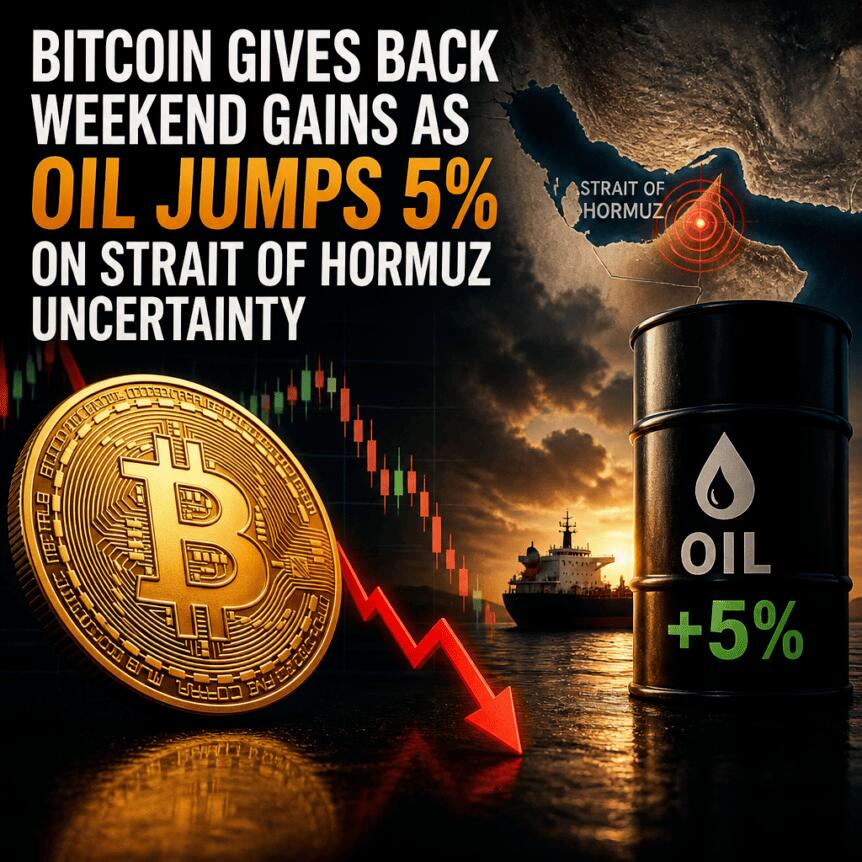
Bitcoin dipped below $64,500 on Monday after Wall Street’s open, tracking a broader risk-off mood tied to fresh uncertainty around US-Iran tensions and the Strait of Hormuz. While crude prices moved higher, equities failed to hold their early direction, and BTC’s early weakness underscored how quickly macro headlines can dominate crypto price action.
At the same time, market attention is being split between geopolitics and FX—particularly the Japanese yen. The yen continued to weaken against the US dollar even after a rare joint Japan-US intervention, putting additional pressure on liquidity-sensitive assets like bitcoin.
Key takeaways
- Bitcoin slid to around $64,447 on Bitstamp shortly after the US open, reflecting risk-off positioning alongside US stocks.
- Iran’s deputy speaker, Ali Nikzad, said reopening the Strait of Hormuz has “no military solution,” adding to uncertainty for energy markets.
- USD/JPY pushed toward 160 in early Asia trading, as the yen remained under pressure after the Japan-US FX intervention.
- On-chain and derivatives signals show stronger institutional demand, but analytics firms describe spot-market recovery momentum as still not fully confirmed.
- US spot Bitcoin ETFs logged net inflows of $865.3 million last week, yet analysts still characterize the rebound as tentative.
Geopolitical uncertainty and macro spillover into BTC
According to TradingView data cited in the report, BTC/USD touched $64,447 on Bitstamp—its lowest level since Friday—before recovering modestly. The move closely followed the pattern in US equities, which initially fell as traders reassessed the likelihood that the Strait of Hormuz oil route would reopen.
Iranian officials added to that caution. Addressing the Islamic Consultative Assembly, deputy speaker Ali Nikzad reportedly said that the “opening of the Strait of Hormuz has no military solution,” a statement quoted by Al Jazeera and other outlets.
Energy markets reflected the same tension. US WTI crude oil was up nearly 5% to about $80.90 per barrel at the time of writing, even as the S&P 500 managed to turn green after dipping—still below Friday’s all-time highs. For bitcoin, the takeaway is less about oil’s direction alone and more about how quickly broader macro uncertainty is feeding into risk appetite.
Yen weakness after Japan-US FX action raises liquidity questions
Beyond geopolitics, the yen remained a focal point for markets. The Japanese currency continued to slide against the US dollar despite a rare joint intervention by Japan and the United States earlier, with USD/JPY reaching 159 on Monday and edging toward the 160 threshold during the first Asia session.
Economist Mohamed El-Erian warned that Japan may need stronger or more decisive policy follow-through for the intervention to translate into sustained FX stabilization. On X, he wrote that the yen has been weakening gradually since the joint Japan-US FX intervention, calling it a reminder that correcting a “mispricing” depends on getting the policy mix right—and that delays could make the intervention’s goal “more elusive.”
For crypto traders, this matters because FX stress can alter global liquidity conditions and risk positioning. When the yen weakens rapidly, it can coincide with shifts in cross-asset funding and hedging behavior—dynamics that often spill into high-beta markets.
Institutional inflows support the backdrop, but analysts see uneven momentum
While bitcoin’s price action looked shaky, institutional and on-chain data offered a more constructive—though not fully decisive—picture. Glassnode’s latest Market Pulse update pointed to what it described as improving components that typically precede more sustainable uptrends, but it also highlighted a key missing piece: the overall momentum in the spot market.
Glassnode said momentum had returned toward neutral and that spot taker buying had accelerated sharply. However, it noted that centralized exchange turnover remained subdued. In the report, the firm interpreted the gap between stronger spot absorption and weaker exchange activity as indicative of demand improving within a broader consolidation environment rather than a broad-based speculative expansion.
ETFs and derivatives hint at accumulation—yet “tentative” remains the watchword
Institutional flows were among the clearest positives in the week’s data. The report cited Farside Investors data showing that US spot Bitcoin ETFs recorded net inflows of $865.3 million last week. Such inflows can matter because they represent steady demand from traditional capital channels, often helping stabilize sentiment during choppy periods.
On the derivatives side, CryptoQuant data referenced in the report indicated that hedge funds had flipped to net long CME bitcoin futures. The CEO of CryptoQuant, Ki Young Ju, characterized the shift as “rare,” arguing that the typical positioning behavior had structurally favored being short via basis trades—an approach he said cannot easily be carried into net long positions. In his framing, hedge funds betting on upside suggests more conviction than simple hedging.
Still, the overall conclusion from the analytics commentary is that bitcoin’s rebound attempts are not fully “locked in.” The report described the comeback as “tentative,” with Glassnode’s divergence between accelerating spot taker buying and subdued exchange turnover serving as a caution signal. In other words: inflows may be arriving, but market breadth and turnover are not yet confirming a full expansion cycle.
Going forward, traders are likely to keep a close eye on whether macro uncertainty around the Strait of Hormuz continues to dominate price action, and whether FX conditions—especially USD/JPY—stabilize or deteriorate further. On the crypto side, the next test is whether ETF-led demand and derivatives positioning can translate into stronger spot-market momentum, rather than staying confined to consolidation.
This article was originally published as Bitcoin Gives Back Weekend Gains as Oil Jumps 5% on Strait of Hormuz Uncertainty on Crypto Breaking News – your trusted source for crypto news, Bitcoin news, and blockchain updates.
0
0

 Manage all your crypto, NFT and DeFi from one place
Securely connect the portfolio you’re using to start.


0
0

0
0

0
0