
Standard Chartered Sees Tokenized RWA Growth to $4T, LINK Could Hit $200 by 2030

0
0
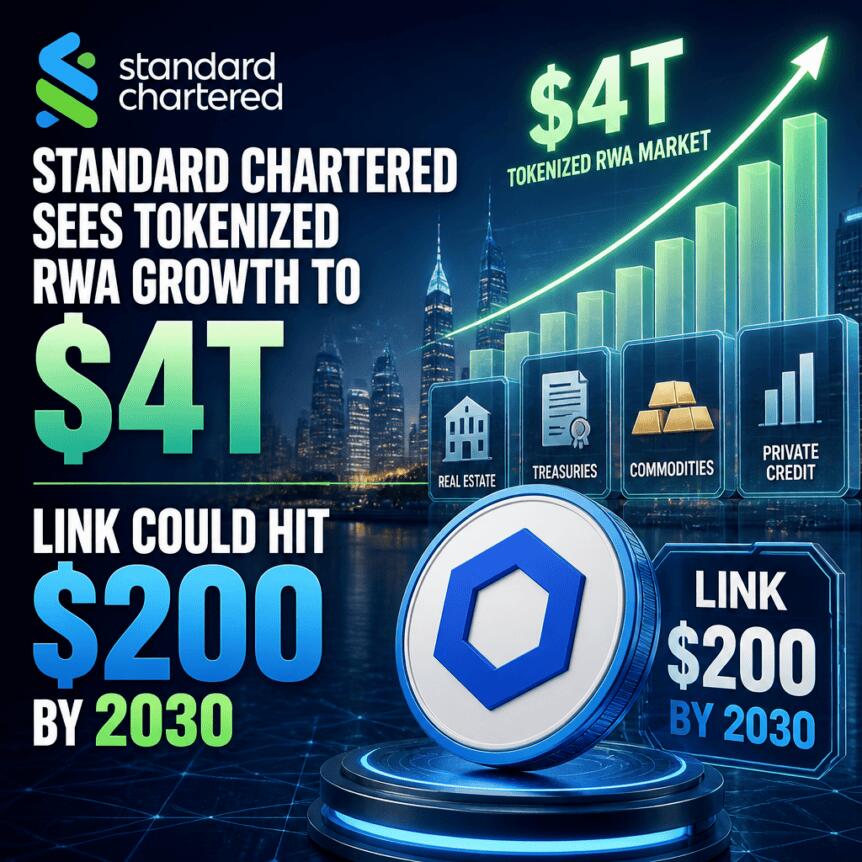
Standard Chartered’s Geoff Kendrick has outlined a bullish long-term scenario for Chainlink’s LINK token, arguing that the accelerating rollout of tokenized real-world assets could significantly expand demand for secure onchain data infrastructure.
In a Monday report shared with Cointelegraph, Kendrick suggested tokenized assets reaching $4 trillion by the end of 2028 could translate into a more than 25-fold increase in LINK by the end of the decade—potentially pushing the token toward $200 by 2030, compared with roughly $8 at the time of the analysis.
Key takeaways
- Standard Chartered forecasts tokenized real-world assets could reach $4 trillion by end-2028, which the report links to increased onchain data needs.
- Kendrick argues that securely bringing external data onchain at scale may raise Chainlink’s fee generation, supporting an end-2030 outlook of $200 for LINK.
- The bank also projected a 37-fold rise in tokenized and crypto-native assets deployed in DeFi, reaching $2.7 trillion by 2030.
- Cointelegraph notes that tokenized RWA trading on decentralized exchanges reached a new all-time high of $141 billion in July, according to CryptoRank data.
- Standard Chartered flagged several risks to its LINK price view, including slower institutional tokenization, competitive pressure from other oracle providers, and potential technical issues.
Why tokenized assets could boost oracle demand
Kendrick’s thesis centers on a practical bottleneck: as tokenized real-world assets move onto blockchains, the ecosystem increasingly depends on reliable, permissioned, and verifiable information to function correctly onchain.
According to the report, tokenized assets will require “external data” to be brought securely onchain. Kendrick linked this to potential increases in Chainlink’s fee generation, suggesting that the LINK token could benefit if tokenized asset growth translates into broader network usage.
The bank’s onchain growth scenario for DeFi and tokenization
The report does not focus solely on tokenized RWA volumes. It also points to broader DeFi expansion, forecasting a 37-fold increase in tokenized and crypto-native assets deployed in decentralized finance—rising to $2.7 trillion by the end of 2030.
To support that kind of growth, Kendrick argued these assets will need more than just tokenization mechanics. The report highlights requirements including trusted data sourcing, interoperability between networks, privacy-preserving compliance, and integrations with existing financial systems.
In Kendrick’s view, meeting these needs is a capability currently embodied by Chainlink—an argument framed around the role of decentralized oracle infrastructure and the practical integration of offchain information into onchain applications.
Market momentum: tokenized RWA activity on DEXs keeps rising
The bullish framework arrives as tokenized RWA trading activity appears to be gaining traction in public markets.
Cointelegraph cited CryptoRank data showing tokenized RWA trading on decentralized exchanges reached a new all-time high of $141 billion in July. The same dataset was described as representing a 19.5% month-over-month increase, with public equities listed as a major driver.
That growth aligns with the report’s underlying premise: if more tokenized products—particularly those tied to traditional financial instruments—are actively traded onchain, the ecosystem’s dependency on secure and interoperable data workflows tends to rise in parallel.
Chainlink’s competitive positioning and the risks to the forecast
Standard Chartered’s bullish conclusion also builds on Chainlink’s standing in the oracle sector.
The report referenced crosschain oracle infrastructure metrics compiled by data aggregation services. Cointelegraph notes that Chainlink is ranked as the leading decentralized oracle provider for crosschain communication, citing $34.4 billion in total value secured, while Chronicle is listed second with $7.36 billion, according to DefiLlama’s oracle data.
Even with that positioning, Kendrick’s report included explicit caveats. Standard Chartered said risks to its LINK price forecast include slower-than-expected institutional tokenization initiatives, competition from specialist oracle providers, and potential technical setbacks that could affect performance or adoption.
What investors should watch next
Whether LINK reaches the kind of valuation implied by Standard Chartered’s end-2030 outlook will depend on how quickly real-world asset tokenization scales beyond pilots, and whether oracle infrastructure sees sustained fee growth alongside rising onchain trading and DeFi deployment. Readers should monitor both RWA adoption metrics and signs of intensifying oracle competition or execution risk.
This article was originally published as Standard Chartered Sees Tokenized RWA Growth to $4T, LINK Could Hit $200 by 2030 on Crypto Breaking News – your trusted source for crypto news, Bitcoin news, and blockchain updates.
0
0

 Manage all your crypto, NFT and DeFi from one place
Securely connect the portfolio you’re using to start.


