
Trade Desk falls 17% on weak outlook: Should you buy the dip?

0
0
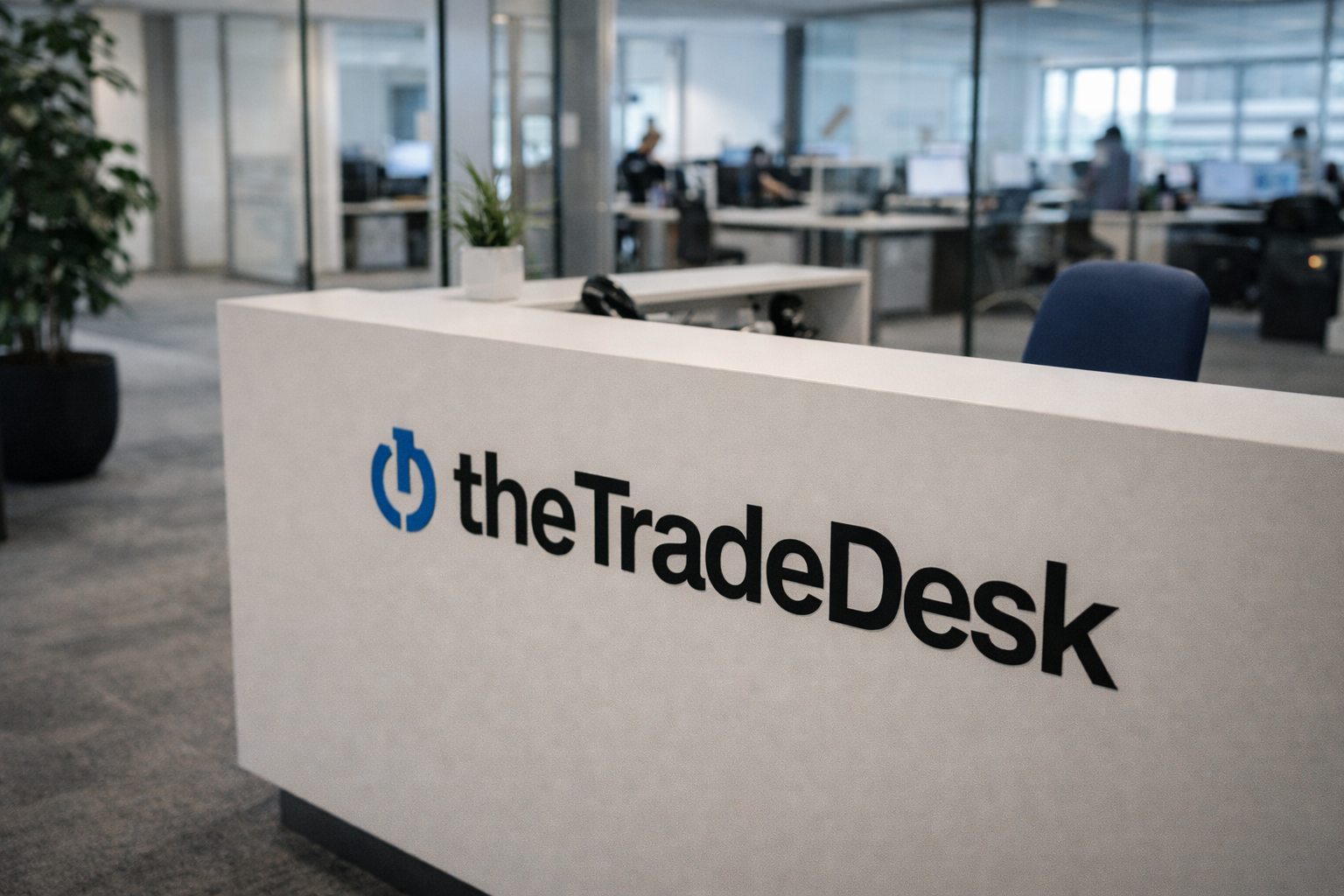
Shares of The Trade Desk fell more than 17% in premarket trading on Thursday after the advertising-technology firm projected first-quarter revenue below Wall Street expectations, intensifying concerns over a sharp slowdown in growth.
The company forecast revenue of at least $678 million for the current quarter, missing analysts’ average estimate of about $689 million, according to data compiled by LSEG.
The guidance points to a further deceleration in expansion for a business that had once been among the faster-growing names in digital advertising.
Growth slowdown gathers pace
The latest forecast implies that revenue growth could slow to roughly 10% year on year in the first quarter, down from 25.4% in the first quarter of 2025.
Growth subsequently eased to 18.7% in the second quarter, 17.7% in the third and 14.3% in the fourth.
For investors accustomed to stronger double-digit gains, the steady moderation has raised questions about competitive pressures and the broader health of advertising budgets.
Unlike “closed” digital ecosystems such as those operated by Meta Platforms or Google, Trade Desk functions as an independent platform that enables advertisers to buy placements across a wide range of websites and apps.
Its open-internet positioning has long been central to its appeal.
Competition from walled gardens intensifies
However, the company faces mounting competition from so-called walled gardens that combine content, commerce and user data within a single platform.
Amazon in particular has emerged as a formidable rival, leveraging its vast trove of first-party shopping data to strengthen its demand-side advertising platform.
"Competitor platforms that integrate content, data and commerce into a single environment incentivize ad buyers to remain within that ecosystem rather than routing it through the Trade Desk," Wedbush's Alicia Reese wrote in a note to clients ahead of earnings.
Chief executive Jeff Green has pushed back on that narrative, arguing that Trade Desk benefits from not competing directly with its own clients.
He contends that companies such as Amazon both sell advertising inventory and operate marketplaces that may compete with the brands advertising there, potentially creating conflicts of interest.
Macro pressures weigh on key sectors
On the earnings call, Green cited sustained weakness among some large consumer packaged-goods companies and parts of the automotive sector, which together account for more than a quarter of Trade Desk’s business.
“In these two categories, all global companies have levels of uncertainty that we haven’t seen for most of the last 15 years,” he said, pointing to tariff concerns and pressure on household budgets.
Many companies, he added, made difficult spending decisions in 2025 and could face further trade-offs in the months ahead.
The cautious outlook comes despite solid fourth-quarter results.
For the period ended December 31, Trade Desk reported revenue of $846.8 million, ahead of analysts’ estimates of $840.2 million.
Adjusted earnings came in at 59 cents per share, also topping expectations.
Still, investors focused squarely on forward guidance and the trajectory of growth rather than past performance.
Strategic bets and leadership changes
Trade Desk continues to invest in initiatives such as OpenPath, which allows advertisers to buy digital ad inventory directly from publishers.
The company believes these efforts will strengthen its position in connected-television advertising and the broader open internet.
Green reiterated his confidence in the long-term opportunity, particularly as the company does not own advertising inventory and can offer clients flexibility in an increasingly fragmented and, at times, oversupplied market.
He said advertisers now have more choice than ever and that Trade Desk has helped them reach relevant audiences at lower cost.
At the same time, the company has experienced leadership changes.
In January, it appointed Chief Accounting Officer Tahnil Davis as interim chief financial officer after Alex Kayyal, who had taken the role in August 2025, stepped down.
Should you buy the crash?
ouComparisons with larger peers have added to investor unease.
While Trade Desk’s growth has slowed, Meta recently reported fourth-quarter revenue growth of 24% year on year and issued a strong outlook for the first quarter, underscoring the divergent trajectories within digital advertising.
Some market commentators argue that investors can buy faster-growing, more dominant platforms at similar valuation multiples.
Others caution that if Trade Desk manages to reaccelerate revenue growth while controlling costs, the current weakness could eventually prove to be an attractive entry point.
For now, however, the combination of slowing top-line expansion, competitive pressures and macroeconomic uncertainty has left the stock under pressure.
The post Trade Desk falls 17% on weak outlook: Should you buy the dip? appeared first on Invezz
0
0
 Manage all your crypto, NFT and DeFi from one place
Securely connect the portfolio you’re using to start.