
Bitcoin CME Gap May Narrow as CME Moves Toward 24/7 Crypto Futures Trading

0
0

Bitcoin CME gap discussions are entering a new phase as CME Group prepares to introduce 24/7 trading for its regulated cryptocurrency futures and options markets beginning May 29, pending regulatory review. The move changes one of the most closely watched structural patterns in Bitcoin trading where institutional participants previously had limited access during weekends while crypto markets continued moving without interruption.
For years, the Bitcoin CME gap reflected the disconnect between nonstop crypto trading and CME’s weekday-focused derivatives schedule. Weekend price swings frequently produced visible gaps between Friday’s close and Monday’s reopening on CME futures charts. Those gaps later became a widely monitored institutional trading signal across the digital-asset market.
CME’s latest transition does not fully remove the traditional business-day structure behind regulated futures trading. Instead, it expands execution access through weekends while clearing, settlement and regulatory reporting continue operating on a weekday framework. The shift may reduce the most visible form of the Bitcoin CME gap while introducing new focus areas tied to liquidity depth and post-trade operations.
How Did the Bitcoin CME Gap Become a Major Market Indicator?
The Bitcoin CME gap became important because Bitcoin trades continuously across global crypto exchanges while CME futures historically paused during weekends. When Bitcoin prices moved sharply between Friday evening and Sunday, CME futures reopened at different levels, creating visible price gaps on institutional charts. Over time, the Bitcoin CME gap developed into more than a technical pattern.

Traders began using it to gauge institutional positioning and short-term market sentiment. The significance increased as institutional adoption of Bitcoin futures accelerated. CME stated that client demand for digital-asset risk management reached record levels, generating nearly $3 trillion in notional volume across its cryptocurrency futures and options products during 2025.
The exchange also reported year-to-date average daily volume of 407,200 contracts in 2026, up 46% from the previous year. Futures average daily volume reached 403,900 contracts, marking a 47% annual increase. Bitcoin is currently trading around $73,278.85, down 3.29% over the past 24 hours.
The asset’s market capitalization stood near $1.46 trillion following a 3.28% decline, while 24-hour trading volume rose 16.92% to $42.08 billion. The volume-to-market-cap ratio was recorded at 2.85%, reflecting continued market activity despite the broader pullback. At that scale, institutional traders faced growing pressure to manage exposure outside traditional trading hours.
What Exactly Is CME Changing in Its Crypto Trading Structure?
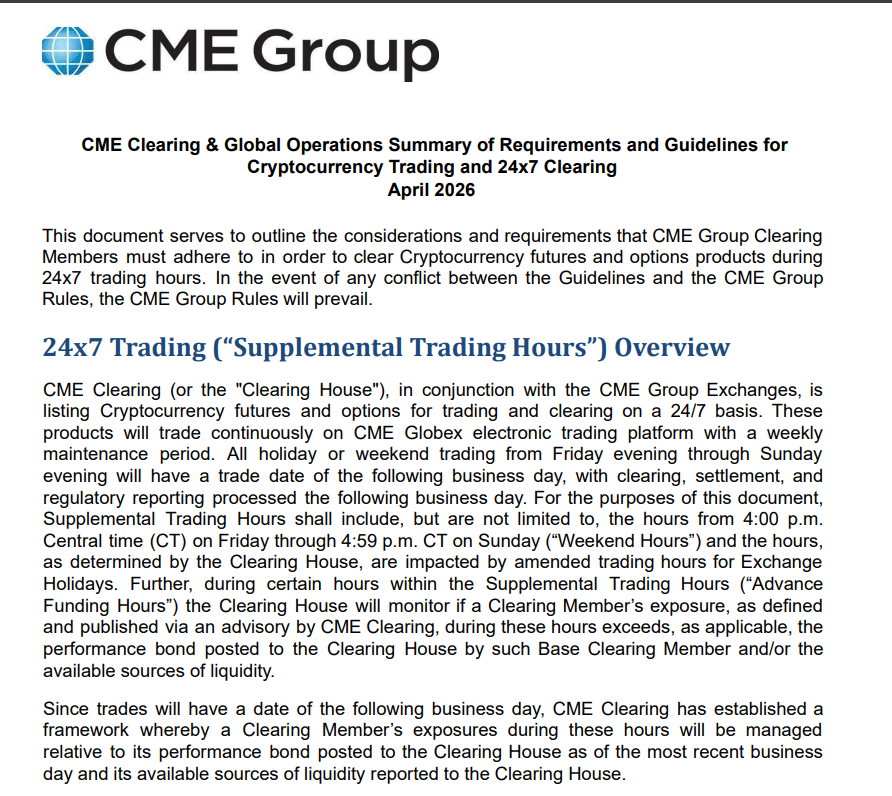
CME announced that its regulated cryptocurrency futures and options products will become available for trading 24 hours a day and seven days a week through CME Globex and ClearPort, subject to weekly two-hour maintenance windows. The expanded schedule is expected to begin on Friday, May 29 at 4:00 p.m. CT, pending regulatory approval.
The launch is designed to give institutional traders continuous access to regulated hedging instruments during weekends and holidays. That access is particularly relevant for firms managing spot Bitcoin exposure, basis trades, ETF-linked positions and volatility-driven liquidation risks. CME stated that growing institutional participation was one of the main reasons behind the operational change.
The exchange noted that continuous access allows participants to manage digital-asset exposure during periods when crypto-native markets remain active. The adjustment could significantly reduce traditional Bitcoin CME gap formations because institutional traders would no longer need to wait for Monday reopening sessions to react to major weekend price moves.
Why Do Business-Day Rules Still Matter?
Despite the shift toward continuous trading, CME’s operational framework still relies heavily on business-day procedures. Weekend trades executed from Friday evening through Sunday evening will carry the following business day’s trade date. CME also confirmed that clearing, settlement and regulatory reporting tied to weekend activity will continue to be processed on the next business day.
That distinction remains critical because it highlights the difference between execution access and post-trade processing. The Bitcoin CME gap may become less visible on charts, but operational bottlenecks tied to settlement cycles and reporting schedules could still influence institutional market behavior.
CME’s clearing guidelines also require participating firms to maintain enhanced risk controls for supplemental trading hours. Clearing members must receive CME approval and establish policies covering account monitoring, credit controls, position limits, liquidity management and overnight exposure supervision.
The exchange stated that firms participating in weekend activity must submit weekly liquidity templates and prefund anticipated weekend clearing exposure through separate settlement accounts before Friday afternoon. These measures show that while crypto prices operate continuously, the institutional systems supporting regulated futures still rely on structured weekday infrastructure.
Will All Institutional Clients Immediately Move to Seven-Day Trading?
Not necessarily. CME documents indicate that some clearing members and institutional participants may continue operating on traditional five-day schedules even after seven-day access becomes available. That could create uneven participation during the early stages of the launch.
Some firms may quickly adopt continuous trading because of ETF-linked exposure or active basis strategies. Others may delay implementation because of staffing requirements, compliance systems or internal risk-management procedures.
As a result, market participants will likely monitor which clearing members fully enable weekend access and how much institutional liquidity actually develops outside standard weekday hours. The Bitcoin CME gap may narrow structurally while participation gaps between institutions continue influencing market depth during weekends.
Could Weekend Liquidity Become the Next Major Challenge?
Liquidity quality may become the next key issue once continuous trading begins. Historically, the Bitcoin CME gap reflected visible price dislocations caused by market closures. Under the new structure, attention could shift toward whether weekend order books remain sufficiently deep and stable during volatile conditions.
If liquidity remains thin, spreads widen or market-making activity weakens during stress events, the market could remain operationally open without functioning as smoothly as weekday sessions. CME appears aware of those concerns.
Regulatory filings tied to cryptocurrency futures and options show the exchange preparing market-maker programs requiring participants to maintain continuous two-sided quotes within maximum spread limits and minimum quote sizes. The effectiveness of those programs will likely become clear during periods of elevated volatility.
Recent market analysis has also suggested that ETF-era Bitcoin liquidity tends to be stronger during weekdays and thinner during weekends, leaving smaller participants more vulnerable during sudden price swings. That dynamic means the Bitcoin CME gap discussion could gradually shift from visible chart patterns into broader concerns surrounding market depth, liquidity resilience and operational efficiency.
Why Does This Matter for ETF and Basis Trading Strategies?
The launch carries broader implications for institutional trading infrastructure beyond speculative positioning. CME’s basis trading at index close framework already supports strategies tied to CME CF reference rates across London, New York and Asia-Pacific benchmark closes.

The exchange also identified ETF creation and redemption NAV risk as a practical use case for continuous trading access. Institutional desks managing futures against spot Bitcoin positions often rely on precise hedging windows. Previously, delayed access during weekends exposed those firms to timing mismatches whenever Bitcoin prices moved sharply outside CME trading hours.
Continuous access could improve hedging flexibility for ETF-linked products and basis traders attempting to manage exposure in real time. The change may also reduce pressure that previously built into Monday reopenings after major weekend headlines or macro-driven market events.
Conclusion
Bitcoin CME gap discussions are unlikely to disappear entirely even as CME Group moves toward continuous cryptocurrency futures and options trading. The exchange’s launch addresses a major institutional limitation by allowing qualified participants to react to weekend volatility through regulated derivatives markets.
At the same time, the underlying infrastructure supporting settlement, clearing and reporting still follows a business-day clock. That means the weekend gap may migrate from visible price charts into less visible market depth and operational constraints. Liquidity conditions, clearing participation and post-trade processing efficiency could become the next factors shaping institutional Bitcoin trading behavior.
For now, CME’s 24/7 expansion represents a major structural development for regulated crypto markets. Whether it fully transforms weekend trading dynamics will depend on how institutional liquidity providers, clearing firms and market participants adapt once continuous trading officially begins.
Glossary
Bitcoin CME Gap: Weekend price gap in CME Bitcoin futures.
CME Group: Regulated exchange for crypto futures trading.
Crypto Futures: Contracts betting on future crypto prices.
Basis Trading: Trading strategy using spot and futures price gaps.
BTC Futures: Futures contracts linked to Bitcoin prices.
Frequently Asked Questions About Bitcoin CME Gap
Why does the Bitcoin CME gap happen?
The gap happens because Bitcoin trades all weekend while CME futures previously paused trading.
When will CME start 24/7 crypto futures trading?
CME plans to begin 24/7 crypto futures trading on May 29, pending approval.
Why is the Bitcoin CME gap important to traders?
Many traders use the Bitcoin CME gap to study market sentiment and price movements.
Could weekend liquidity still remain weak?
Yes, weekend liquidity may still stay lower than normal weekday trading activity.
Why does CME’s 24/7 launch matter for Bitcoin markets?
The launch could change how institutions manage Bitcoin risk during weekends.
Sources
Read More: Bitcoin CME Gap May Narrow as CME Moves Toward 24/7 Crypto Futures Trading">Bitcoin CME Gap May Narrow as CME Moves Toward 24/7 Crypto Futures Trading
0
0


 Manage all your crypto, NFT and DeFi from one place
Securely connect the portfolio you’re using to start.


0
0