
How AI Bitcoin Wallet Recovery Helps Dormant Wallet Move 5 BTC After 11 Years

0
0

AI Bitcoin wallet recovery drew fresh attention after a dormant Bitcoin wallet moved nearly 5 BTC on May 13 following more than 11 years of inactivity. Its pseudonymous owner reportedly used Anthropic’s Claude to search old files linked to the wallet.
The wallet reportedly held coins worth about $400,000 at the time of transfer. Public blockchain records showed that address 14VJySbsKraEJbtwk9ivnr1fXs6QuofuE6 distributed the Bitcoin across five transactions.
Claude’s Role in AI Bitcoin Wallet Recovery
The recovery was shared on X by an account named Cprkrn. The post drew more than 11 million views within hours and attracted reactions from crypto figures including Nic Carter and Jesse Pollak.
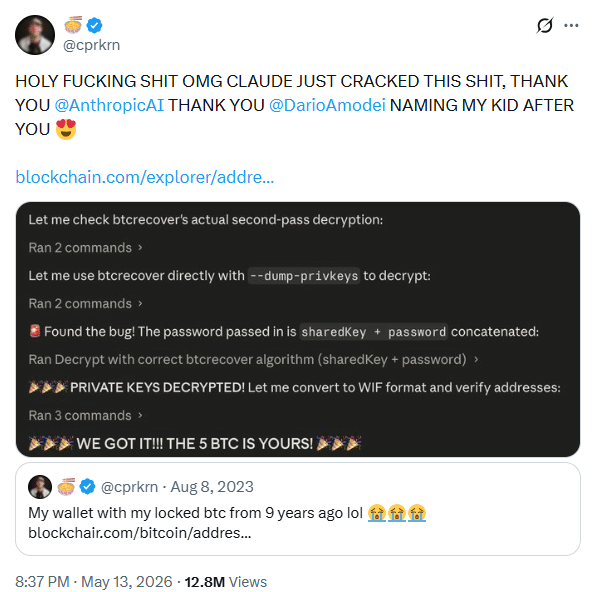
The case turned into a wider discussion about AI Bitcoin wallet recovery and its limits. It also raised questions about whether consumer AI tools can reduce the cost of searching old wallet files.
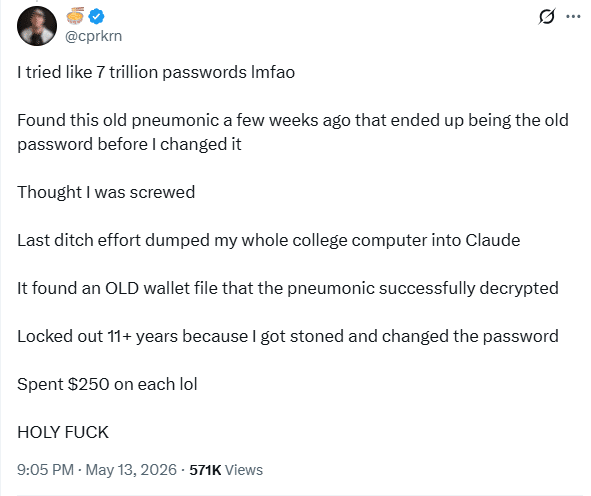
The AI did not break Bitcoin encryption. Cprkrn reportedly told Cointelegraph that he had already found a handwritten mnemonic in an old notebook before using Claude.
The AI Bitcoin wallet recovery process instead focused on file search and data sorting. Claude reviewed old devices, emails, notes, and message archives to locate clues linked to the forgotten wallet.
Claude’s Role in the Search
Claude searched through two Macs, two external hard drives, an Apple Notes export, iCloud Mail, Gmail, and X direct messages. The data reportedly totaled more than one gigabyte.
In this AI Bitcoin wallet recovery case, Claude found a wallet backup file from December 2019. That backup existed before Cprkrn changed a password on blockchain.info, which made the older file useful.
BTCRecover Detail Added Context
Claude also identified a logic detail in BTCRecover, an open-source recovery tool. The tool combines a sharedKey value with the user password during the decryption process.
That detail helped explain how the older backup could be decrypted with the mnemonic. Cprkrn said the total compute cost was about $15, far below previous recovery attempts.
Recovery Costs Face New Pressure
Commercial wallet recovery firms have long charged high fees for technical recovery work. Some services also take a percentage of recovered funds after a successful recovery.
The AI Bitcoin wallet recovery account suggests that some holders may try consumer AI tools before hiring professional services. However, this depends on having surviving files, backups, or recovery phrases.
Dormant Bitcoin Supply Remains Central
The case also revived debate over lost and inactive Bitcoin. Industry estimates often place unrecoverable Bitcoin between 2.3 million and 4 million BTC.
There is no evidence that this AI Bitcoin wallet recovery case changes those estimates in a meaningful way. Still, it shows how forgotten wallets may become recoverable when old files and human clues still exist.
Experts Say It Was Forensic Work
Wallet recovery experts told Decrypt that the screenshots appeared to show file forensics, not cryptographic cracking. Their view was that Claude helped sort large amounts of historical data and identify useful wallet clues.
That distinction matters for AI Bitcoin wallet recovery claims. The process did not defeat Bitcoin security, but it helped organize old information that a user may have missed.
Broader AI Crypto Trend
The incident comes as AI tools are being tested across crypto and finance. Revolut engineers reportedly built an AI-driven trading workflow with Claude earlier this year.
Other firms have also explored AI for market data, trading signals, and crypto infrastructure. In this case, the user relied on Claude’s consumer interface rather than a custom recovery platform.
Conclusion
The case shows how old backups, handwritten mnemonics, and forgotten files can remain important in Bitcoin recovery. Claude helped reduce the search burden, but it did not crack the wallet.
AI Bitcoin wallet recovery may become more common where users still control valid clues. The main lesson is that AI could assist forensic sorting, while Bitcoin’s encryption remains intact.
Appendix Glossary of Key Terms
Dormant Bitcoin Wallet: A Bitcoin address that has not moved funds for many years.
Mnemonic Phrase: A set of recovery words used to restore access to a crypto wallet.
Wallet Backup: A saved wallet file that may help recover old crypto funds.
BTCRecover: An open-source tool used to help recover Bitcoin wallet passwords.
File Forensics: The process of searching stored data to find useful digital evidence.
Blockchain Records: Public transaction data stored on a blockchain network.
Private Key: A secret code that gives control over funds in a crypto wallet.
Lost Bitcoin: Bitcoin that cannot be accessed because keys, passwords, or recovery phrases are missing.
Frequently Asked Questions About AI Bitcoin Wallet Recovery
1- Did Claude crack Bitcoin encryption?
No. The AI did not break Bitcoin’s encryption. It helped search old files and identify a useful wallet backup.
2- How much Bitcoin was moved?
The wallet sent roughly 5 BTC on May 13. The coins were worth about $400,000 at the time.
3- Why did the case gain attention?
The wallet had been inactive for more than 11 years. The use of Claude also raised interest in AI-assisted crypto recovery.
4- Does this mean lost Bitcoin can now be recovered easily?
No. Recovery still depends on available backups, passwords, mnemonics, or other valid clues. AI can help search data, but it cannot recover coins without useful information.
References
Read More: How AI Bitcoin Wallet Recovery Helps Dormant Wallet Move 5 BTC After 11 Years">How AI Bitcoin Wallet Recovery Helps Dormant Wallet Move 5 BTC After 11 Years
0
0


 Manage all your crypto, NFT and DeFi from one place
Securely connect the portfolio you’re using to start.

0
0

0
0

0
0
