

Crypto Market Down: A Guide to Protect and Grow Your Portfolio

Alright, let's be real. Watching your portfolio bleed red is a gut-wrenching feeling. Your first instinct is probably to hit the big red "sell" button before it all goes to zero.
We've all been there. But the most successful investors know that moves made in panic are almost always the wrong ones. So, what do you actually do when the crypto market is down? Before you do anything else, you need to pause and see what's really going on.

What to Do When the Crypto Market Is Down
The first few moments of a market dip are where the biggest mistakes happen. Reacting on impulse is a recipe for disaster. Instead, your first job is to get a clear, complete picture.
Think about it. Frantically jumping between your Coinbase account, your MetaMask wallet, and that obscure DEX you used once gives you a chaotic, fragmented view. All it does is amplify the panic as you try to piece together just how bad the damage is.
What you need is a single source of truth—one dashboard that shows every single asset you own. That’s how you get immediate clarity and shift from fear to strategy.
To get you grounded in facts, not feelings, we've put together a quick checklist. In a sea of red, your ability to make data-driven decisions is what separates a smart recovery from a costly mistake.
| Immediate Actions During a Crypto Downturn |
| :— | :— | :— |
| Action Step | Reasoning | Tool to Use |
| Get a Full Portfolio View | You can't make a plan without knowing your total exposure. Stop guessing and see your actual Profit & Loss (P&L) across every wallet and exchange. Any of the best crypto trackers will do this for you in a few minutes of setup. | CoinStats Portfolio tracker |
| Assess Your Portfolio Health | Get a clear, data-backed score on your portfolio's current standing. This metric cuts through the noise and tells you where you really are. | Portfolio Health metric |
| Set Up Smart Alerts | Stop doom-scrolling charts. Set notifications for key price points or changes in your total portfolio value so you can react based on a plan, not panic. | CoinStats automatic alerts |
By following these initial steps, you turn a moment of chaos into one of strategic assessment. You're no longer just reacting to the market's every whim.
Instead, you're armed with a clear understanding of your financial position. With that solid foundation, you can start thinking about what comes next.
Understanding Why Crypto Markets Fall
To make it through a crypto winter, you first have to understand what causes the storm. It’s almost never just one thing. Market crashes are usually a messy combination of big-picture economics, investor psychology, and crypto-native drama.
Think of the crypto market as a small, fast boat on the massive ocean of the global economy. When a central bank like the U.S. Federal Reserve raises interest rates, it’s like a storm rolling in. Suddenly, safer investments like government bonds look a lot more attractive, and money gets pulled out of “risk-on” assets like crypto.
The Ripple Effect of Economic Shifts
These macroeconomic shifts create powerful waves. We all saw this play out during the 2022-2023 market collapse, which torched about $2 trillion in value. One of the biggest triggers was the Fed’s interest rate hike in May 2022. In just over a week, Bitcoin tanked 27% and Ethereum fell 33.5%.
This link between traditional finance and crypto is real. When the economy gets tight, big institutional players are the first to de-risk their portfolios. And what's often the first thing they sell? Crypto. That massive sell pressure hits the market hard, and every retail investor feels it.
The Influence of Market Cycles and Contagion
On top of outside economic pressure, crypto has its own internal cycles. These are driven by tech breakthroughs, adoption trends, and pure sentiment. A bull market builds hype and sucks in new money, but eventually, things get overheated, and a correction is inevitable.
This is where contagion kicks in. The crypto world is deeply interconnected. When a single large exchange, lender, or project implodes, it sets off a domino effect. Fear spreads like wildfire. Investors scramble to withdraw their funds, which creates liquidity crises at other platforms, leading to even more panic selling.
Knowing this risk is crucial. It’s why having a single, clear view of all your holdings isn’t a nice-to-have; it's non-negotiable. A tool like the CoinStats Portfolio tracker gives you that complete picture, showing you exactly where your assets are and how exposed you are to any one coin or platform. With that clarity, you can check your Portfolio Health and make smart moves instead of just reacting to fear. For even deeper market insights, CoinStats AI is there to help you cut through the noise.
How One Failure Can Create a Domino Effect
In crypto, nothing exists in a vacuum. The market isn't just a big list of coins; it's a web of interconnected exchanges, lenders, and protocols. When one major player stumbles, it can pull everyone else down with it. Think of it as an avalanche started by a single falling rock.
We all saw this happen in real-time with the spectacular collapse of FTX. What started as whispers about one company's balance sheet in November 2022 quickly became a full-blown crisis. On November 10, 2022, the lending platform BlockFi slammed the brakes on withdrawals, pointing a finger at the chaos at FTX. The very next day, FTX filed for bankruptcy, and the real panic began.
The contagion spread like wildfire. Just a few days later, on November 16, Genesis Global Trading and Gemini also froze customer withdrawals. By November 28, BlockFi was officially bankrupt, stating its financial ties to FTX were the cause. You can trace the entire timeline of this domino effect, and it’s a brutal lesson in how fast things can unravel.
This whole mess taught us something vital: knowing what you own is only half the battle. Knowing where you hold it—and whether that platform is built on solid ground—is just as critical, especially when the market turns south.
Visualizing the Chain Reaction
Getting a handle on these triggers is the first step to not getting rekt in the next downturn. This chart shows how big-picture economic pressure, normal market cycles, and contagion risk can brew the perfect storm.
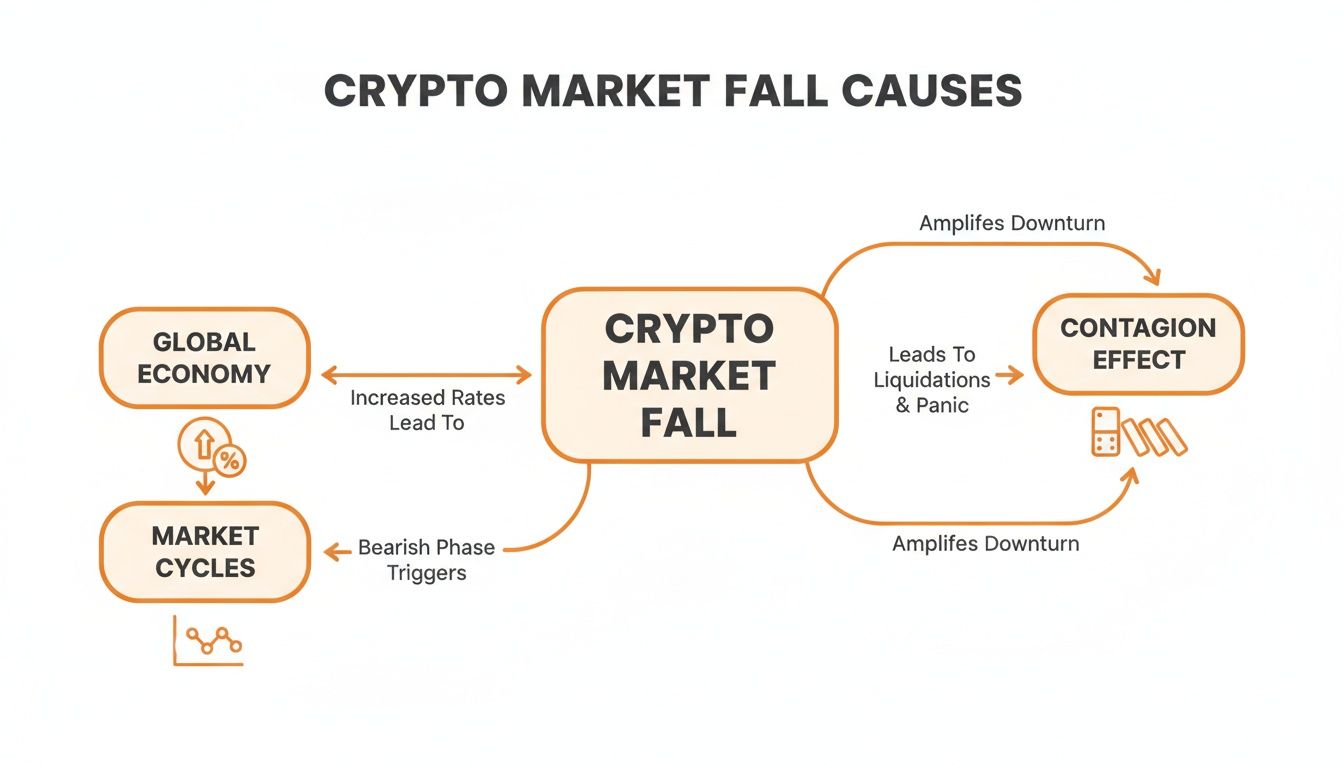
As you can see, outside economic factors might light the match, but it’s the internal contagion that turns a spark into an inferno. This all comes down to counterparty risk—the danger that the other side of your trade or deposit (like an exchange) won't be able to pay you back. When your coins are sitting on an exchange, you’re betting on that exchange not going to zero.
This is exactly why seeing your entire portfolio in one place isn't just a nice-to-have; it's non-negotiable. Without a complete picture of your holdings across every exchange and wallet, you’re flying blind to how much you could lose if one platform goes down.
Tools like the CoinStats Portfolio tracker pull everything into a single view, letting you gauge your Portfolio Health and spot where you might be too exposed. For an even deeper look, CoinStats AI offers insights to help you make sense of market movements and stay a step ahead of the fallout.
Using CoinStats to Protect Your Portfolio
Riding out a crypto downturn takes more than just a strong stomach. When the market is a sea of red, panic is your worst enemy. This is the moment to stop being a spectator and start being a strategist. Your first move? Getting a crystal-clear picture of your assets.
That means no more frantic tab-switching between exchanges and wallet apps. You need a single source of truth for your entire crypto life. During the last downturn, users who had full exposure to all their portfolios with CoinStats analytics were better able to limit their losses. You can gain this same edge with the CoinStats Portfolio tracker.
Get an Unfiltered View of Your Portfolio Health
Once your accounts are connected, it's time for an honest look at your Portfolio Health. This isn't just about how much you're down. It's a data-backed gut check that cuts through the noise of red candles and clickbait headlines, giving you a real assessment of your portfolio's condition, P&L, and risk exposure, which directly impacts your P&L improvement during a bear phase.
This is what a real command center looks like—a clean, no-BS overview of your holdings.

With your P&L, allocations, and other key metrics in one place, you finally have a solid foundation for making smart decisions instead of emotional ones.
Of course, market dips aren't the only threat. Protecting your crypto from hacks and theft is just as critical. Solid data leakage prevention strategies are non-negotiable for securing your bags. You can learn more in our guide to the best digital asset management tools out there.
Use Automatic Alerts to Manage Risk
When the market is tanking, the best feature you can have isn't a complex chart—it's a notification that lets you step away from the screen. Doomscrolling prices is a one-way ticket to anxiety and bad trades. This is exactly why so many users lean on CoinStats automatic alerts during a bear market, citing them as the most valued feature for managing risk when prices are falling.
Instead of being glued to your screen, you set custom triggers that match your personal game plan. These alerts let you execute your strategy with precision, not panic.
- Price Drop Alerts: Get pinged the second a coin hits your target price. Is it time to cut losses or a perfect buying opportunity? You decide, but you'll know instantly.
- Portfolio Value Thresholds: Set an alert for when your total portfolio value drops by a specific percentage or dollar amount. It’s a clear signal to step in and re-evaluate.
- Whale Activity Notifications: Keep an eye on the big players. Tracking significant blockchain transactions tells you when major market moves are happening.
By automating your monitoring, you trade fear for a predefined plan. These alerts are like your personal market watchdog, giving you the power to act decisively based on data, not headlines. It’s how you limit your losses and stay in control.
Advanced Bear Market Strategies and Opportunities
Alright, so you’ve battened down the hatches. Now what? It’s time to stop thinking about survival and start looking for opportunities. A crypto winter isn’t just something to grit your teeth through; it’s when the real groundwork for the next bull run gets laid.
This is about more than just HODLing. With the right moves, you can turn this period of widespread panic into a serious advantage. This is your chance to lower your average cost, scoop up solid projects at a discount, and even earn passive income on the coins you’re in for the long haul.
Turn Fear into Opportunity
When everyone is terrified, it’s often a sign to pay attention. We saw this recently when the Crypto Fear & Greed Index cratered to a score of 9 out of 100—a level of panic we hadn't seen since the 2022 crash. In just one 24-hour window, over 588,000 traders got liquidated, wiping out $2.7 billion, mostly from leveraged long positions. You can dig into the market's reaction to this mass liquidation event to see the full impact.
For anyone juggling multiple wallets and exchanges, that kind of volatility is exactly why you need a clear overview. The CoinStats Portfolio tracker gives you that full picture, letting you monitor your overall Portfolio Health and P&L in one place.
A bear market is a fire sale for the patient investor. The assets that survive and thrive are often the ones you can acquire at a deep discount when everyone else is running for the exits.
One of the best ways to play this is with dollar-cost averaging (DCA). Forget trying to perfectly time the bottom—nobody can. Instead, you invest a fixed amount of money at regular intervals. This simple move smooths out your purchase price over time and takes the sting out of volatility.
Build Your Strategy with AI-Driven Insights
Finding those undervalued gems isn't just about buying whatever's down 90%. You need to see which assets are showing relative strength even while the rest of the market is bleeding out. This is where you need an edge.
And that’s exactly where a tool like CoinStats AI comes in. It helps you cut through the noise by:
- Analyzing Market Trends: Get AI-powered summaries of what’s actually moving the market, so you’re not drowning in headlines.
- Identifying Relative Strength: Pinpoint the assets that are holding up better than their peers—a huge clue about their underlying quality.
- Gaining Deeper Insights: Use AI to make sense of complex market dynamics and decide where to place your bets for the next cycle.
Don't forget, a bear market is also the perfect time to earn passive yield on your long-term holds through staking. If you genuinely believe in a project, staking its token lets you stack more while you wait for the market to turn. For those with more experience, you can even explore ways to profit from the downturn itself; our guide on how to short crypto breaks down advanced strategies for traders.
How to Prepare for the Next Market Cycle
Every crypto winter ends. The real question is, what will you have to show for it? The quiet of a bear market is the perfect time to stop stressing about the red charts and start preparing for the next bull run. When the "crypto market down" trend finally flips, you want to be ready to ride the wave, not get caught swimming.
This isn’t a crisis; it’s the off-season. The discipline you build and the homework you do now is what separates the lucky tourists from the serious investors. It’s a rare chance to build a smarter foundation before the FOMO kicks in again.
Refine Your Strategy and Mindset
First things first: zoom out. A bear market gives you the breathing room to actually think, learn from your mistakes, and sharpen your investment thesis without the noise of a raging bull market screaming at you.
Think of it like a pro athlete in the off-season. This is where you hit the gym, study the playbook, and get your fundamentals right. For an investor, that means:
- Do the Homework: Actually dive deep into the projects you like. Read the whitepapers. Understand the tokenomics. Figure out what real-world problem they’re trying to solve.
- Set Your Rules: Write down your own personal investment rules. What’s your entry signal? Your exit signal? How much risk are you really willing to take? Getting this on paper now will save you from making emotional, gut-wrenching decisions later.
A bear market is a wealth transfer from the impatient to the patient. Your goal is to use this time to ensure you’re on the right side of that transfer by building a robust, data-driven system.
This is also the perfect moment to get a real grip on your toolkit. Getting a full picture of your holdings with a tool like the CoinStats Portfolio tracker lets you analyze your Portfolio Health and see your true allocation. For an even deeper look, CoinStats AI can help you spot long-term trends you might otherwise miss.
Combine that deep knowledge with powerful analytics, and you’ve just turned a period of market fear into your most productive training camp. If you want to go deeper on structuring your holdings for the long haul, check out our guide on crypto asset allocation.
Frequently Asked Questions
When the charts are all red, the questions start flying. It’s easy to get caught in the FUD and wonder if you're making the right moves.
Let's cut through the noise. Here are the straight answers to the questions we all face when the market tanks.
Should I Sell Everything When the Crypto Market Is Down?
The short answer: probably not. Panic selling into a sea of red is usually a fast track to regret. Your first move shouldn’t be hitting the sell button, but getting a clear, honest look at where you actually stand.
Fire up the CoinStats Portfolio tracker. It gives you the full, unvarnished picture of your P&L across every wallet and exchange you own. No more guesswork.
Once you see your real numbers, ask yourself why you bought each asset in the first place. Has the fundamental reason changed? If not, holding or even dollar-cost averaging is often the smarter play. Selling should be a strategic exit, not a gut reaction.
How Can I Tell a Dip from a Prolonged Crash?
There’s no crystal ball, but there are clues. Think of it like this: a dip is often a localized storm, usually kicked off by a specific news event or a temporary shift in sentiment. It might be sharp, but the bounce-back can be just as quick.
A full-blown crash or bear market feels different. It’s more like a change in seasons, tied to massive macroeconomic shifts (think global recessions) or deep, systemic problems within the crypto industry itself.
You don't have to guess. Use data-driven tools to check market sentiment, or turn to the insights from CoinStats AI. It can help you make a much more educated call on whether you're facing a brief shower or a long crypto winter.
What Is the Most Important CoinStats Feature in a Crash?
During a crash, the best feature is the one that lets you stick to your plan without letting emotion take the wheel. For thousands of users, that tool is CoinStats automatic alerts. They are your tireless market watchdogs.
These alerts were a lifesaver for our users during past downturns. You can set custom notifications for specific price drops, changes in your total portfolio value, or big market movements.
This means you can step away from the charts, knowing you’ll be notified when it’s time to act. It forces you to execute your strategy, not your fear, and is one of the best ways to protect your portfolio's Portfolio Health.
Ready to take control of your crypto journey, even when the market is down? With CoinStats, you get a complete view of all your assets in one place, powerful analytics to assess your portfolio's health, and automatic alerts to execute your strategy with precision. Stop reacting and start strategizing by exploring the CoinStats Portfolio tracker today.