Difference Between Stop and Limit Order: 2026 Crypto Guide

You buy a coin, set what you think is a sensible exit, walk away for an hour, and come back to a fill price that makes no sense. That's a normal crypto lesson. It's also an expensive one.
Most traders don't blow up because they can't read a chart. They blow up because they use the wrong order for the market they're in. In stocks, that mistake can hurt. In crypto, where trading never sleeps and liquidity can disappear fast, it can get brutal.
The difference between stop and limit order types looks simple on paper. In real trading, it decides whether you get out fast, get your exact price, or get neither.
Feeding a trading tool? See price data API alternatives.
Why Your Crypto Order Type Matters More Than You Think
A lot of order-type advice still comes from stock market education. That's part of the problem. Crypto doesn't trade on a neat schedule, and many pairs don't have deep books when volatility hits.
If you trade majors on large venues, you can get away with generic advice more often. If you trade lower-liquidity altcoins, newer listings, or anything that can gap hard on news, generic advice stops being useful fast.
The mistake most newer traders make
They assume a stop order means, “sell me at this price,” and a limit order means, “wait for this price.” That's too simplistic for crypto.
What matters is this:
| Order type | What you control | What you give up | Best fit |
|---|---|---|---|
| Stop order | The trigger level | The final execution price | Fast exits, damage control |
| Limit order | The execution price | Any guarantee of getting filled | Precise entries and take-profits |
That trade-off gets sharper in crypto because markets can move through your level before the book has enough liquidity to fill cleanly.
Practical rule: If your first thought is “I need out no matter what,” you're thinking in stop-order terms. If your first thought is “I refuse to trade worse than this price,” you're thinking in limit-order terms.
Why this matters beyond retail trading
Even if you're not trying to trade full time, execution skill matters. It's one of the habits that separates casual guessing from professional process. If you're curious what that process looks like in actual markets, these top crypto trader jobs give a useful look at how serious trading roles think about risk, discipline, and execution.
The point isn't to overcomplicate a simple topic. It's to stop treating order types like a checkbox on the ticket. In crypto, they're part of the strategy itself.
Understanding Stop Orders The Volatility Trigger
A stop order is a trigger. It does nothing until price hits your stop level. Once that happens, the order wakes up and turns into a market order.
That second step is the part traders miss.
You choose the trigger price. You do not choose the final fill price after the trigger. The exchange fills you at the next available prices in the book.
How a stop order actually works
Think of a stop order like a tripwire on a door.
- You set the tripwire at a price level.
- Market price touches or crosses that level.
- Your order fires.
- The exchange tries to fill it immediately at available market prices.
For a sell stop, traders usually place the stop below the current market to cap downside. For a buy stop, traders usually place it above the market to enter on strength or a breakout.
That's why stop orders are mostly about automation and protection, not price precision.
Where stop orders work well
They're useful when hesitation is a primary danger. If you know you freeze during sharp selloffs, a stop order can remove the decision in the moment.
They also help when you don't want to babysit a chart all day. Crypto trades nonstop. A stop order lets you define your line in the sand before the market tests it.
A stop order answers one question well: “At what point do I need to act?”
The risk you're accepting
The weak point is slippage. Once the stop triggers, your order competes with every other trader trying to exit or enter at the same time. If liquidity is thin, the fill can land well away from your trigger.
This matters even more on coins that trade in bursts, not smooth waves. A small-cap token can print one price, then the next meaningful liquidity might sit much lower.
Here's the cleanest way to remember it:
- A stop order protects against inaction.
- A stop order does not protect your exact exit price.
- A stop order is strongest when execution matters more than precision.
If you track a major asset like Ethereum market data, you'll notice how differently price behaves during calm sessions versus sudden repricings. That's exactly why stop orders need context. The same setup can behave reasonably in a liquid market and terribly in a disorderly one.
Understanding Limit Orders The Price Guarantee
A limit order is the opposite mindset. You're telling the exchange: execute only at my price or better.
That rule applies whether you're buying or selling. A buy limit sets the highest price you're willing to pay. A sell limit sets the lowest price you're willing to accept.
If the market never reaches that price, nothing happens.
Why limit orders feel cleaner
A limit order is built for control. You define the terms, then wait.
That makes it useful for patient traders who already know where they want to do business. If you've marked a support level where you want to buy, or a resistance area where you want to take profit, a limit order lets you commit without chasing.
Here's the basic logic:
- Buy limit: below current market, when you want to buy a dip.
- Sell limit: above current market, when you want to sell into strength.
- Result: price protection, but no promise the order fills.
What limit orders don't solve
A limit order can leave you behind. That's not a flaw. It's the cost of insisting on your price.
Suppose a coin dips close to your entry, front-runs the level, then rips higher. Your limit order stays untouched. The market gave you almost what you wanted, but not exactly.
That's frustrating, but it's also the deal you made. Limit orders reward discipline. They also punish traders who set unrealistic levels and then blame the order for not filling.
If your plan depends on “close enough,” a pure limit order may be too rigid for the way you trade.
Where they shine in crypto
Limit orders tend to work best when you want to avoid emotional decisions. They're useful for:
- Buying planned dips: You choose the level in advance instead of panic-buying a bounce.
- Scaling out of winners: You can ladder sell limits above current price to take profit into strength.
- Avoiding bad fills: On jumpy pairs, a limit keeps you from accepting a worse execution than you intended.
That last point is the core of the difference between stop and limit order behavior. A stop order says, “get me moving when this level breaks.” A limit order says, “only trade if I get acceptable pricing.”
Stop vs Limit Order The Core Differences
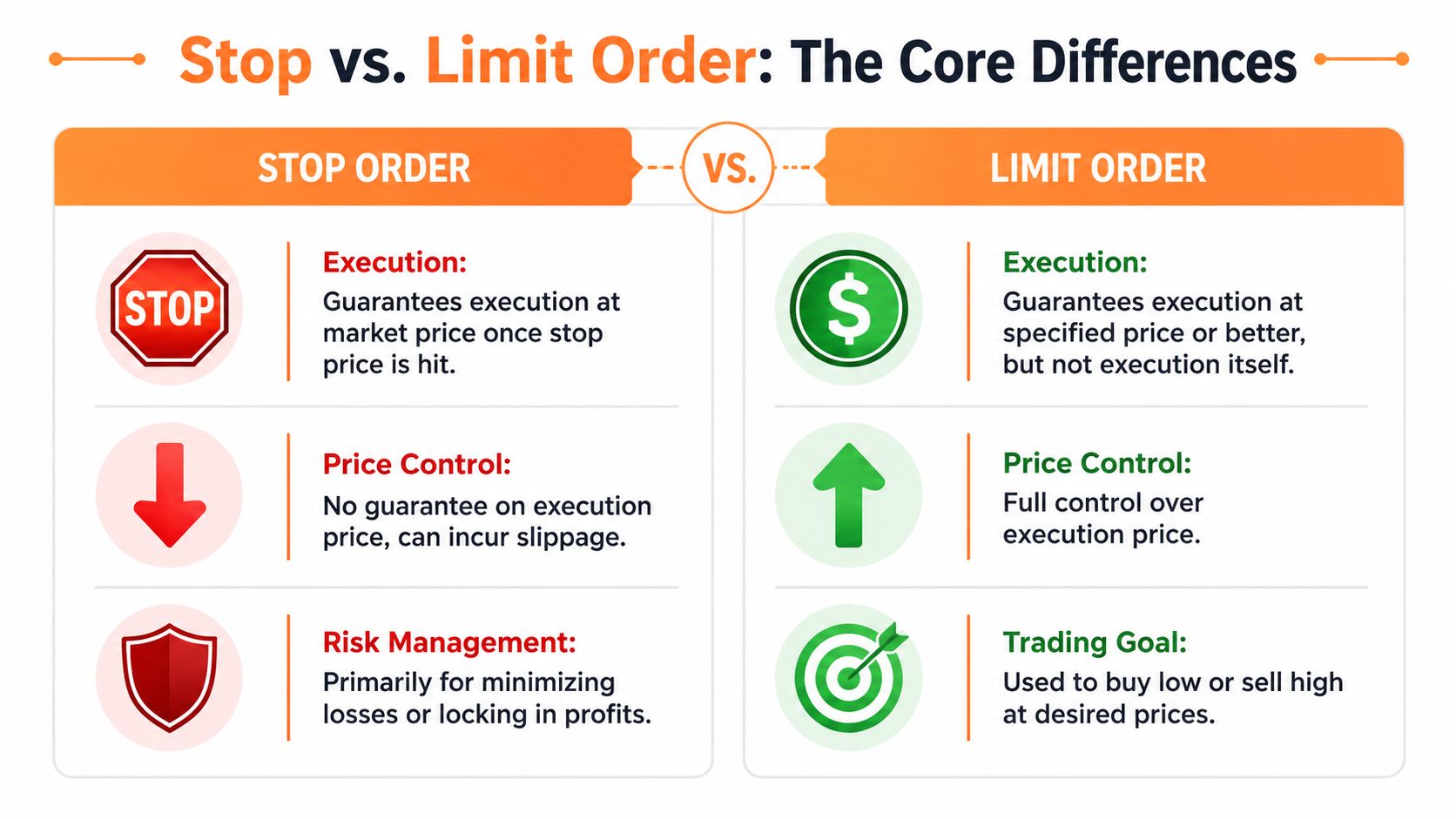
Most confusion disappears once you separate trigger from execution. A stop order is built around a trigger. A limit order is built around an execution boundary.
That sounds small, but it changes how each order behaves when crypto gets messy.
Side by side comparison
| Feature | Stop order | Limit order |
|---|---|---|
| Primary purpose | Protect capital or enter on confirmation | Control entry or exit price |
| Activation | Triggers when stop price is reached | Rests in the book at your chosen price |
| Fill logic | Becomes a market order after trigger | Fills only at limit price or better |
| Price certainty | Low | High |
| Execution certainty | Higher after trigger, but price may vary | Lower, because the market may never trade there |
| Main risk | Slippage | Missed fill |
That's the practical difference between stop and limit order choices in one view. One favors action. The other favors control.
The stop-limit wrinkle
There's also a hybrid. A stop-limit order triggers at one price and then places a limit order instead of a market order. That gives you a trigger plus price protection.
The trade-off is clear in KuCoin's explanation of stop market and stop-limit orders. Once the stop price is hit, the stop-limit becomes a limit order and only executes at the specified limit price or better. If price gaps past that level in a fast crypto move, the order can remain unfilled, while a stop market order would execute without that same price control (KuCoin's stop market vs stop-limit guide).
That makes stop-limit orders useful, but only when you fully accept the possibility of no fill.
A practical decision filter
Ask these questions before placing the order:
Do I care more about getting out, or about the exact price?
If getting out matters most, stop logic usually fits better.Is this market liquid enough to trust a triggered exit?
If the book is thin, a stop can still fill badly.Am I entering, taking profit, or defending capital?
Limit orders usually fit planned entries and profit targets. Stop orders usually fit defense and momentum entries.
Decision test: If a missed fill would hurt more than a bad fill, lean toward a stop. If a bad fill would hurt more than a missed fill, lean toward a limit.
What experienced traders usually avoid
They don't use one order type for everything. That's the beginner mistake.
A trader might buy with a limit order, protect with a stop, and take profit with another limit. The order type should match the job. Once you see it that way, the difference between stop and limit order use becomes much more practical and much less theoretical.
When to Use Each Order in Real Crypto Scenarios
Definitions are fine. Trading decisions happen in messy conditions, not neat examples.
Here's where each order tends to make sense.
Taking profit on a fast altcoin run
You're up hard on an altcoin after a sharp move. You don't want to guess the exact top, but you also don't want to dump at any random price.
A sell limit order often makes the most sense here. You can place one or several profit targets above current price and let the market come to you. If the rally continues, you get paid at your chosen levels or better.
This works especially well when you're not under pressure. You're not trying to escape damage. You're trying to sell strength on your terms.
Buying a correction without chasing
You want exposure, but current price feels stretched. A buy limit order lets you name the level where the trade becomes attractive.
That's cleaner than waiting with your finger on the button and then entering emotionally. It also keeps you from converting a planned dip buy into an impulsive market buy after the first green candle.
If you're watching a major asset and waiting for a better entry, tracking Bitcoin live market action can help you define levels before momentum pulls you into a rushed decision.
Protecting capital in a thin market
The situation becomes uncomfortable. You buy a low-liquidity token. News hits, liquidity disappears, and everyone heads for the exit at once.
A stop order can still be useful because you may care more about getting out than about the exact print. But you need to respect what can happen in a vacuum. During the May 6, 2010 Flash Crash, the Dow plunged 9% in minutes, and over 20,000 trades executed at prices 60% or more away from pre-crash levels, with stop orders playing a major role in those cascading market sell-offs, according to the SEC investor bulletin on stop and limit orders.
That wasn't crypto, but the mechanics are familiar to anyone who's traded a violent crypto unwind. The lesson is simple. A stop order can save you from staying in a collapsing market, but it can't promise a graceful exit when liquidity vanishes.
In a real panic, the market doesn't care where you hoped to get filled.
A quick scenario map
| Situation | Better fit | Why |
|---|---|---|
| Planned dip entry | Buy limit | You want a specific price |
| Planned profit-taking | Sell limit | You want to exit into strength at your terms |
| Emergency downside protection | Sell stop | You need an automatic exit trigger |
| Breakout entry | Buy stop | You only want in after confirmation |
The right answer depends less on the coin and more on the job the order needs to do.
Combining Concepts with Stop-Limit Orders
A stop-limit order combines both ideas. You choose a stop price that activates the order, and a limit price that sets the worst price you'll accept.
That gives you more control than a plain stop order. It also creates a new failure point.
How the two prices work together
For a sell stop-limit, the stop is the trigger. Once market price hits that stop, the exchange places a sell limit order at your chosen limit price.
So the order has two separate decisions built in:
- When should this order activate?
- What's the lowest acceptable fill once it activates?
That sounds elegant because it is. But it only works when price trades through your acceptable range with enough liquidity to fill you.
Where stop-limit orders help
They're useful when a plain stop feels too loose, especially on assets that can spike through levels and snap back. You may want the automation of a stop, but not the open-ended price risk that comes with becoming a market order.
For many traders, stop-limit orders make sense when:
- The market is liquid enough that gaps are less violent.
- The position is large enough that execution quality matters a lot.
- The level is technical and you don't want a terrible print far below it.
The trap
The trap is non-execution.
If the market gaps through both your stop and your limit, your order triggers but doesn't fill. That can leave you holding the position while price keeps moving against you.
This is why stop-limit orders aren't “better” than stop orders. They solve one problem and create another.
Trader's rule of thumb: Use stop-limit orders when you need protection from bad fills. Don't use them when failure to exit is the bigger danger.
That's the whole game. Every order type is a trade-off. The trader who understands that usually manages risk better than the trader looking for a perfect setting.
Manage Your Trading Strategy with CoinStats
Good execution starts before you place the order. You need to know your levels, track your exposure, and keep your positions visible across wallets and exchanges.
That's where tools matter. A dashboard helps you spot when your planned stop is too tight, when your profit target sits in a messy area, or when your total exposure is larger than you thought.
A practical workflow looks like this:
- Use alerts before execution: Set price alerts so you're not making order decisions in a panic.
- Review positions in one place: A unified tracker makes it easier to see whether you're stacking similar risks across accounts.
- Check stablecoin exposure too: If you're parking funds between trades, even something as basic as monitoring Tether price and market data can help keep your account context clear.
The true edge isn't just knowing the difference between stop and limit order types. It's applying that knowledge consistently. Traders usually make their worst execution mistakes when they're fragmented across apps, reacting late, or placing orders without seeing the full portfolio.
If you want fewer rushed decisions, better awareness of open risk, and cleaner planning around entries and exits, use tools that keep the whole picture in front of you.
If you want one place to track holdings, watch key levels, and make smarter decisions around stop, limit, and stop-limit setups, try CoinStats. You can monitor your portfolio with the CoinStats Portfolio Tracker and explore market insights with CoinStats AI.