Best Crypto Wallet APIs for Developers 2026

Written by Tigran Mkrtchyan · Reviewed and fact-checked by Narek Gevorgyan · Published May 20, 2026 · Last updated September 7, 2026
Crypto wallet data sits at the center of every onchain app. Portfolio trackers, tax tools, AI agents, DeFi dashboards: they all need it.
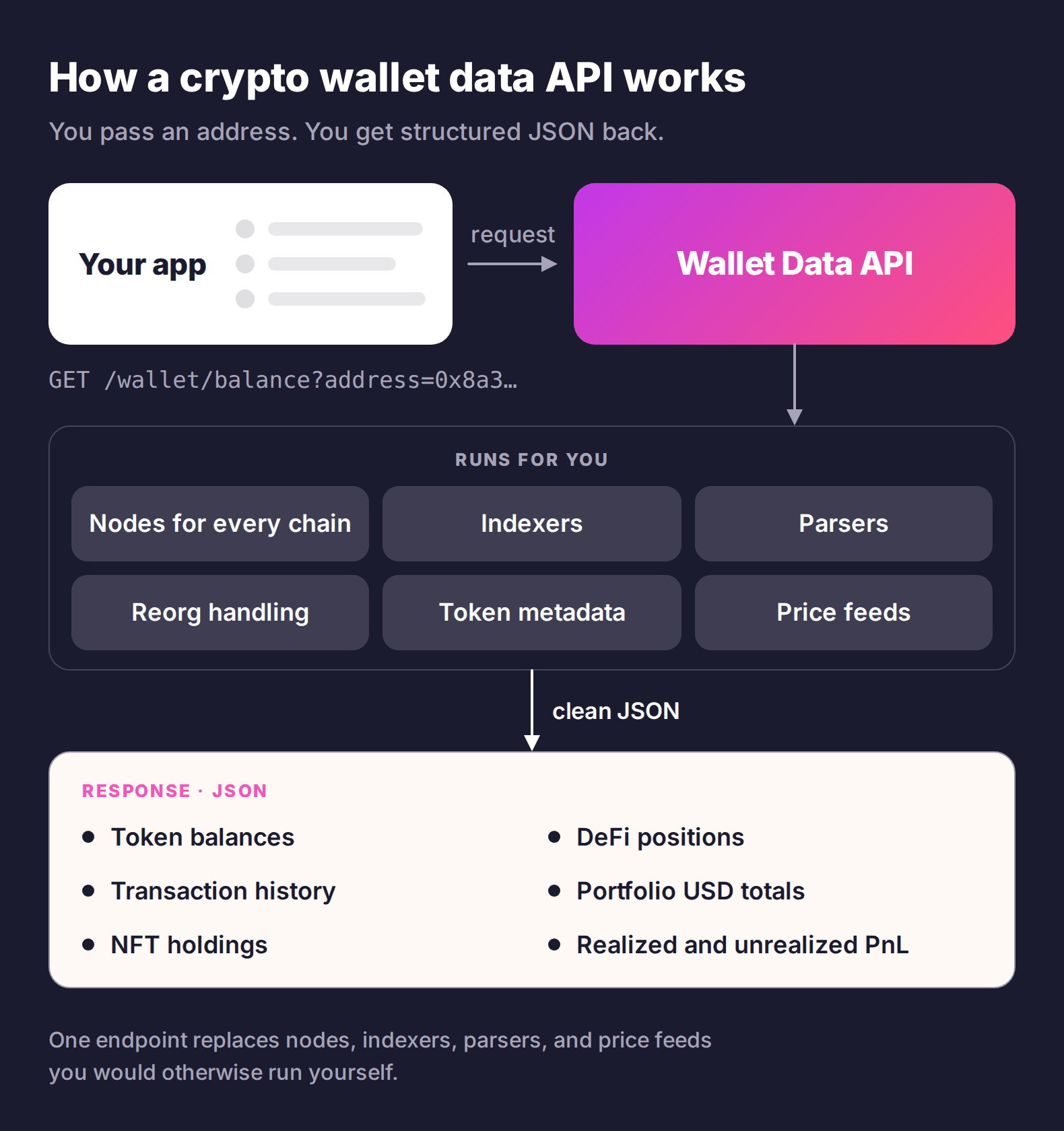
Building it from scratch is brutal. Nodes for every chain. Indexers. Parsers. Reorg handling. Token metadata. Price feeds. Months of work before you ship a single feature.
A crypto wallet data API replaces that stack with one endpoint. You query an address. You get balances, transactions, NFTs, and DeFi positions back as clean JSON.
This guide ranks the five best wallet APIs developers use in 2026. We cover what they support, who they fit, and where they trade off. Wallet APIs are one slice of the broader crypto API landscape. This guide is specific to wallet-level data. If you are still weighing the wider field, our guide on how to choose a blockchain API covers the selection criteria.
The winner is CoinStats. The runners-up are strong in narrower lanes.
Want one key for everything? See these all-in-one crypto API alternatives.
On the EVM side, pair it with a purpose-built Ethereum wallet API.
New to this? Learn what a blockchain API is and how it works.
What Is a Crypto Wallet Data API?
A crypto wallet data API exposes blockchain wallet data through HTTP requests. You pass an address. You get structured JSON back.
The data covers everything a wallet shows on screen. Token balances. NFTs. Transaction history. DeFi positions. Profit and loss. All of it without running your own nodes.
This matters because raw blockchain data is fragmented. Every chain has its own RPC interface. Managed RPC node providers smooth that over, but they stop at raw data. Every protocol has its own contracts. A crypto token balance api for five chains is already a serious build. For 50 chains, it’s a full-time team.
A wallet data API does the heavy lifting upstream. The provider runs the nodes. Indexes the blocks. Parses smart contract events. Resolves DeFi positions to readable values. Calculates USD prices. The output is uniform across every chain.
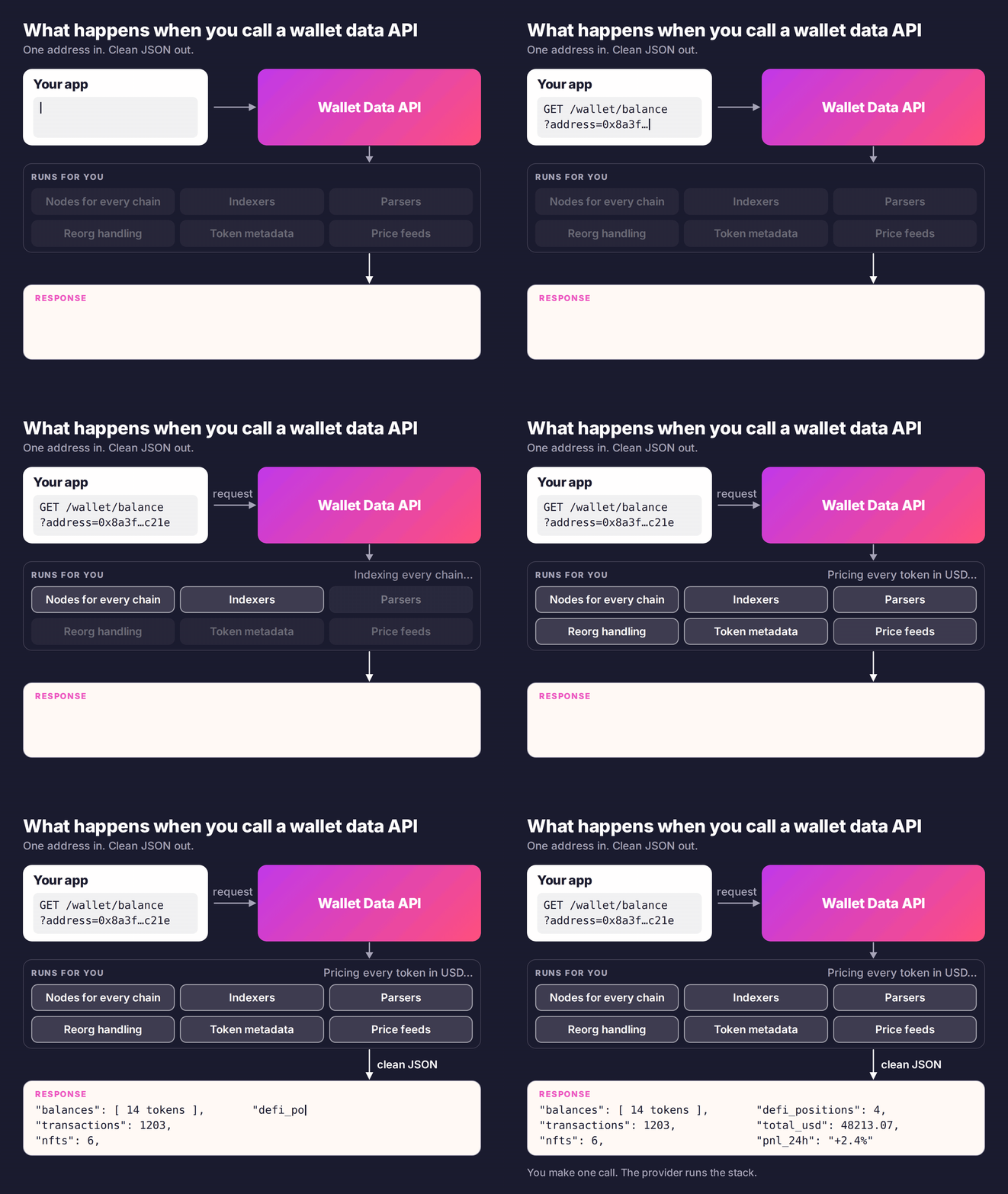
Most providers ship REST endpoints. Some add GraphQL. Some add webhooks for real-time updates. The shape of the data varies a lot. Some return raw events. Others return pre-enriched portfolio views with token logos, USD values, and PnL already attached.
A typical wallet API exposes these data types:
- Token balances across native and ERC-20 tokens
- Transaction history with timestamps and counterparties
- NFT holdings including metadata and traits
- DeFi positions like staking, lending, and LP shares
- Portfolio summaries with USD totals and asset allocation
- PnL for realized and unrealized gains
Prefer one key for everything? See all-in-one API alternatives.
Use Cases for a Crypto Wallet Data API
Wallet data sits behind most onchain products. Five use cases dominate the requests we see.
Portfolio trackers. Show users their holdings, allocation, and PnL across wallets and chains. A multichain portfolio api is the core dependency. It pulls balances and DeFi positions into one view without per-chain integration work.
Trading and signal apps. Combine wallet balances with market data to inform decisions. Bots monitor positions. Dashboards flag opportunities. Real-time pricing matters more than historical depth here.
Crypto tax and accounting. Reconcile every transaction across every chain a user has touched. A crypto wallet transaction history api is the spine of any tax tool. It needs timestamps, token identifiers, USD values at the time of transfer, and cost-basis-ready output.
DeFi dashboards. Track lending, borrowing, LP positions, and yield farming per wallet. A crypto wallet defi positions api has to resolve protocol contracts to readable values. Principal, interest, rewards owed, debt. Coverage depth matters more than chain count. For a side-by-side look at providers focused on this layer, see our best DeFi APIs guide.
AI crypto assistants. LLM-powered agents query wallets through natural language. Modern wallet APIs ship MCP servers so agents can call tools without custom glue code. Claude, Cursor, and N8N all connect this way.
Block explorers and wallet apps. Surface balances, transaction details, and activity feeds inside consumer products. Wallets like Phantom and MetaMask use wallet data APIs to power their UIs at scale.
How to Choose Your Wallet Data API
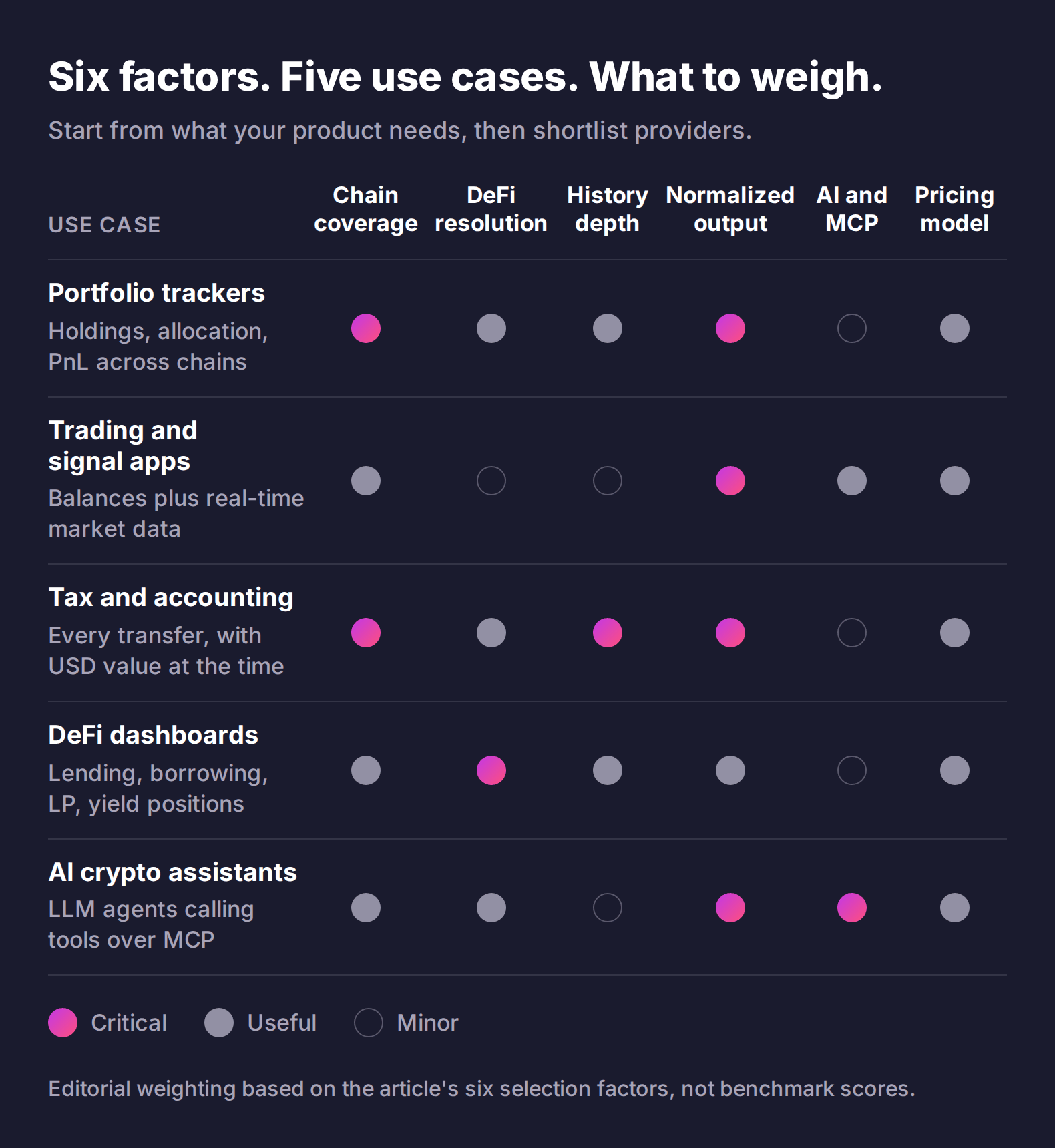
Six factors separate the right wallet data api from the wrong one.
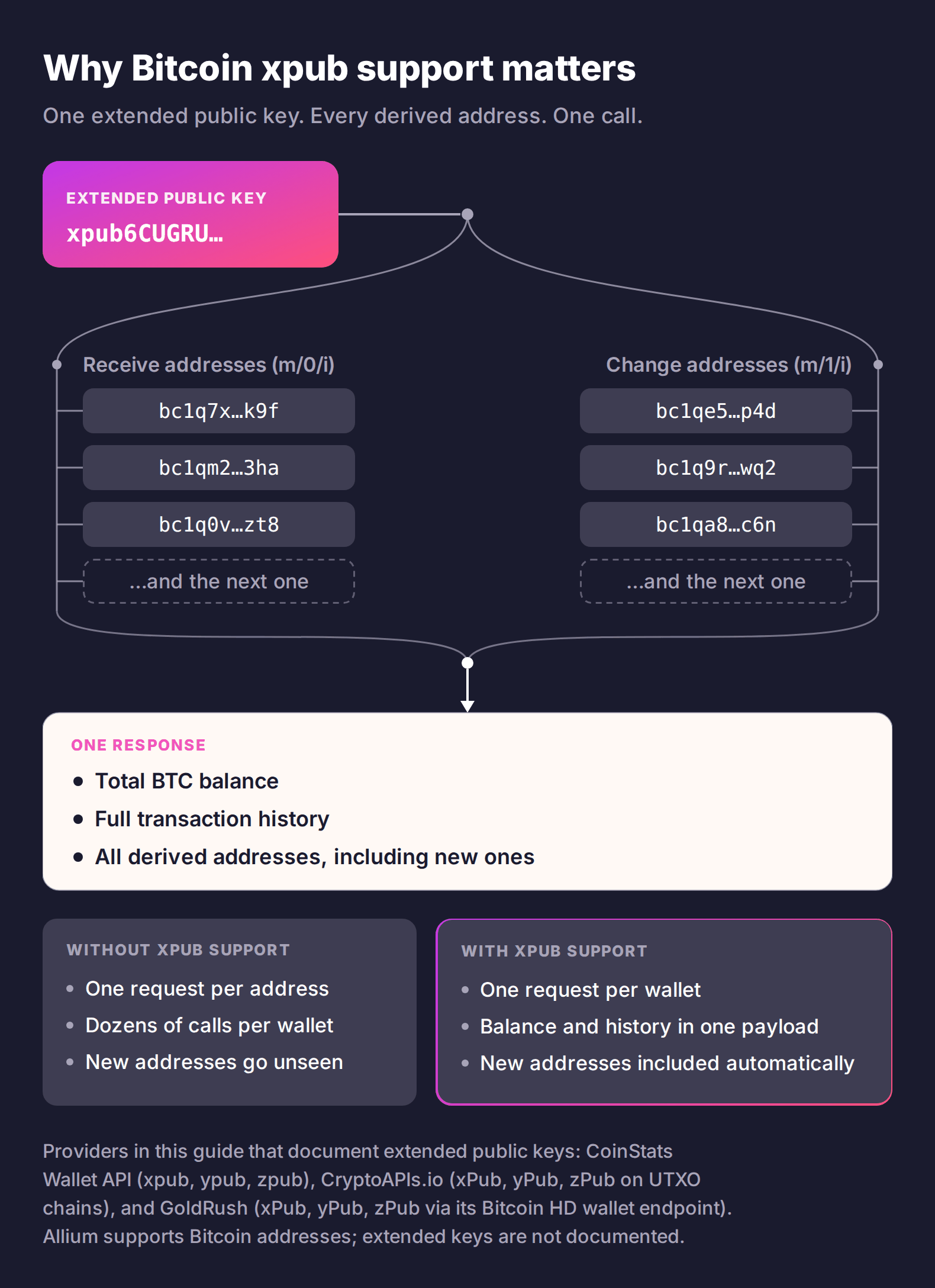
Chain coverage. Count the chains you actually need. Some providers cover 30 EVM chains and call it broad. Others stretch to 150+ across EVM, Solana, Bitcoin, Cardano, and beyond. If your users hold BTC, look for native Bitcoin xpub key support.
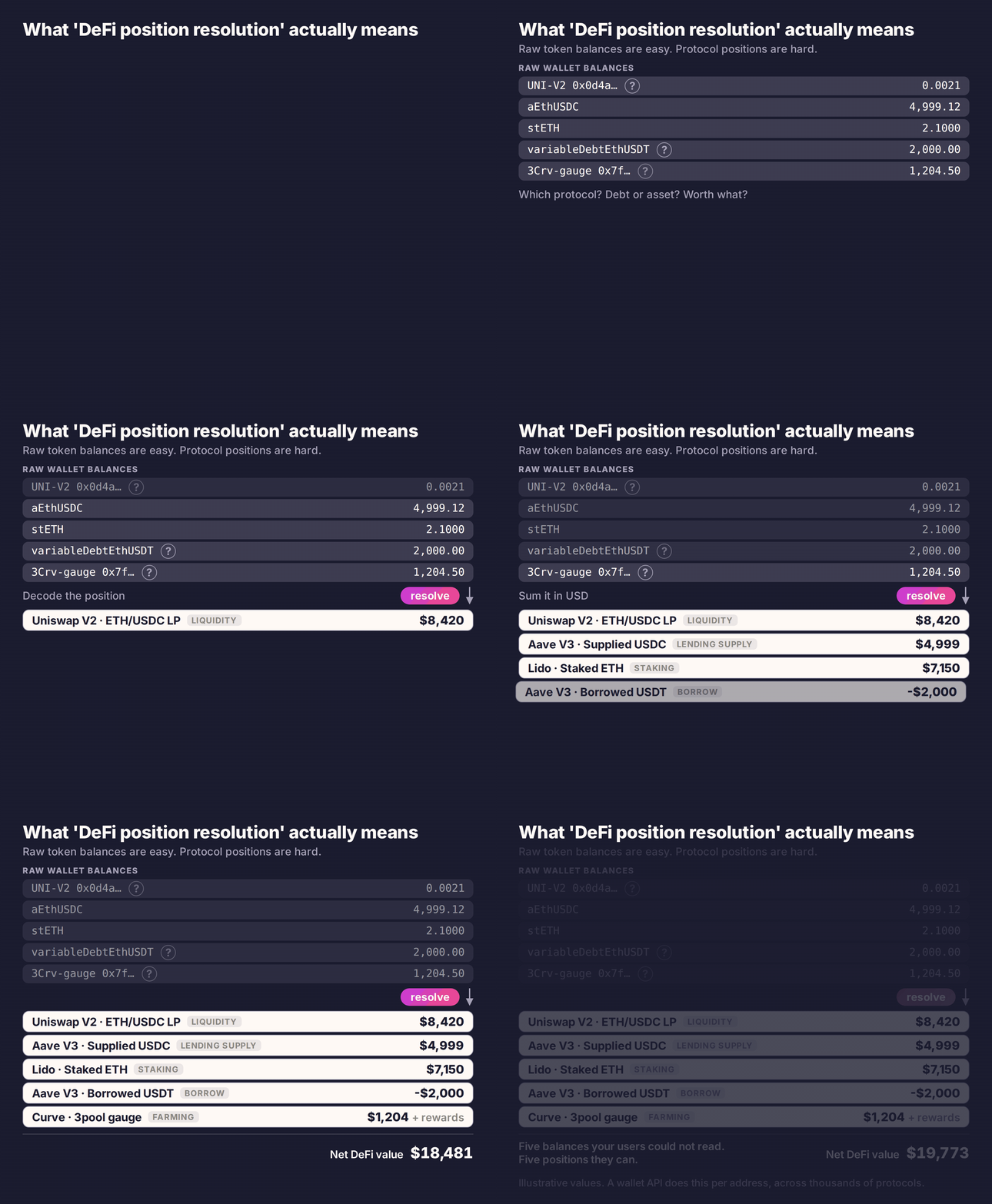
DeFi position resolution. Token balances are easy. Protocol-level positions are hard. A wallet with USDC supplied on Aave should show its supplied position with APY. Not a raw aToken balance. Coverage measured in protocol count is the metric to watch.
Transaction history depth. Some APIs return the last 1,000 transactions. Others go back to the genesis block. Tax tools and accounting workflows need the full history. Real-time apps usually do not.
Response normalization. Two APIs can both return wallet balances and still ship completely different schemas. Pre-enriched responses with USD values, token logos, and price changes are faster to integrate. Raw responses give you more control.
AI and MCP support. AI agents need structured tool access. The newer wallet APIs ship MCP servers. These plug directly into Claude, Cursor, and N8N. Without one, your agent integration becomes glue code.
Pricing model. Flat tiers, credit-based, request-based, or enterprise contracts only. Free tiers matter for prototyping. Credit-based pricing scales smoothly with usage. Enterprise-only providers usually mean a sales call before you can test.
The Top 5 Crypto Wallet Data APIs in 2026
Each API below covers wallet data, but the strengths and tradeoffs differ a lot. Here are the five we’d pick from in 2026, starting with the broadest fit.
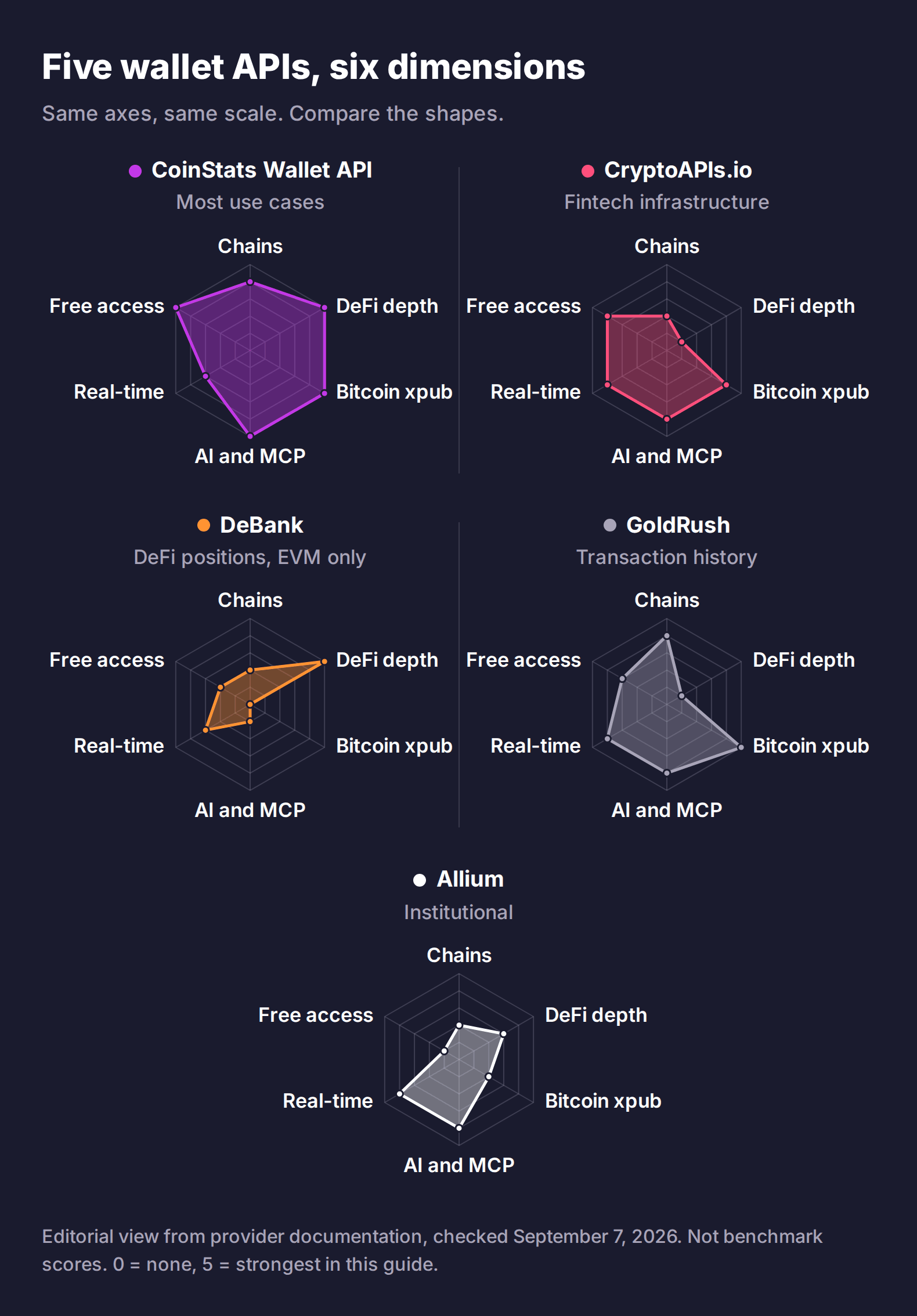
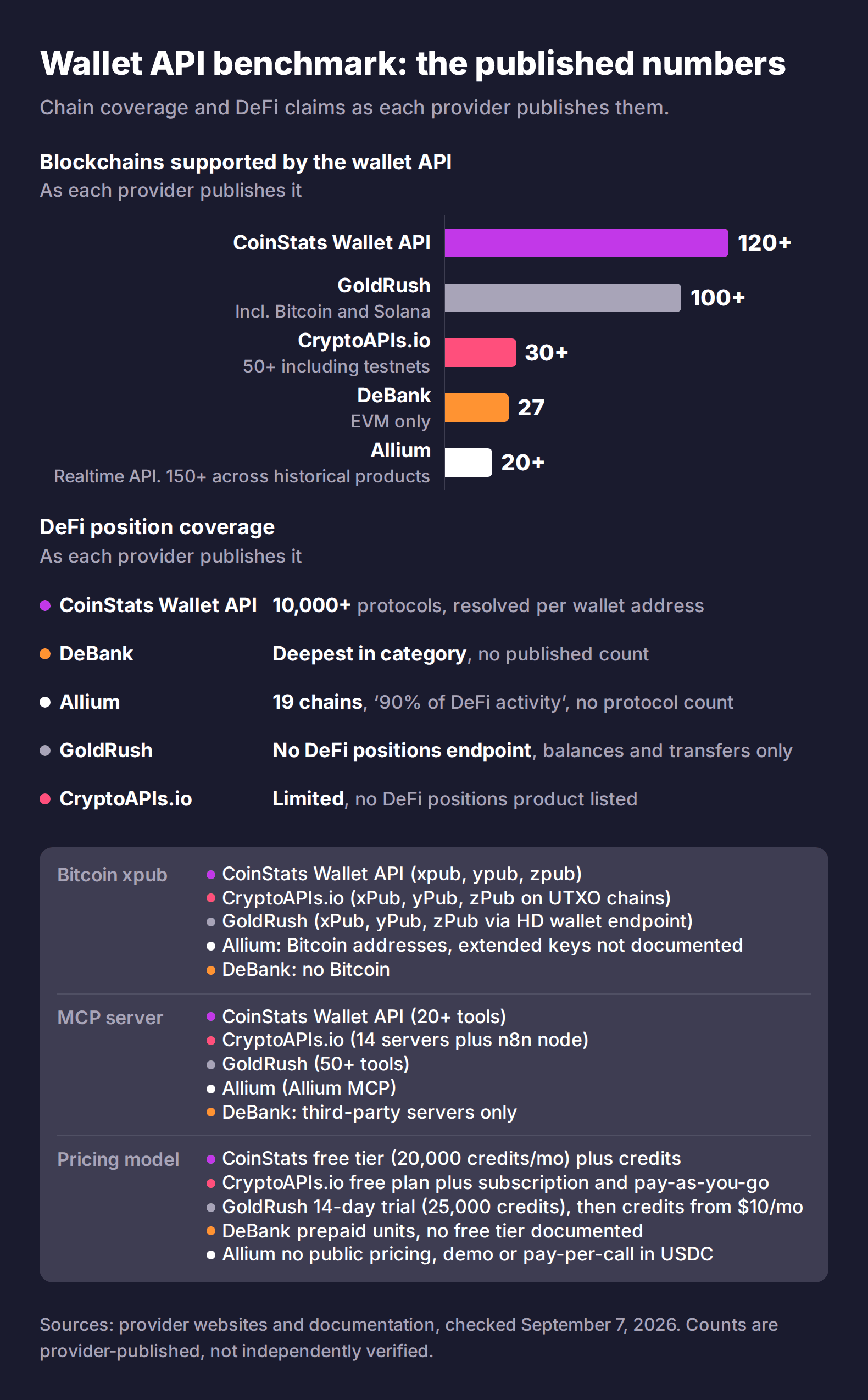
CoinStats Wallet API is the broadest crypto wallet data api in this guide. It covers 120+ blockchains through one integration. EVM chains, Solana, Bitcoin, Cardano, Tron, Cosmos, Polkadot, and more share one endpoint format. You pass an address and a connection ID. You get balances, transactions, and DeFi positions back.
The Bitcoin support is the differentiator most developers miss until they need it. CoinStats accepts standard BTC addresses plus xpub, ypub, and zpub extended public keys. One xpub returns the full balance and history across all derived addresses. Most competitors stop at EVM and Solana. For Solana depth, see the best Solana APIs for developers.
DeFi position resolution is the other standout. The API auto-detects positions across 10,000+ protocols. Staking, lending, LP shares, and yield farming all surface per wallet without manual setup. With 10,000+ protocols covered, this is the largest published number in the category for any crypto wallet defi positions api.
The CoinStats MCP Server exposes wallet, DeFi, and portfolio tools to AI agents. It uses the Model Context Protocol. Claude, Cursor, Claude Code, VS Code, and N8N all connect to it. The same API key works for both REST and MCP.
The data infrastructure also powers the CoinStats app and its 1M monthly users. Same backend, same data, same scale.
Key features:
- 120+ blockchains in one endpoint format
- 10,000+ DeFi protocols auto-detected per wallet
- Bitcoin xpub, ypub, and zpub key support
- Native MCP Server for AI agents
- Portfolio analytics with PnL and charts
- Free tier with credit-based pricing
CryptoAPIs.io targets fintech and enterprise teams building crypto on top of regulated infrastructure. It serves 500+ companies including Ledger, Nexo, Swyftx, and CoinSwitch Kuber. The product surface is broad. Address data, transaction data, and blockchain events. HD wallets, node-as-a-service, market data, and AML screening.
Chain coverage is solid but narrower than the top providers. The site states 30+ networks supported. FAQ language mentions 50+ across mainnet and testnet. The focus is on the major chains developers actually deploy on. Bitcoin, Ethereum, XRP, Litecoin, Dogecoin, BNB Smart Chain, Polygon, TRON, and similar.
Wallet data sits inside the broader product set. Address Latest and Address History endpoints return balances and transaction data. HD Wallets Management handles wallet generation, key management, and address derivation. Blockchain Events delivers real-time webhooks under 100ms.
The enterprise positioning shows up in the certifications and infrastructure. ISO and SOC compliance. 25,000+ requests per second. 25ms average processing time. The product is built for teams with audited environments. Crypto data has to fit inside their existing compliance stack.
The newer AI Compatibility product includes 14 MCP servers. It also ships an N8N MCP client. Useful when you ship AI features without a separate data layer build.
Pricing starts with a free tier. Paid plans run on subscriptions plus pay-as-you-go usage. The free tier covers prototyping before you commit.
Key features:
- 30+ blockchain networks across mainnet and testnet
- 100+ REST API endpoints
- HD Wallets Management with key generation
- Blockchain Events with sub-100ms webhooks
- AML address screening across 20+ blockchains
- 14 MCP servers plus N8N MCP client
- ISO and SOC certified infrastructure
DeBank built its reputation as a DeFi portfolio tracker before opening up its OpenAPI. The product covers EVM only. On DeFi depth, it goes further than anyone else in the category.
The OpenAPI exposes per-wallet portfolios across 20+ EVM chains. Coverage includes Ethereum, BNB Chain, Polygon, Avalanche, Arbitrum, Optimism, Fantom, and more. The complex protocol endpoint returns staking, lending, LP shares, and farming positions. Most responses refresh inside one minute.
The data model is structured around protocols rather than tokens. Picture a wallet with positions in Aave, Compound, and Uniswap V3. You get a clean breakdown per protocol. Each position includes supply tokens, debt tokens, USD values, and rewards owed. Tax tools and DeFi dashboards lean on this granularity heavily.
DeBank covers no non-EVM chains. No Bitcoin. No Solana. No Cardano. For EVM-first, DeFi-heavy products, this is the best crypto wallet defi positions api available. If you need broader chain coverage, you’ll need a second provider alongside it.
Pricing runs on a pay-as-you-go credit model with enterprise tiers. The free tier supports prototyping. Production-scale use requires a paid plan.
Key features:
- 20+ EVM chains
- Deepest DeFi protocol coverage in the category
- Per-wallet position resolution refreshed under a minute
- Complex protocol endpoint with debt, supply, and rewards
- Wallet, token, and gas market endpoints
- Pay-as-you-go credit pricing
GoldRush is the developer API from Covalent, indexing blockchains since 2018. It covers 100+ chains through one REST interface. EVM networks, Bitcoin, Solana, Sei, and Hyperliquid share the same endpoint pattern. The company reports 70K+ developers on the platform.
Transaction history is the strength. The paginated transactions endpoint starts at the earliest transaction for an address. Every response includes decoded log events, token transfers, and gas costs quoted in USD. Tax tools and activity feeds get readable history without parsing raw logs.
Wallet coverage runs through the Foundational API. Token balances, historical portfolio value, transfers, NFTs, and token approvals each have an endpoint. Bitcoin HD wallets are supported natively. Pass an xpub, ypub, or zpub key. GoldRush returns balances for every active child address.
Real-time data arrives through the Streaming API. It runs GraphQL subscriptions over WebSocket. Wallet activity, decoded swaps, transfers, and OHLCV prices stream as they happen.
AI tooling is mature. The GoldRush MCP Server exposes 50+ tools. Claude Desktop, Claude Code, Cursor, and Windsurf connect to it. It runs with npx and no install. An x402 pay-per-request option serves autonomous agents.
The gap is DeFi. GoldRush documents no protocol position endpoint. You get raw token balances, including LP and receipt tokens, but not resolved positions. Pricing is credit-based. A 14-day trial includes 25,000 credits with no card. Paid plans start at $10 per month. A $250 Professional tier and custom enterprise contracts follow.
Key features:
- 100+ chains including Bitcoin, Solana, Sei, and Hyperliquid
- Paginated transaction history from the earliest transaction, with decoded logs
- Bitcoin HD wallet endpoint accepting xpub, ypub, and zpub keys
- Streaming API with GraphQL subscriptions over WebSocket
- MCP Server with 50+ tools plus x402 pay-per-request for agents
- 14-day trial with 25,000 credits, then credit-based plans from $10 per month
Allium sits at the institutional end of the wallet data API market. The product is built for funds, exchanges, fintechs, and analytics teams. These teams treat blockchain data as a system of record. SOC 1 and SOC 2 certified. Audit-grade history. 150+ blockchains across its historical products. 20+ chains on the real-time API.
The product line splits into historical and real-time data. Allium Explorer and Datashares cover historical analytics through Snowflake, BigQuery, Databricks, and S3 integrations. Allium Developer is the real-time REST API for wallet data. Endpoints cover balances, activity, PnL, NFTs, liquidity, and prices. Datastreams pushes live blockchain events through Kafka, PubSub, and SNS.
Phantom uses Allium Developer to power live balances and activity for its 15 million MAUs. MetaMask uses it for real-time Solana and EVM token data. Visa publishes its onchain stablecoin analytics through Allium dashboards.
The Allium MCP Server gives AI agents structured tool access to the same data. No glue code. The MCP product is positioned alongside the AI Assistant for plain-English querying.
Where Allium trades off is accessibility. The product is enterprise-first. There’s no free tier and no public pricing. Most engagements start with a sales call and a custom contract. The fit is wrong for solo developers and most startups. It’s right when crypto data needs to pass an audit.
Key features:
- 150+ blockchains in historical data, 20+ on the real-time API
- SOC 1 and SOC 2 certified
- Real-time Developer API with balances, activity, PnL, and NFTs
- Datastreams for Kafka, PubSub, and SNS
- Allium MCP Server for AI agents
- Historical data through Snowflake, BigQuery, Databricks
Comparing the Top 5 Wallet Data APIs
The table below summarizes the headline tradeoffs across chain coverage, Bitcoin support, DeFi depth, AI compatibility, and pricing.
Swipe sideways to see all columns →
| Provider | Chains | Bitcoin xpub | DeFi protocols | MCP / AI | Pricing |
|---|---|---|---|---|---|
| CoinStats Wallet API | 120+ | Yes | 10,000+ | Native MCP Server | Free tier + credits |
| CryptoAPIs.io | 30+ | Yes (HD Wallets) | Limited | 14 MCP servers + N8N | Free tier + subscription |
| DeBank | 27 EVM | No | Deepest in category | No | Prepaid units |
| GoldRush | 100+ | Yes (HD wallets) | No positions endpoint | MCP Server, 50+ tools | 14-day trial + credits |
| Allium | 20+ real-time (150+ historical) | Not documented | Not published | Allium MCP Server | No public pricing |
Dune Sim held this fourth slot in earlier versions of this guide. Dune shut the product down on August 1, 2026. Our guide to Dune Sim API alternatives covers the migration.
Build Now
The right crypto wallet data api saves months of integration work. It unlocks features you couldn’t ship alone. Each provider in this guide has its own lane. Pick the lane closest to your stack today. You can always swap providers later.
For most use cases, CoinStats Wallet API is the broadest fit. That covers portfolio trackers, tax tools, multi-chain wallet apps, DeFi dashboards, and AI assistants. 120+ chains. 10,000+ DeFi protocols. Bitcoin xpub. Native MCP Server. One integration.
Tigran is the Head of Digital Marketing at CoinStats, working across crypto and consumer apps. His writing covers first-hand crypto experience and marketing case studies from that work. He has taken the stage at industry-leading conferences like MAU Vegas, Business of Apps Berlin, and App Promotion Summit London.
More from Tigran on the CoinStats blog · LinkedIn · X