Logan Paul NFT: The Full Story and Investor Guide for 2026

In the 2021 NFT boom, Logan Paul looked like he had perfect timing. A celebrity audience, expensive buys, fast sellouts, and a market eager to treat attention like value made the Logan Paul NFT story feel unstoppable, until it became one of the clearest cautionary tales in Web3.
The Rise and Fall of a YouTube Star's NFT Empire
Logan Paul's NFT run became impossible to ignore when he used his Impaulsive platform to discuss a purchase reportedly costing $170,000, while also describing a market where some assets first distributed for free in 2017 were later trading for “upwards of two million dollars” in his telling on the show (watch the episode). That kind of framing mattered because CreatorDB estimates he has 45.1 million combined followers across Instagram and TikTok, which helps explain how quickly NFT narratives around him spread through retail audiences in the same source.
At the peak, celebrity plus scarcity looked like a formula. For traders, collectors, and casual fans, the line between entertainment and investment got blurry fast. That wasn't unique to Logan Paul, but his brand made the pattern easier to see because everything happened in public.
The collapse mattered more than the hype. Once the market cooled and CryptoZoo drew scrutiny, the conversation stopped being about flex-value and started being about execution, disclosure, and whether buyers had been sold access to a real product.
Why this saga still matters
Most celebrity crypto stories fade after the prices fade. This one didn't, because it touched almost every major risk category at once: promotion risk, liquidity risk, reputational risk, and product risk.
If you want a clean investor lesson, it's this:
Practical rule: Treat celebrity reach as a distribution advantage, not as proof that the underlying asset deserves its price.
The Logan Paul NFT cycle also sits inside a broader gaming-and-metaverse era, where tokens tied to virtual economies drew heavy speculation. For context on one of the larger names from that period, CoinStats keeps a live market page for The Sandbox token.
A Timeline of Logan Paul's NFT Ventures
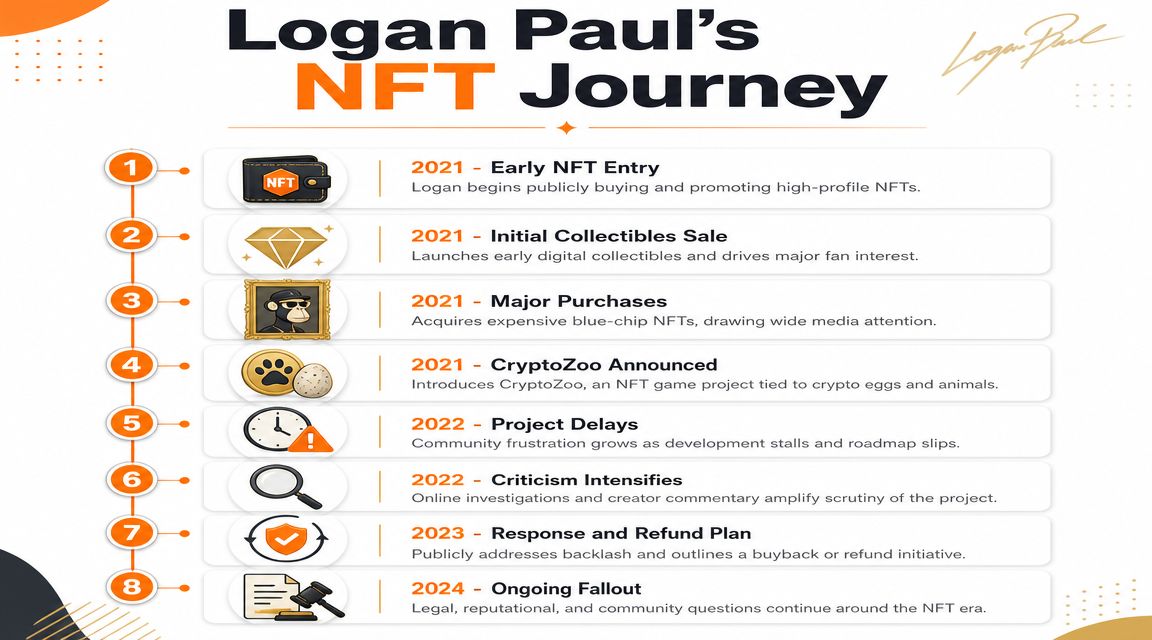
The fastest way to understand the Logan Paul NFT story is to follow the sequence. His path moved from collectible hype to a larger game-based project, and that shift is where the risk profile changed.
Early collectible momentum
His first major NFT sale was a real signal of market appetite. Reporting tied to his video coverage says he sold about 2,500 of 3,000 digital trading cards in a 36-hour window for over $2,000 each, generating more than $5 million (video reference).
That result showed what worked in the 2021 market:
-
Direct audience access lets him sell without needing traditional collector infrastructure.
-
Scarcity mechanics were simple enough for fans to understand.
-
Personal branding did much of the valuation work.
It also showed what doesn't age well. A strong initial sellout tells you demand existed at launch. It doesn't tell you whether secondary-market demand will hold up once novelty fades.
The move from collectibles to CryptoZoo
The bigger turning point came with CryptoZoo. Wikipedia notes that the project launched in September 2021 and drew poor public reception, including criticism for using stock images (project summary).
That launch mattered because it changed the nature of the buyer bet. A collectible asks one main question: Will someone else want this later? A game-linked NFT asks several harder questions: is the product real, will it launch properly, does the token have utility, and can the team execute?
Once a project makes that jump, investors shouldn't analyze it like merch or signed memorabilia. They should analyze it like a startup with on-chain wrappers.
Snapshot of the main projects
| Project Name | Launch Year | Concept | Public Outcome |
|---|---|---|---|
| Digital trading cards | 2021 | Celebrity NFT collectible sale | Strong initial sales during the 2021 NFT peak |
| CryptoZoo | 2021 | NFT-based game with token-linked participation | Became highly controversial and drew litigation scrutiny |
| 0N1 Force purchase | 2021 | High-profile acquisition of an existing profile-picture NFT | Became a public example of NFT valuation collapse |
A timeline like this helps because it separates launch success from long-term validity. In crypto, those are often treated as the same thing. They aren't.
The CryptoZoo Controversy Explained
CryptoZoo is where the Logan Paul NFT conversation stopped being about celebrity collecting and became a consumer-protection case study.
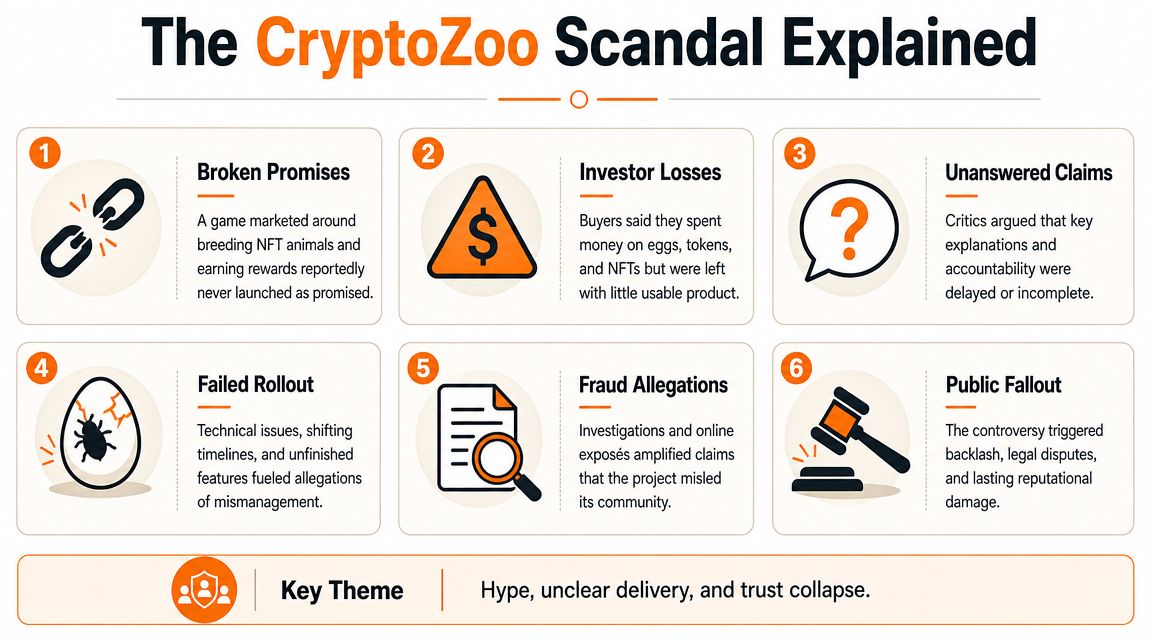
The central allegation in the class-action coverage is blunt. Plaintiffs allege that Logan Paul and others induced buyers to purchase Zoo Tokens and NFTs for a game that “did not work and never existed” (class-action coverage).
That's a very different problem from “the floor price went down.” Prices can collapse in any speculative market. A product allegedly failing to exist or function moves the analysis into a different category entirely.
What investors thought they were buying
When a project is marketed as an NFT game, buyers usually assume several things are true:
-
A usable product is in development
-
The NFTs have some stated in-game purposes
-
The token economy connects to an experience
-
The team can ship what it promotes
If any of those assumptions break, the entire valuation framework breaks with them.
The CryptoZoo case became particularly significant. In a normal collectible market, utility is optional. In a game-linked NFT market, utility is often the thesis. If the utility doesn't materialize, the asset can lose not only speculative premium but also its core narrative support.
This overview captures the allegations visually:
Why Was the Backlash So Severe?
Public criticism around CryptoZoo wasn't just about losses. It was about a mismatch. The project sat at the intersection of celebrity trust, technical claims, and retail money.
Three details made the controversy especially damaging:
-
Product-readiness concerns became central. Investors started asking whether there was a functioning game behind the pitch.
-
Presentation choices hurt credibility. Criticism over stock images fed the view that the project lacked serious execution.
-
Expectation-setting appears to have outrun delivery. That is usually where reputational damage becomes hard to contain.
For public figures, this kind of blowback often turns into a long-tail brand problem, not just a bad launch. If you're studying how celebrities respond when a digital product controversy spills across search, social, and press, this guide to reputation management for public figures gives useful context.
When a project depends on future utility, buyers shouldn't ask whether the pitch sounds exciting. They should ask what already works today.
How to analyze a similar project before buying
If a celebrity-backed crypto game lands on your radar, check these first:
-
Working product evidence
Look for something functional, not just concept art, trailers, or token pages. -
Clear utility path
If the NFT is supposed to matter inside a game, the project should explain exactly how. -
Claims discipline
Vague promises are a red flag. Precise claims can be tested. -
Team execution history
Marketing skill isn't a game-development skill.
That last point is where many investors still get trapped. A creator can be exceptional at building attention and still be the wrong person to evaluate, run, or promote a complex Web3 product.
Valuation and Market Performance of Paul's NFTs
The cleanest pricing example in the Logan Paul NFT story is his well-known 0N1 Force purchase. One version of the coverage framed the token as a $623,000 buy that later fell to an estimated $10, illustrating how violently peak-cycle NFT pricing can unwind (market coverage).
That headline number is useful because it captures the emotional reality of the cycle. But the more interesting investor lesson is underneath it.
Why NFT pricing can look irrational
The same coverage notes that the NFT came from the 0N1 Force collection of 7,777 characters, and reporting based on DappRadar estimated the specific token's value at about 6.8 ETH versus a collection floor of 0.288 ETH, despite an estimated 98.5% decline from the purchase price in that analysis. That gap matters because a single NFT doesn't always trade at the collection floor. Rarity traits, visual identity, historical ownership, and social cachet can all distort pricing for individual tokens.
In other words, two things can be true at once:
-
The collection has collapsed in broad market terms
-
One specific token can still trade above the floor
That's why NFT investors get burned when they rely on simple screenshots or selective comps. The floor tells you what the cheapest seller is willing to accept for the least expensive item in a collection. It does not tell you what your token is worth.
The practical takeaway for buyers
When a celebrity owns an NFT, the market often prices in story value. That can include attention, status, resale mythology, and the possibility that future buyers want the provenance more than the art.
Valuation rule: Separate collection liquidity from token-specific narrative premium. They aren't the same asset story.
This problem was common across gaming and PFP assets in the last cycle, not just celebrity wallets. If you follow crypto gaming tokens, a live market page like Axie Infinity on CoinStats is a useful reminder that NFT-related ecosystems can move sharply even when the headline narrative hasn't changed.
For savvy investors, the main lesson isn't “never buy expensive NFTs.” It's narrower and more useful: don't confuse a public purchase price with durable market value.
Key Lessons from the Logan Paul NFT Saga
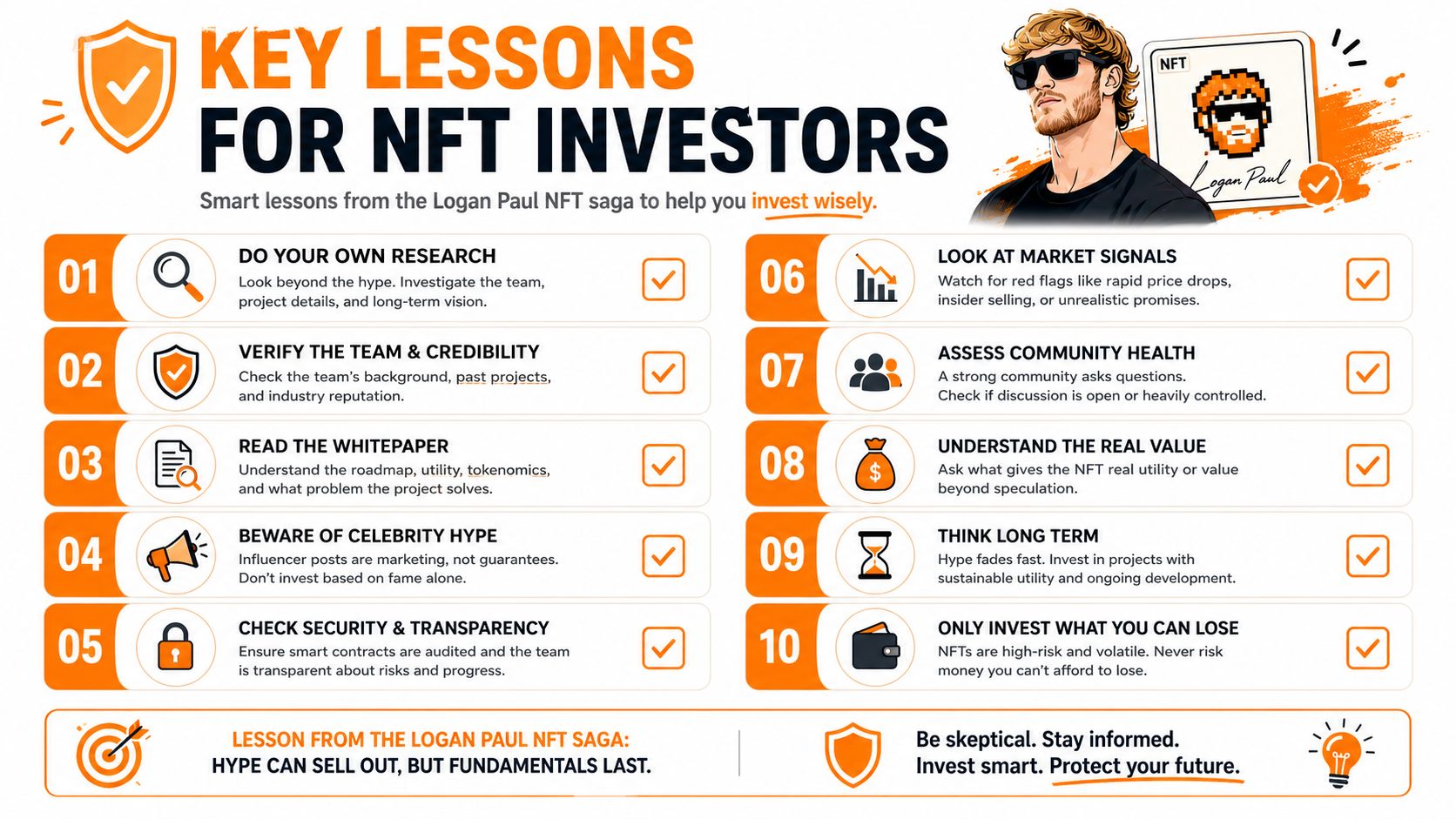
The Logan Paul NFT saga is useful because it compresses several years of retail mistakes into one visible example. If you strip away the personalities, you get a practical due diligence framework for any influencer-led crypto project.
Separate audience power from product quality
A giant audience can create launch velocity. It can't manufacture a functioning game, healthy token sinks, or sustainable demand.
That distinction sounds obvious, but bull-market buyers repeatedly ignore it. They see a creator's distribution and start treating it like a substitute for technical validation.
Use a red-flag checklist
Here are the signs I watch most closely in celebrity-backed NFT and token projects:
-
The roadmap reads like marketing copy
If every milestone is aspirational and nothing is testable, assume the timeline is soft. -
Utility is described, not demonstrated
A project should show how the asset works, not just promise future use. -
The thesis depends on community vibes alone
Community helps. It doesn't replace mechanics. -
The buying pressure comes from status signaling
That's fine for collectibles. It's dangerous when buyers think they're funding software. -
Questions get answered with more hype
When teams avoid specifics, they're telling you something.
Watch how the project handles stress
Strong teams usually become clearer under scrutiny. Weak teams get reactive, vague, or combative.
That matters because NFT markets don't fail gracefully. They fail in public, on social platforms, in Discords, in wallet data, and in search results. If you're interested in how brands and creators handle online blowups once a narrative turns against them, this piece on social media crisis management is worth reviewing.
Good due diligence starts where the marketing stops.
Build a process, not a vibe
A lot of retail investors still buy these projects with an entertainment mindset and a venture-risk exposure. That's the mismatch.
A better process looks like this:
-
Verify what exists today
Working app, playable demo, contract activity, actual utility. -
Map the incentive design
Who benefits first, the user or the issuer? -
Test the downside path
If hype disappears next week, what still has value? -
Review market signals without outsourcing your judgment
Tools can help you spot trends, wallet behavior, and sentiment shifts, but they shouldn't replace first-principles analysis. For investors who want an AI layer in their research workflow, CoinStats AI can help surface market context while you do the harder work of deciding whether the thesis is real.
The cleanest lesson from this entire episode is simple. Attention can launch a crypto project. Only execution can sustain it.
How to Track and Manage Your NFT Portfolio
If you hold NFTs across multiple wallets, bad recordkeeping creates its own losses. You miss cost basis, forget transfer history, and end up making decisions from memory instead of data.
What to track consistently
At a minimum, your system should show:
-
Wallet-level holdings so you know where each NFT sits
-
Transaction history, including buys, sales, and transfers
-
Current estimated value with enough context to avoid mistaking floor data for guaranteed exit liquidity
-
Realized and unrealized performance for portfolio review and tax prep
Many investors start with spreadsheets and eventually outgrow them. If you want to compare different approaches before choosing a setup, it's useful to explore portfolio tools on PeerPush.
A practical tracking workflow
We use CoinStats Portfolio Tracker when the goal is to consolidate wallets and exchange accounts into one view instead of bouncing between explorers, marketplaces, and manual notes. That becomes especially helpful when NFT positions sit alongside fungible tokens and DeFi exposure.
If you're active in NFT infrastructure plays, it also helps to keep an eye on related ecosystems such as Immutable X on CoinStats, since NFT portfolio risk often extends beyond the JPEG or in-game asset itself.
For developers and analysts building internal dashboards, CoinStats also offers API documentation, plus chain-specific wallet endpoints for Ethereum and EVM wallets, Solana wallets, Bitcoin wallets, and other supported chains.
Don't ignore taxes and custody
NFT traders often focus on entry and forget administration. That's a mistake.
Keep clean records of acquisitions, disposals, swaps, and wallet transfers. And treat wallet security as part of portfolio management, not a separate topic. An NFT you can't access has the same portfolio value as one you sold at the wrong time. For active collectors, process discipline beats post-hoc reconstruction every time.
Conclusion: Investing Smarter in the Web3 Era
The Logan Paul NFT story isn't just gossip from the last cycle. It's a usable framework for judging celebrity-backed crypto deals in any market. Hype can create demand, but it can't replace a working product, credible utility, or disciplined execution.
Web3 still has real potential. The difference now is that investors have fewer excuses for buying blind. The smarter path is simple: verify claims, track positions carefully, and treat attention as noise until the fundamentals prove otherwise.
CoinStats helps you do that work with less friction. Use CoinStats to track wallets, monitor NFT and token positions, research markets, and build a clearer picture of your real exposure before hype turns into regret.