DeFi Risk Management With a Wallet by Wallet Review Checklist

Key Takeaways
- DeFi risk management involves identifying, monitoring, and reducing risks across wallets, assets, and protocols.
- Regular wallet reviews help uncover hidden risks, forgotten positions, and excessive exposure to individual protocols.
- Monitoring loan health factors and maintaining sufficient collateral can help reduce liquidation risk.
- Revoking unused token approvals and reviewing transaction history can help protect wallets from theft and scams.
- CoinStats DeFi Tracker simplifies risk management by bringing positions, balances, and protocol exposure across multiple wallets into one place.
Most DeFi losses don’t start with a bad protocol. They start with a wallet nobody has checked in months.
You may have ETH staked in one wallet, a loan in another, and funds in a liquidity pool on a third chain. Each wallet looks fine on its own. But what happens if ETH falls by 30% or a DeFi app gets hacked?
In 2025, Chainalysis counted 158,000 personal wallet compromises, affecting more than 80,000 people.
What is DeFi risk management?
DeFi risk management is the process of finding, tracking, and limiting the risks of using decentralized finance (DeFi) apps. It applies to lending, borrowing, staking, yield farming, and trading on decentralized exchanges (DEXs).
The goal is not to have zero risk. The only way to have no risk is to not participate in the first place. So, our goal is to know three things:
- How much you could lose
- What could cause that loss
- What you can do to reduce the risk
Unlike traditional finance, DeFi often puts the burden of risk management on the user. There may be no bank, fund manager, or support team to step in when things go wrong.
What are the main types of DeFi risks?
A single DeFi position can expose you to several risks at once.
For example, lending a bridged stablecoin exposes you to smart contract, stablecoin, bridge, and liquidity risks, all at once.
| Type of DeFi risk | What it means |
| Smart contract risk | A bug or hack in the code could lead to a loss of funds. |
| Market risk | A drop in token prices can reduce the value of your assets. |
| Liquidation risk | A protocol may sell your collateral if your loan falls below its required safety level. |
| Liquidity risk | You may not be able to sell or withdraw your assets at a fair price. |
| Stablecoin risk | A stablecoin may lose its peg to the US dollar or another asset. |
| Oracle risk | A faulty price feed can cause incorrect trades or liquidations. |
| Bridge risk | A hack or fault in a cross-chain bridge can put your funds at risk. |
| Wallet security risk | A stolen key, fake website, or harmful approval can lead to theft. |
| Governance risk | Those who control a protocol may change its rules or misuse their power. |
A Wallet-by-Wallet DeFi Risk Management Checklist
1. List All Your Wallets and DeFi Positions
Write down every address you’ve ever used, on every chain. Include old wallets. Forgotten wallets often hold the oldest and riskiest approvals.
Tag each one as vault, active DeFi or burner. Then add them all to CoinStats DeFi portfolio tracker so you see one list instead of ten browser tabs.
2. Check what the wallet holds
Start by asking yourself if too many funds are tied up in a single token, app, or chain. Set clear limits and stick to them.
For instance, you might decide to keep no more than 20% of any wallet in a single protocol. Make sure to account for different stablecoin issuers as well, since even “stable” assets can carry unique risks.
3. Review Your Loans and Liquidation Risk
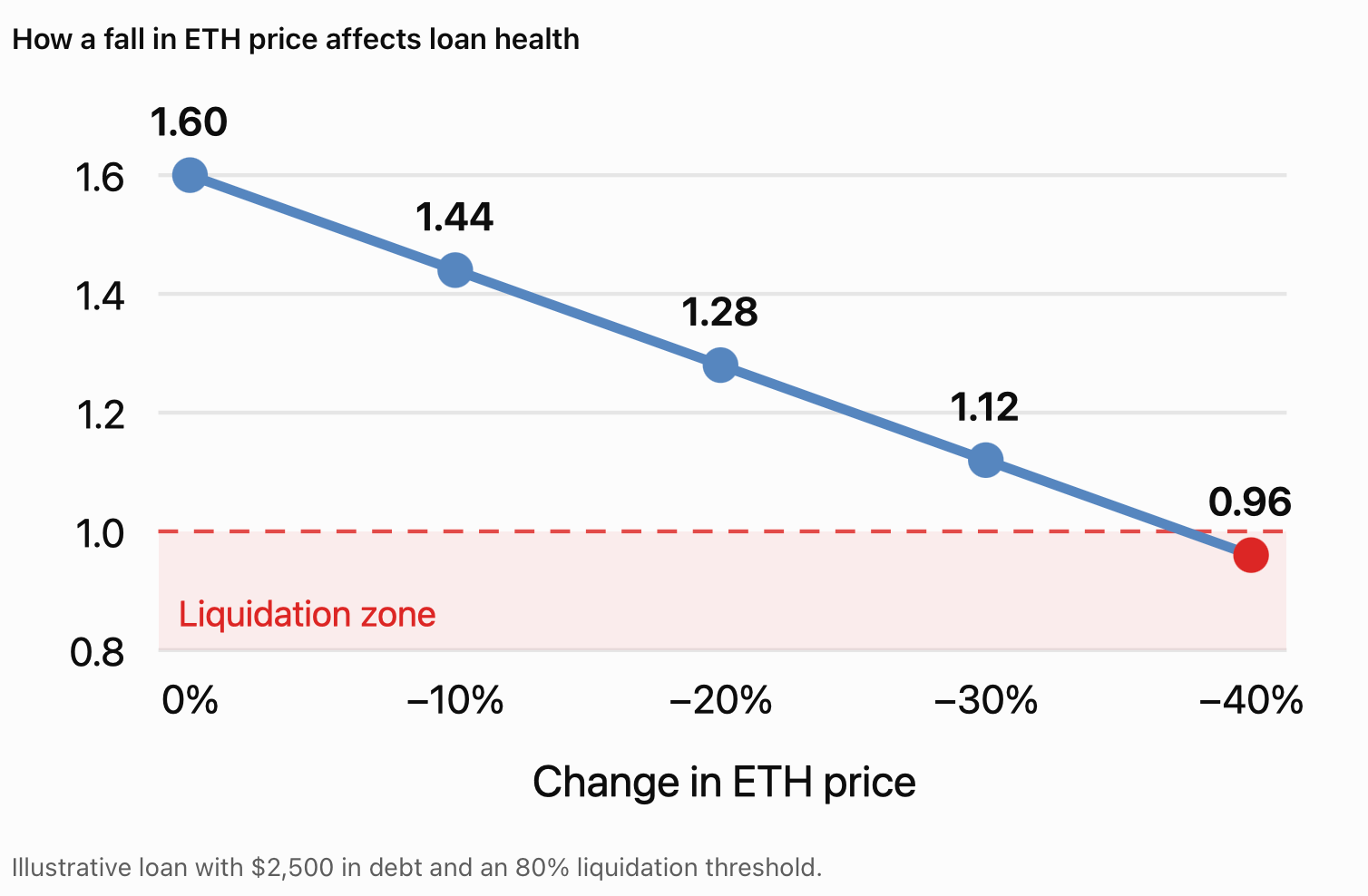
The health factor tells you how close a loan is to liquidation. Aave works it out like this.
{Health factor} = {{Collateral value}*{Liquidation threshold}}/{{Debt value}}
Say you supply $10,000 of ETH with an 80% liquidation threshold and borrow $6,000. Your health factor is 1.33. Now ETH drops 25%. Your collateral is worth $7,500, and your health factor falls to exactly 1.0.
On Aave, a loan becomes eligible for liquidation once it drops below 1. At 0.95 or lower, up to 100% of the debt can be liquidated. That’s why a 1.33 buffer is thinner than it looks.
Here’s what you can do next. Pick your own floor, such as 1.5 for volatile collateral. If a loan sits below it, repay some debt or add collateral. Our guide on when a DeFi loan gets liquidated walks through the math in more detail.
4. Review and revoke token approvals
An approval lets a smart contract move a token from your wallet. Many apps ask for unlimited approvals to save you gas later. If that contract is ever hacked, it can drain the full balance of that token.
The catch is that disconnecting your wallet from an app may not be enough to protect you. The approval lives on the blockchain until you revoke it.
So, open an approval checker like Revoke.cash, a block explorer’s approval tool, or your wallet’s built-in manager. Revoke approvals that are unlimited, tied to apps you no longer use, or linked to contracts you don’t recognize. Each revoke costs a little gas, so start with the tokens worth the most.
5. Scan recent activity for anything you didn’t do
Open the last 30 days of history for the wallet. Look for transfers you didn’t send, approvals you didn’t give, and tiny incoming payments from addresses that look like yours.
Those tiny payments are often address poisoning. The scammer hopes you’ll copy their look-alike address from your history next time you send funds.
If you find a transfer or approval you didn’t make, assume the wallet is compromised. Move what’s left to a fresh wallet from a clean device, then revoke approvals.
How to track DeFi risk with CoinStats
The more wallets and apps you use, the harder it gets to keep track of your funds by hand.
With the CoinStats DeFi Tracker, you can view your DeFi assets across supported wallets, chains, and protocols in one place.
You can use CoinStats to:
- Track assets across multiple DeFi wallets
- View DeFi positions by protocol
- Monitor lending and borrowing positions
- Check loan health data where available
- Track staked assets and liquidity pool positions
- Monitor portfolio value and profit or loss
- Find how much of your portfolio depends on specific assets
Conclusion
Good DeFi risk management starts with knowing where your money is, what it depends on, and how you can get it back.
A wallet-by-wallet review helps you find risks that may not be clear from your total portfolio balance. It also helps you spot old token approvals, risky loans, and too much exposure to a single protocol.
Frequently asked questions
What is the biggest risk in DeFi?
There is no single biggest risk. A bug in a smart contract can wipe out funds. A stolen seed phrase can put every wallet tied to it at risk. Loans also face the risk of liquidation when prices fall.
Does using more wallets reduce DeFi risk?
It can help if the wallets use separate keys and serve distinct roles. However, it will not reduce your exposure to a token or protocol if you use it across all your wallets.
What is a safe DeFi yield?
There is no risk-free DeFi yield. Before you chase a high APY, find out where the yield comes from, what risks you take, and how you can get your funds back.
How can I reduce my DeFi liquidation risk?
You can reduce liquidation risk by borrowing less, keeping a larger collateral buffer, monitoring your loan health factor, and repaying debt before you reach the liquidation threshold.
Can a DeFi portfolio tracker help manage risk?
Yes. A DeFi portfolio tracker like CoinStats helps you monitor positions, track asset values, review loans, and understand your exposure across wallets and protocols. However, it cannot prevent smart contract exploits or guarantee the safety of your funds.