Crypto Trading Fees Explained for Everyone

Key Takeaways
- You pay fees on both ends of a trade, once when you buy and again when you sell. Always count the round trip.
- Limit orders usually pay the lower maker fee. Market orders pay the higher taker fee.
- The “Buy” button in simple apps often costs 10 times more than the exchange’s order book, because of spreads and convenience fees.
- Withdrawal and network fees depend on the coin and the network you choose, and the network can matter more than the exchange.
- On a $1,000 trade, the gap between the cheapest and most expensive way to trade can swallow almost half your profit.
Say, you bought a coin at $100. In a few days, the price went to $120. So, you decide to sell at that moment, and you do. Then, you look at your wallet and see only $90.
How is it that you sold when the price is higher and still ended with a $10 loss?
We aren’t making this up. This is the reality for many new traders who jump into the waters without fully understanding crypto trading fees and profit calculation.
In this article, we will guide you through these waters in a way that will make sense and stay with you for a long time in memory. You will also learn how to work out your real profit after fees with the CoinStats Crypto Profit Calculator.
What are crypto trading fees?
Crypto trading fees are the charges you pay when you buy, sell, swap, deposit or withdraw crypto. Exchanges charge trading fees and withdrawal fees to earn money, while blockchains charge network fees to pay the miners or validators who process transactions. Most trades involve at least two of these.
Here is every fee you are likely to meet, in one place.
| Fee | Who charges it | When you pay it | Typical size |
| Maker / taker fee | Exchange | Every buy or sell on the order book | 0.00% to 0.90% per trade, by exchange and region |
| Spread | Exchange or broker (built into the price) | Instant buys and sells in simple apps | Around 0.5% to 1%+ |
| Convenience or instant-buy fee | Exchange app | Using the simple “Buy” button | About 1% to 4% depending on payment method |
| Card or deposit fee | Exchange or payment provider | Funding your account | Bank transfer often free; cards around 3.75% to 4% |
| Withdrawal fee | Exchange | Moving crypto or cash off the exchange | Fixed amount per coin and network |
| Network (gas) fee | The blockchain | Any on-chain transfer or DeFi swap | Changes with network traffic |
| Funding fee | Paid between traders | Holding perpetual futures | Usually set every 8 hours, can be positive or negative |
Maker vs taker fees
Exchanges with an order book often distinguish between orders that add liquidity and orders that use existing liquidity. Liquidity means the orders available for other traders to buy or sell against.
A maker fee applies when your order waits on the order book, such as a limit order below the current price. A taker fee applies when your order fills instantly against an existing order, such as a market order.
Makers add liquidity to the market and takers remove it, so maker fees are almost always lower.
| Order role | What happens | Simple example |
| Maker | Your order rests on the order book and another trader later matches it | A buy order below the current lowest asking price |
| Taker | Your order immediately matches an existing order | A market buy that accepts available sell orders |
What major exchanges charge in 2026
These are entry-level spot fees for a new account with low trading volume. The last column shows what a single $1,000 market buy costs.
| Exchange | Maker fee | Taker fee | $1,000 market buy |
| Coinbase Advanced (Brazil, India, other international) | 0.09% | 0.10% | $1.00 |
| OKX (global) | 0.08% | 0.10% | $1.00 |
| Binance | 0.10% (0.075% paying in BNB) | 0.10% (0.075% paying in BNB) | $1.00 |
| Bybit | 0.10% | 0.10% | $1.00 |
| Coinbase Advanced (EU and UK) | 0.25% | 0.50% | $5.00 |
| Kraken Pro (Tier 1) | 0.40% | 0.80% | $8.00 |
| Coinbase Advanced (US) | 0.50% | 0.90% | $9.00 |
How to calculate crypto profit after trading fees
For one buy followed by one sale of all your coins, subtract the total cash you spent from the cash you received after selling.
Let’s take a hypothetical trade of 10 coins priced at $100 each at the time of buy and at $105 each at the time of sell. You pay both fees in dollars and keep all 10 coins until you sell.
You can follow along in the CoinStats Crypto Profit Calculator. Both fee fields take dollar amounts.
| CoinStats field | Enter | Where the number comes from |
|---|---|---|
| Buy price | $100 | The price paid per coin |
| Investment | $1,000 | 10 coins × $100, before the buy fee |
| Sell price | $105 | The price received per coin |
| Investment Fee | $2.00 | 0.20% of the $1,000 purchase |
| Exit Fee | $2.10 | 0.20% of the $1,050 sale |
Now, the calculationL
- The purchase costs $1,002 including the buy fee.
- The sale brings in $1,047.90 after the sell fee.
- Subtract one from the other and you get $45.90 in profit, a 4.58% return on the $1,002 you spent.
What price covers both trading fees?
Your break-even price is the price per coin at which you get your $1,002 back.
With a 0.20% sell fee, you keep 99.8% of the sale. Divide $1,002 by 0.998, then by 10 coins. You need about $100.40 per coin to break even, before rounding. Even a sale at $100.20 would leave you about $2 short.
How spreads and slippage affect your price
Every market has two prices. The “bid-ask spread” is the difference between the highest price someone wants to pay and the lowest price someone wants to sell for.
If buyers offer $99.90 and sellers want $100.10, the gap is $0.20. If you buy right away and sell immediately at those prices, you lose $0.20 before fees.
Some easy-buy apps add extra costs to their prices. Coinbase, for example, includes a spread in simple buy and sell quotes. Coinbase Advanced lets you trade directly on the main order book instead.
“Slippage” is the difference between the price you expect and the price you get. If you expect to pay $100.10 but the trade finishes at $100.25, you pay $0.15 more per coin. For completed trades, put your final buy and sell prices in the calculator, as they already include the spread and slippage.
How to avoid or control spreads and slippage?
Most large exchanges offer a free “advanced” or “pro” trading screen. The latter looks busier but gives you more control and visibility.
If you trade very infrequently and at small prices, then the cost of convenience is likely worth it. If you are an avid trader or you buy in large amounts, then even a small spread or slippage can add up to large numbers.
Network, withdrawal and deposit fees
Network fees (often called gas fees in case of Ethereum) go to the blockchain, not the exchange, and rise when the network is busy. Withdrawal fees are what an exchange charges to send your crypto out, usually a fixed amount per coin and network. Deposit fees mostly hit cash funding, and cards cost far more than bank transfers.
Network fees
Every on-chain transaction pays a small fee to the miners or validators who process it. On Bitcoin, the fee depends on how much data your transaction uses and how busy the network is. On Ethereum and similar chains, it is called gas and rises when many people are trading at once.
You cannot avoid network fees when you move crypto on-chain, but you can pick when and where you pay them.
- Pick the cheapest network: Many coins, especially stablecoins like USDT and USDC, can be sent on several blockchains. The same $100 transfer can cost very different amounts depending on the network you choose.
- Send when it is quiet: Gas fees usually drop outside busy trading hours.
Withdrawal fees
When you withdraw crypto from an exchange, it charges a fee to cover the network cost, sometimes with a margin on top. Most exchanges, including Binance, Kraken and OKX, publish a fixed fee per coin and per network. Coinbase shows the network fee at the moment you withdraw instead.
Because the fee is usually a flat amount, it hurts small withdrawals the most. Paying a $2 fee on a $20 withdrawal is 10%. On $2,000, it is 0.1%.
Deposit and payment fees
Depositing crypto into an exchange is usually free. Depositing cash depends on the method.
- Bank transfer. Often free or a small flat fee.
- Debit or credit card. Expensive. Kraken charges 3.75% + $0.25 on US card deposits, and Coinbase charges 3.99% on card purchases.
- Third-party providers. Some exchanges route card purchases through outside payment companies, each with its own rate.
If you buy with a card every month, switching to bank transfers alone can save you around 4% of every purchase.
7 ways to cut your crypto trading fees
Here are seven effective ways to minimize how much you end up paying in trading fees on your crypto trades:
- Use the advanced trading screen: It is free on most big exchanges and can help avoid the spread markup and convenience fee.
- Place limit orders: You pay the lower maker fee, and you control the exact price.
- Fund by bank transfer: Card deposits cost around 4%. Bank transfers are often free.
- Compare fees in your region: The same exchange can charge very different rates by country. Coinbase Advanced charges a new US trader 0.90% taker but 0.10% in many international markets.
- Pay fees with the exchange token: On Binance, paying in BNB cuts spot fees by 25%.
- Batch your withdrawals: Withdrawal fees are usually flat, so one large withdrawal costs less than five small ones.
- Choose the cheapest supported network: Check which networks both the exchange and your wallet support, then pick the cheapest one.
Calculate your crypto profit after fees with CoinStats
The CoinStats Crypto Profit Calculator includes fields for your coin, buy price, investment amount, sell price, Investment Fee, and Exit Fee. It displays profit or loss, total investment amount, and total exit amount.
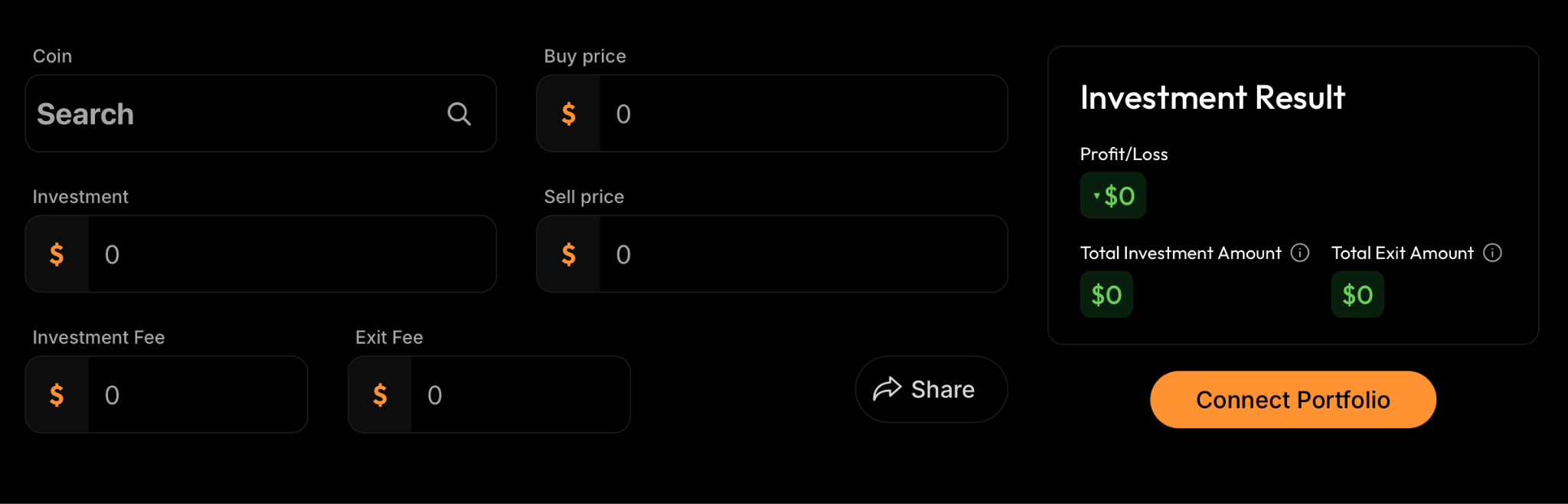
To estimate a trade:
- Select the cryptocurrency.
- Enter the purchase price and investment amount.
- Add the actual or expected selling price.
- Enter the purchase-related charges in Investment Fee.
- Enter the sale-related charges in Exit Fee.
- Review the result and adjust the selling price to compare scenarios.
Frequently asked questions
Do you pay crypto trading fees when buying and selling
Usually, yes. Treat the purchase and sale as separate transactions and check the applicable rate for each. A promotion or particular fee schedule may waive one or both charges.
Does zero-fee crypto trading mean there are no costs
No. A zero trading commission can still leave spreads, payment charges, withdrawal costs, or subscription charges.
How do I calculate crypto profit after fees?
Subtract your total fees from your gross gain. Gross gain is your sell value minus your investment. Total fees are the buy fee plus the sell fee plus any withdrawal or card fees. The CoinStats Crypto Profit Calculator does this when you enter your investment and exit fees in dollars.