
Trump Freezes Congress Over SAVE Act — What Happens to Crypto’s CLARITY Act?

0
0

President Donald Trump has declared he will refuse to sign any legislation until the SAVE America Act (SAVE Act) passes in its strongest form. It adds a new layer of uncertainty to an already stalled Digital Asset Market Clarity Act (CLARITY Act).
The declaration, posted on Truth Social on March 8, 2026, demands that the SAVE Act, which requires proof of citizenship for voter registration, move to the front of the congressional queue immediately.
SAVE Act Crowds Out Legislative Calendar
The CLARITY Act (H.R. 3633) was passed by the House with bipartisan support in July 2025 by a vote of 294-134.
However, it has been sitting in the Senate Banking, Housing, and Urban Affairs Committee since September 2025.
A markup scheduled for January 15, 2026, was postponed indefinitely after major industry players, including Coinbase, withdrew support over stablecoin yield provisions.
Trump’s SAVE Act ultimatum now threatens to crowd out whatever remaining Senate bandwidth existed for crypto legislation.
Trump’s statement effectively creates a political squeeze that could make it harder for other bills to move forward.
This stance has crypto supporters facing an uncertain future regarding the long-overdue Clarity Act, with several users already raising concerns.
“The Senate will have to deal with the SAVE Act first, then we can possibly get the Clarity Act. But we are running out of time,” wrote Chad Steingraber, a popular user on X.
The SAVE Act passed the House on February 11, 2026, on a narrow 218-213 vote. It now faces a near-certain Democratic filibuster in the Senate, requiring 60 votes to advance, a threshold Republicans cannot reach without cross-party support.
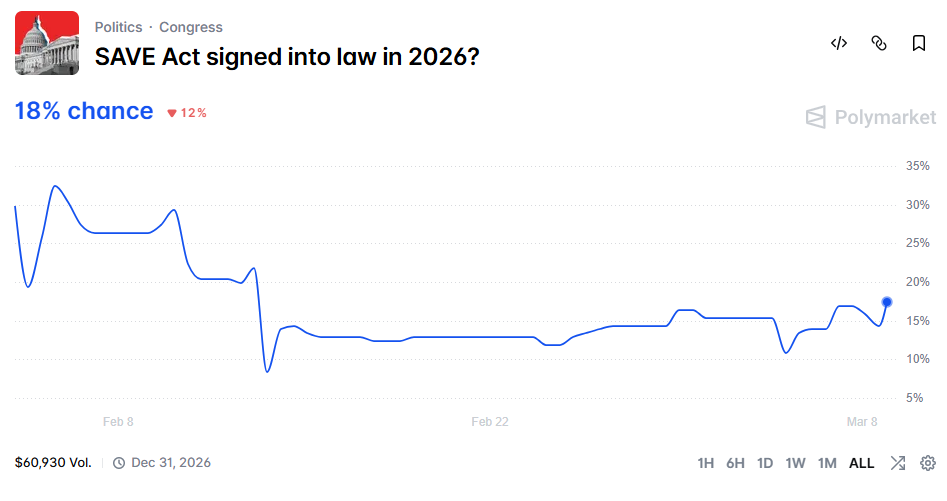 Odds of Signing SAVE Act into Law in 2026. Source: Polymarket
Prediction markets currently place the odds of full passage in 2026 at 18%.
Stablecoin Dispute Remains the Central Roadblock
Even without the SAVE Act bottleneck, the CLARITY Act faces significant obstacles of its own. The core dispute centers on whether crypto platforms can offer yield-like rewards to stablecoin holders.
Banks, led by the Bank Policy Institute and executives including JPMorgan CEO Jamie Dimon, argue that yield-bearing stablecoins threaten deposit flight at commercial banks.
Bank of America CEO Brian Moynihan has suggested that such products could divert as much as 30–35% of commercial bank deposits.
A US Treasury analysis cited figures approaching $6.6 trillion in potential exposure.
A White House deadline of March 1, 2026, set by Crypto Council Executive Director Patrick Witt, passed without resolution.
A Senate Banking Committee markup is now tentatively expected in mid-to-late March, with potential negotiations extending into April.
Analysts at JPMorgan have flagged CLARITY passage, if it occurs, as a significant positive catalyst for crypto markets, potentially materializing in the second half of 2026.
Trump has separately pressured Congress to move on the CLARITY Act, accusing banks of holding the bill hostage to protect their low-interest savings accounts from stablecoin competition.
What Comes Next
Senator Cynthia Lummis has urged Congress to act quickly, warning that delays risk ceding ground in digital asset policy to other jurisdictions.
Polymarket odds for eventual passage of the CLARITY Act sit at 70%, reflecting long-term optimism despite near-term gridlock.
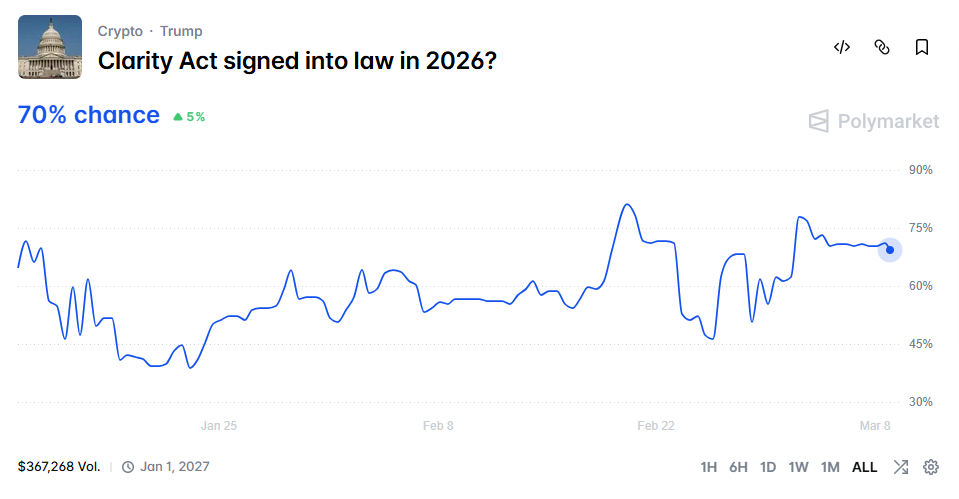 Odds of CLARITY Act Passing in 2026. Source: Polymarket
However, with a soft July 2026 deadline before midterm election-year politics intensify, the overlap between the SAVE Act fight and unresolved stablecoin negotiations narrows the CLARITY Act’s path forward.
If no compromise materializes, the Securities and Exchange Commission (SEC) and the Office of the Comptroller of the Currency (OCC), which recently issued a 376-page proposed rule-making on rewards, may fill the regulatory vacuum through enforcement rather than legislation.
0
0


 Manage all your crypto, NFT and DeFi from one place
Securely connect the portfolio you’re using to start.

0
0

0
0

0
0
