
Aave Valuation Comes Under Scrutiny After Reported Kraken-Linked Interest

0
0

Aave valuation is facing a new test as investors assess whether a DAO-owned lending protocol can be measured using traditional financial frameworks while keeping its economics token-native. The recent AAVE rally, reported strategic interest, and institutional expansion have shifted attention toward a bigger question: how much of Aave’s revenue ultimately reaches the DAO after partner shares, rebates, subsidies, user incentives, and governance decisions.
AAVE traded around $94.32 on June 27, rising 13.16% over 24 hours as market participants increased their focus on Aave’s lending model. The move has pushed investors to look beyond price performance and examine whether decentralized financial infrastructure can create value in a way similar to established financial institutions.
The debate is not simply about whether Aave generates activity or revenue. The market is trying to determine whether those figures can translate into sustainable tokenholder economics while operating through a decentralized governance structure.
Why is Aave valuation being compared with traditional financial models?
Aave valuation is increasingly being discussed through the lens of “bank-style math,” where investors use familiar financial measures such as liquidity, revenue generation, risk management, and capital returns to analyze the protocol. Aave has several features that resemble financial infrastructure. It provides lending markets, manages liquidity, generates protocol fees and is expanding into institutional products.

However, applying traditional financial models to Aave requires caution. A bank is typically valued through corporate earnings, balance sheets and shareholder ownership. Aave operates through smart contracts and DAO governance, where tokenholders influence decisions regarding revenue use and capital allocation.
The central market question is whether Aave can be valued using familiar financial tools while remaining a token-native financial network. The comparison provides a framework for investors, but it also highlights a structural difference. Aave’s scale is visible, yet scale alone does not determine how much value reaches the AAVE token.
How does Aave’s revenue flow affect its valuation debate?
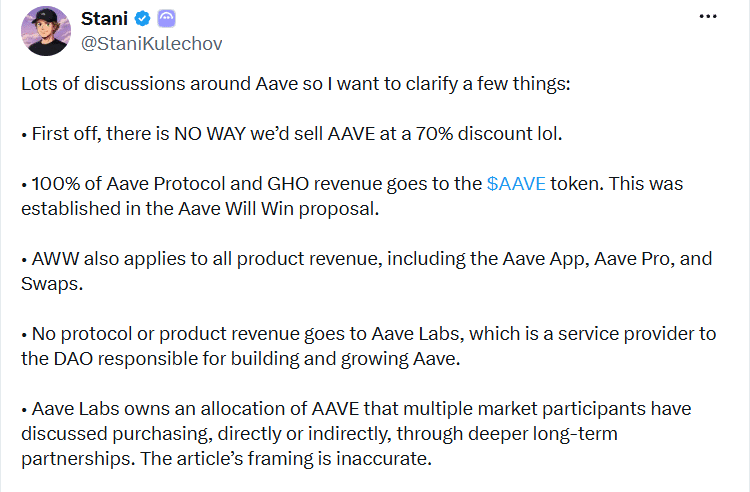
Kulechov said zero protocol or product revenue goes to Aave Labs. He calls Aave Labs a service provider that builds and grows Aave for the DAO. Aave is making $134M in annualized revenue that goes straight to the Aave DAO. Even though who owns the revenue is the main point, investors are focused on what happens before it hits the DAO.
Gross protocol activity does not equal net revenue the DAO keeps. Final economics depend on partner shares, rebates, subsidies, incentives, and governance choices. This matters because regular companies usually have a clearer link between business activity and shareholder value. With Aave, you have to follow the full route from product revenue to DAO treasury moves and then to any tokenholder benefits.
Why is Aave’s bank comparison both attractive and limited?
The Aave vs banks comparison comes from the protocol’s ability to deliver financial services using decentralized infrastructure. Aave uses supplied liquidity instead of deposits, automated lending markets instead of bank loans and governance instead of corporate management. That’s why investors are applying financial analysis to the protocol. But the comparison has limits.
Supplied assets in Aave are smart-contract lending participation, not bank deposits. Lending and fees show demand but don’t automatically mean retained earnings. The bank analogy may support a stronger valuation framework if Aave continues improving revenue capture and financial transparency.
But the same analogy could become a ceiling if investors assume AAVE functions like company equity and overlook the differences created by DAO governance. The market is therefore evaluating whether decentralized lending infrastructure can achieve financial-company-style valuation without losing its token-based structure.
How do buybacks and treasury policies shape Aave’s financial outlook?
Aave’s capital allocation plans have become another important part of the valuation discussion. The buyback program has acquired more than 205,000 AAVE, representing over 1.28% of total supply, in less than a year. The DAO has discussed reducing the annual buyback budget from around $50M to around $30M.
The proposal noted that 2026 revenue has benefited from significant liquidation fee revenue, while borrow fees have declined about 25% from their peak as interest rates compressed. The DAO has also discussed changing buyback funding from stablecoins to include ETH. The DAO holds $39.9M in ETH-correlated assets, with the approach aimed at reducing asset price divergence and preserving stablecoin runway.
Other proposed changes include reducing stkABPT emissions to 0 AAVE per day and replacing rented liquidity with Protocol-Owned Liquidity. The DAO currently rents liquidity at 14,600 AAVE per year, representing around 0.09% of total supply. The plan also includes reducing stkAAVE emissions to 220 AAVE per day.
This continues the previous reduction path from 385 to 360, then 315, 260, and 220 AAVE per day. The target is around 2.75% APR while reducing emissions by 14,600 AAVE annually, around 0.09% of total supply. The DAO also plans to maintain stablecoin reserves with a three-to-six-month GHO buffer and 12 months of overall stablecoin runway. It also aims to expand GHO Protocol-Owned Liquidity and continue reducing ALC annual spending from a peak of around $12M toward $5M or below as Protocol-Owned Liquidity grows.
These measures provide investors with a clearer view of Aave’s capital strategy. However, their impact depends on governance decisions, treasury management, and execution. Unlike traditional companies, DAO-based capital allocation is not controlled by a fixed corporate structure. Buybacks and other financial decisions depend on governance approval and community priorities.
What does reported strategic interest reveal about Aave’s structure?
Reported discussions involving Kraken parent company Payward and an Aave-related entity have increased attention on the difference between entity-level interest and protocol-level economics. The discussion has highlighted the separation between Aave Labs, potential strategic relationships, and the Aave DAO’s ownership of protocol revenue.
Kulechov clarified that Aave Labs owns an allocation of AAVE that market participants have discussed purchasing directly or indirectly through deeper long-term partnerships. He also stated that the article framing around those discussions was inaccurate.
For investors, the distinction matters because AAVE is not corporate equity in Aave Labs. Interest in an Aave-related entity does not automatically represent ownership of protocol revenue or control over DAO economics. At the same time, strategic partnerships could help Aave improve distribution, attract users, and connect with institutional markets.
A previous governance proposal involving Ink, Kraken’s Ethereum layer 2, outlined a whitelabel Aave V3 deployment with revenue-share mechanics for the DAO. The broader challenge is maintaining balance between commercial expansion and preserving transparent, DAO-controlled economics.
How does Aave Horizon contribute to institutional adoption?
Aave Horizon has become an important part of Aave’s institutional strategy through its focus on real-world assets. The platform allows qualified investors to borrow stablecoins against tokenized securities and other real-world assets while maintaining compliance requirements.
Aave Horizon integrated the VanEck Treasury Fund (VBILL), a tokenized fund investing in U.S. Treasury securities, as collateral. After adding the fund, Aave Horizon reached more than $450 million in net deposits and around $135 million in borrowing.
The platform uses native VBILL tokens rather than synthetic wrapped versions, keeping compliance controls and transfer restrictions connected with the original asset structure. Its shared liquidity model allows new assets to access a larger stablecoin pool rather than creating isolated markets.
However, Horizon represents one part of the broader Aave ecosystem. Its performance must be evaluated through product design, partner terms, compliance requirements, risk controls, and DAO governance. Institutional adoption may strengthen Aave’s position, but it does not remove the complexity of valuing a decentralized financial network.
Can Aave valuation be measured like a traditional financial company?
Aave valuation reflects a broader challenge facing decentralized finance: whether DAO-owned financial networks can be evaluated using traditional investment frameworks. Aave has built significant lending infrastructure, developed institutional products, and created mechanisms for governance-controlled capital management.

However, investors are still trying to price the gap between open lending infrastructure and tokenholder economics. Aave is currently trading around $90.02, down 1.75% over 24 hours. Its market capitalization stands at $1.38B, down 1.77%. The 24-hour trading volume is $227.84M, down 18.28%, while the volume-to-market-cap ratio is 16.31%.
Conclusion
Aave valuation is being closely watched as investors try to judge whether the protocol’s growth can translate into long-term value for AAVE holders. The platform has moved beyond simple lending activity with new products, institutional markets and revenue channels giving Aave a structure that increasingly resembles parts of traditional finance.
But the long-term value case depends on whether these elements remain coherent. Markets will continue monitoring revenue flow from products to the DAO, governance decisions on capital allocation and the impact of partnerships on overall economics.
Aave’s bank-style comparison could become a useful framework for understanding decentralized finance. But if governance, partner economics or revenue capture become difficult to align, the same comparison could become a limitation rather than a validation of its value.
Glossary
DAO Revenue: Income managed by the Aave DAO.
AAVE Token: Token used for governance voting.
GHO Stablecoin: Aave’s decentralized stablecoin.
Governance: Community-led protocol decision-making.
Protocol Revenue: Income earned by the Aave protocol.
Frequently Asked Questions About Aave Valuation
What is driving the Aave valuation debate?
The debate focuses on whether Aave can be valued like traditional financial infrastructure.
Who receives Aave protocol revenue?
According to Aave’s governance framework, protocol revenue flows to the Aave DAO.
Does Aave Labs receive protocol revenue?
No. Aave Labs says it acts as a service provider, while protocol revenue goes to the DAO.
Why are investors comparing Aave with banks?
Investors compare Aave with banks because it offers lending services, earns fees, and manages liquidity.
How do buybacks support Aave’s valuation?
Buybacks can improve token economics by reducing the circulating supply over time.
Sources –
Read More: Aave Valuation Comes Under Scrutiny After Reported Kraken-Linked Interest">Aave Valuation Comes Under Scrutiny After Reported Kraken-Linked Interest
0
0

 Manage all your crypto, NFT and DeFi from one place
Securely connect the portfolio you’re using to start.

0
0

0
0

0
0

0
0