
Aave Restores WETH Borrowing After Kelp DAO rsETH Exploit Recovery

0
0

Aave restores WETH borrowing as decentralized lending markets steadily stabilize after the disruption caused by Kelp DAO’s April bridge exploit. The update enables users to resume borrowing against wrapped Ether collateral across several affected Aave V3 deployments, following weeks of emergency restrictions.
The move follows a sequence of technical recoveries, including the reinstatement of rsETH backing, the reopening of withdrawals, and coordinated support from the DeFi United recovery initiative, a coalition of protocols assisting post-exploit recovery. Legal proceedings concerning frozen Ether tied to the incident remain active, and market participants are monitoring whether trust in the lending ecosystem will be fully regained.
How did Aave restore WETH borrowing become a key recovery step?
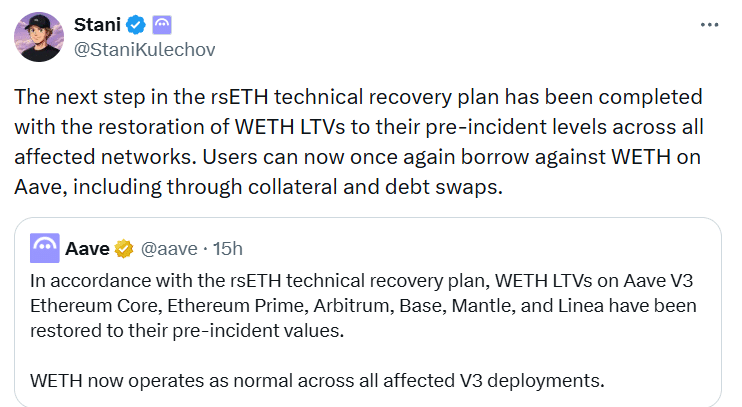
Aave restores WETH borrowing after reinstating loan-to-value ratios for wrapped Ether collateral across Aave V3 Ethereum Core, Ethereum Prime, Arbitrum, Base, Mantle, and Linea. The protocol confirmed that WETH collateral now functions under its pre-incident settings again, allowing collateral swaps and debt swaps to resume normal operations. Aave founder Stani Kulechov said the latest update completed another stage of the rsETH technical recovery plan.

He added that users can once again borrow against WETH and manage collateral positions across affected deployments. The safeguards were initially introduced after attackers exploited Kelp DAO’s LayerZero-powered bridge on April 18. The exploit allowed unbacked rsETH to be used as collateral on Aave V3, enabling large-scale borrowing of wrapped Ether from lending pools. Governance participants later approved proposals to remove the restrictions after recovery efforts progressed without additional signs of user risk.
What damage did the exploit cause to Aave’s ecosystem?
Aave restores WETH borrowing only after several earlier recovery stages were completed across the ecosystem connected to the exploit. The recovery process included restoring Ether backing for rsETH, reopening withdrawals, and coordinating token support from protocols participating in the DeFi United recovery initiative. The exploit created nearly $195 million in bad debt on Aave after attackers allegedly linked to North Korean hacking groups stole around 116,500 Kelp DAO Restaked Ether tokens.
Those assets were then allegedly used to drain wrapped Ether liquidity from lending markets. DefiLlama figures indicated that liquidity on Aave dropped sharply after the exploit, with the protocol’s total value locked declining from almost $23.5 billion in March to around $14.8 billion by Monday, reflecting a decrease of more than $8 billion.
Some analysts believe the sharp decline in TVL reflects lingering concerns about security risks tied to cross-chain DeFi infrastructure. Several users affected by the exploit have also continued questioning how long the broader recovery process could take before confidence fully stabilizes.
Why is the legal dispute over frozen Ether still unresolved?
Aave restores WETH borrowing while legal and governance proceedings tied to frozen Ether connected to the exploit continue moving forward. A binding Arbitrum Improvement Proposal opened for voting on May 15 after affected parties sought approval to transfer 30,765 ETH valued at roughly $71 million at the time from the Arbitrum Security Council wallet to an address controlled by Aave LLC.
Court filings showed the funds had been frozen on April 21 after investigators linked the assets to wallets associated with the exploit. Before the governance proposal advanced, Judge Margaret Garnett of the Manhattan federal court modified an earlier restraining notice on May 9. The modification allowed the transfer process to proceed while protecting governance voters and related participants from personal liability connected to the order.
The dispute over the frozen Ether has not been settled yet. In court filings, law firm Gerstein Harrow LLP said the assets could be linked to the Lazarus Group after blockchain investigators connected the exploit to actors allegedly tied to North Korea. The firm represents families seeking to enforce unpaid terrorism-related judgments against the country.
No court has formally established that attribution as a legal fact. The claims currently remain allegations tied to blockchain analysis rather than confirmed legal findings. Responding to the dispute earlier this month, Kulechov stated that the recovered assets belonged to users affected by the exploit and should not be treated as property lawfully owned by attackers.
How is Kelp DAO adjusting its bridge operations after the incident?
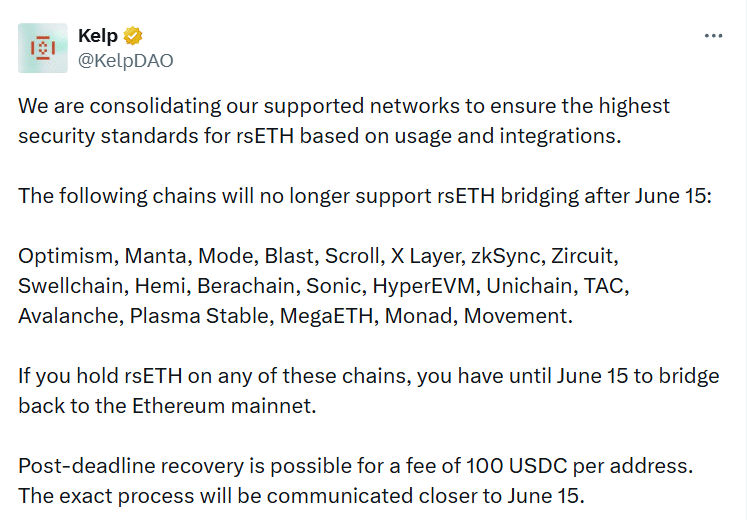
Aave restores WETH borrowing while Kelp DAO continues modifying parts of its rsETH infrastructure following the exploit. Kelp DAO announced plans to discontinue rsETH bridging support on Optimism, HyperEVM, Unichain, Avalanche, and MegaETH after June 15 as part of what it described as a network consolidation effort focused on security and integration activity.
The protocol instructed users holding rsETH on those chains to bridge assets back to the Ethereum mainnet before the deadline. Kelp DAO also stated that users seeking recovery after the deadline would face a 100 USDC fee per address. The protocol said additional recovery instructions would be shared closer to June 15.
Earlier this month, Kelp DAO migrated rsETH to Chainlink’s oracle infrastructure while continuing to attribute the exploit to vulnerabilities connected to LayerZero’s cross-chain systems, its former provider. Some critics within the DeFi sector have argued that protocols launching cross-chain products should implement stronger security safeguards before deployment, particularly after repeated bridge-related exploits across the industry.
What concerns still remain for users and liquidity providers?
Aave restores WETH borrowing during a period when many users and liquidity providers are still evaluating the long-term impact of the exploit on decentralized lending markets. Supporters of the recovery plan believe the return of collateral swaps, debt swaps, and borrowing functionality helps normalize activity across affected markets.

Some analysts also view the phased recovery process as evidence that DeFi protocols are becoming more coordinated during crisis situations. However, skepticism remains over whether user confidence and liquidity levels can fully recover in the near term.
Several market observers continue pointing to the steep TVL decline as evidence that the exploit may leave lasting effects on borrowing activity and risk appetite across cross-chain DeFi products. The broader recovery effort also remains closely tied to unresolved legal proceedings and the eventual distribution of recovered assets tied to the exploit.
Conclusion
Aave restores WETH borrowing as the protocol attempts to move beyond one of the largest disruptions faced by decentralized lending markets this year. The restoration of loan-to-value ratios across affected networks marks an important operational milestone and signals that emergency restrictions tied to the rsETH exploit are gradually being removed.
At the same time, unresolved legal disputes, reduced liquidity levels, and broader security concerns surrounding bridge infrastructure continue shaping sentiment across the market. Kelp DAO’s ongoing network consolidation efforts also reflect how DeFi protocols are reassessing operational risks tied to cross-chain systems after the incident.
For now, the recovery process remains dependent on whether liquidity conditions improve further and whether users regain long-term confidence in decentralized lending infrastructure following the April exploit.
Glossary
Aave: Crypto lending and borrowing platform.
WETH: Wrapped version of Ether used in DeFi.
LayerZero: Cross-chain communication protocol.
Aave V3: The latest version of Aave’s decentralized lending platform.
LTV: The borrowing limit allowed against deposited collateral.
Frequently Asked Questions About Aave Restores WETH Borrowing
What did Aave restore after the exploit?
Aave restored borrowing against WETH collateral across affected markets.
Why did Aave pause WETH borrowing?
Aave paused WETH borrowing to protect users after the Kelp DAO exploit.
How much bad debt did the exploit create?
The exploit created nearly $195 million in bad debt on Aave.
Which Aave markets were affected?
Ethereum Core, Arbitrum, Base, Mantle, Linea, and other Aave V3 markets were affected.
Did the exploit affect Aave liquidity?
Yes, Aave’s total value locked dropped by more than $8 billion after the exploit.
Sources:
Read More: Aave Restores WETH Borrowing After Kelp DAO rsETH Exploit Recovery">Aave Restores WETH Borrowing After Kelp DAO rsETH Exploit Recovery
0
0


 Manage all your crypto, NFT and DeFi from one place
Securely connect the portfolio you’re using to start.

0
0

0
0

0
0

0
0