
Solana's New Fee Design Links Network Usage to SOL Burns

0
0
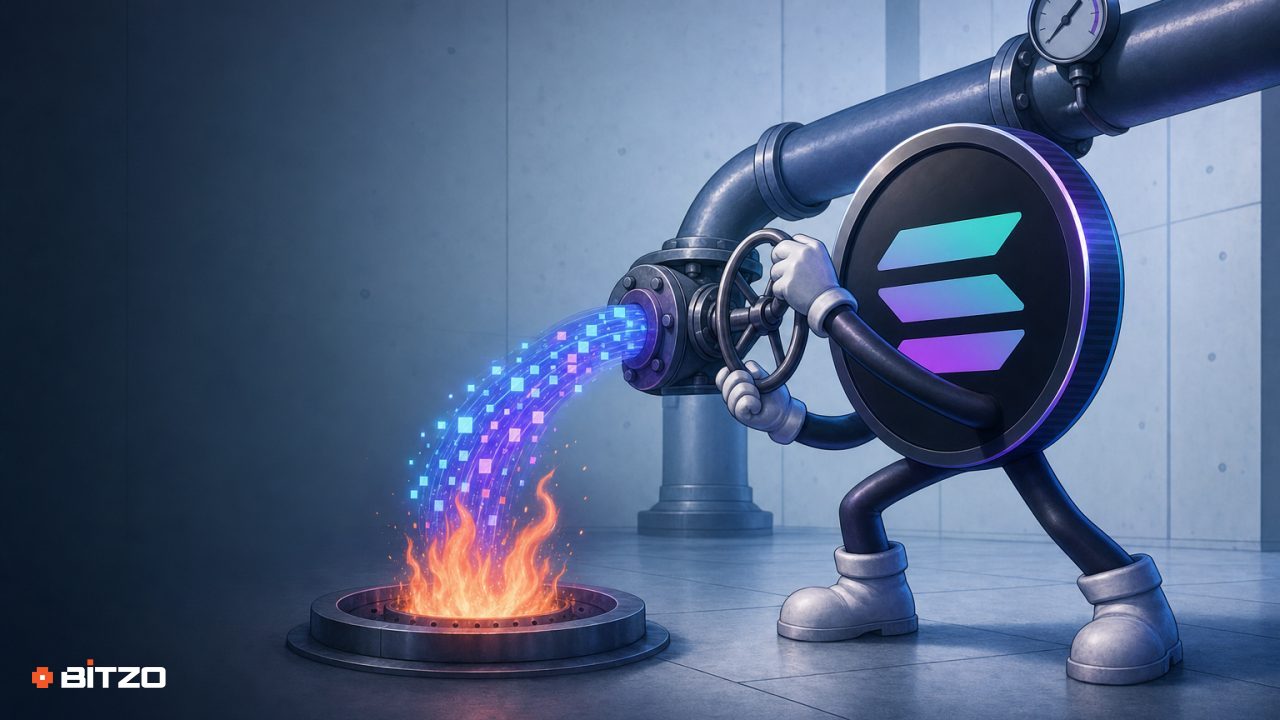
Solana is tweaking how fees move through the system, and it matters because it directly connects everyday network usage to how much SOL gets burned. If you care about token supply, validator rewards, or just what your next transaction will cost, this change is worth a close look.
We’ll break down what actually burns, what still goes to validators, how the burn scales with real activity, and how Solana’s approach stacks up next to Ethereum’s EIP-1559. We’ll also cover the recent Mainnet upgrades that could push more usage through the pipes.
By the end, you’ll know where the burn comes from, what to watch in 2026, and a few traps to avoid.
Solana ties SOL burns to usage by destroying a fixed share of the base fee on every signature. The current base fee is 5,000 lamports per signature, with 50% burned and 50% paid to the block producer. More transactions and signatures mean more SOL burned. Priority fees and other dynamics still matter for final cost, but the base fee burn creates a direct, usage-linked sink for SOL.
- Base fee: 5,000 lamports per signature; split is 50% burned and 50% to the validator Solana Foundation (docs).
- Mainnet capacity bump: per-block compute rose from 60m to 100m units, a 66% lift Solana Foundation (Upgrades).
- Rent cut: on-chain storage costs down ~90%, which can pull in more accounts and activity Solana Foundation (Upgrades).
- Today’s burn vs mint: external trackers estimate ~650 SOL/day burned vs ~60,000 SOL/day minted; proposals suggest a path to materially higher burns if adopted Hubra.
What actually changed in Solana’s fee design?
At the core, Solana burns a portion of the base fee on every signature. The current docs spell it out: the base fee is 5,000 lamports per signature and the base fee is split 50% burned and 50% to the block-producing validator Solana Foundation (docs). That makes the burn rate scale with signatures. No signatures, no base-fee burn. Heavy activity, bigger burn.
Two recent network changes set the stage for more throughput and, potentially, more burns. First, Solana raised per-block compute capacity from 60 million to 100 million compute units on July 29, 2026, which is a 66% increase in headroom for transactions and programs to execute Solana Foundation (Upgrades). Second, the network slashed on-chain rent by about 90%, dropping the target lamports per byte from 6,960 to 696. Lower storage costs make it cheaper to keep and use accounts, which tends to push activity higher over time Solana Foundation (Upgrades).
Why it matters: a base-fee burn that scales with signatures plus higher throughput and cheaper storage is a clear link between real usage and SOL destruction. It’s not the whole story, because tips and local congestion still affect what you pay, but the burn component is now unambiguously tied to activity.
How does the burn scale with real network usage?
Think of it as two dials. Dial one is signatures per block. Every extra signature triggers another base fee, half of which is burned. Dial two is the number of blocks that actually get filled with compute, which depends on throughput limits and demand.
With the compute-per-block limit up 66% to 100 million units, Solana can fit more transaction work into each block without hitting the ceiling as quickly Solana Foundation (Upgrades). If demand shows up, the number of signatures processed per block can climb, and the base-fee burn scales alongside that.
There’s a reality check here. External analysis pegs current burns around ~650 SOL per day against roughly 60,000 SOL minted per day, so the net effect on supply today is still inflationary Hubra. That same report discusses proposals like SIMD-553 and related work that, under their assumptions, could raise burns to roughly 7,500 to 9,000 SOL per day if adopted and if the assumed usage materializes. Those are hypotheticals, not guarantees, but they show how usage-aligned mechanisms could move the needle.
Bottom line: the burn is a function of signatures and blocks processed. More throughput plus more demand equals more burned SOL, while quiet periods dampen burn.
How does this compare with Ethereum’s EIP-1559 burn?
People love to lump all fee burns together, but Solana’s setup is not a carbon copy of EIP-1559. Ethereum burns a dynamically adjusted base fee that targets a specific block fullness, with tips going to validators. Solana burns a fixed share of a per-signature base fee, and handles congestion through compute budgets and localized fee pressure rather than a global base-fee algorithm.
Aspect Solana Ethereum (EIP-1559) What burns by default 50% of base fee per signature docs 100% of base fee per gas unit (variable) Who receives tips/priority Tips and the other 50% of base fee go to block producer Tips go to validator, base fee fully burned Base fee behavior Fixed per signature (5,000 lamports), not auto-tuned per block Algorithmically adjusts to target gas usage per block Congestion handling Compute budgets and local fee markets Global gas market with max base fee targets Supply impact driver Number of signatures processed Gas used times variable base fee
In short, Ethereum’s burn flexes up and down with block demand by design. Solana’s burn is simpler and tied to how many signatures hit the chain. If traffic is heavy, Solana’s burn goes up. If it’s thin, it drops. Different levers, same general idea of linking usage to supply sink.
Who benefits and who pays under this setup?
Users still pay the base fee and any priority fees needed to get included quickly. What changes for users is the predictability of at least one part of the bill: that per-signature base fee is stable, and half of it always gets burned. The rest depends on congestion and how much priority you need.
Validators receive the other 50% of the base fee plus any tips. That’s their incentive to process blocks and maintain performance. A higher burn share would push more value to the sink, but also starve validator economics unless offset elsewhere. Today’s split tries to balance both sides Solana Foundation (docs).
For builders, the big win is clarity. You can forecast the base-fee component of costs with simple math. And with compute capacity up 66% per block, you have more headroom before a traffic jam forces bigger tips Solana Foundation (Upgrades). The rent cut also makes it cheaper to keep accounts alive, which can unlock product designs that were expensive before.
Pro tip: If your app bundles multiple instructions and signatures, profile how many signatures you really need. Trimming even one signature per user flow cuts the base-fee burn they fund and the total they pay.
What risks or edge cases should you watch?
First, fees are still market-driven at the margin. If everyone rushes to mint during a hot launch, priority fees spike. The base-fee burn is predictable, but your total at checkout can still jump. That’s normal in any busy network; just don’t confuse the stable base fee with a stable all-in cost.
Second, usage-linked burns can be lumpy. Bots, liquidations, or airdrop farming bursts might temporarily crank up signatures and burn. That’s not the same as sustainable demand. If you’re thinking in tokenomics terms, focus on multi-week or multi-month averages, not a manic weekend.
Third, supply math is more than burns. External data still shows around ~60,000 SOL minted per day vs about ~650 SOL burned per day today Hubra. Until either issuance falls or burns climb substantially, net supply remains up and to the right. Proposals to route more fees into burns exist, but they’re proposals, not the current rulebook.
Finally, changes to fees, compute limits, or rent can have side effects for performance and economics. Always read the actual network notes when a change ships and test your flow on devnet or a canary release.
How can teams estimate their fee and burn exposure?
You don’t need a fancy model to get 80% of the way there. Start with the base fee per signature, then layer in observed tips during your app’s peak windows. If you’re writing programs, keep a close eye on compute budgets and account touches, since both play into how often you’ll need to juice priority fees.
Here’s a simple checklist you can run before shipping:
- Count signatures per user action. Can you aggregate or reuse where safe?
- Profile compute usage. Trim heavy instructions and avoid hot accounts when possible.
- Measure peak-hour tips in your category for a week. Use the 75th percentile, not the outlier day.
- Budget rent. Even with a ~90% cut, many small accounts add up over time Solana Foundation (Upgrades).
- Stress test with a burst of traffic. Watch inclusion times and tips.
In practice, multiply signatures by the base fee and convert lamports to SOL. That’s your predictable burn-backed component. Then add a tip buffer that matches your category’s congestion profile. Keep it boring and you’ll avoid most surprises.
Is this bullish or just noise for SOL in 2026?
It depends on your time frame. Tying a fixed, transparent burn to signatures is a clean design. Raising capacity by 66% per block can funnel more usage through the network, and slashing rent by ~90% lowers friction for on-chain life. Those are usage-friendly moves, and usage is what fuels the burn Solana Foundation (Upgrades).
But supply cuts need scale. With issuance around ~60,000 SOL per day and the current burn nearer ~650 SOL per day, the needle hasn’t flipped to deflation under today’s rules Hubra. If proposals like SIMD-553 or related fee-routing ideas land in production and usage cooperates, burns could materially rise. Until then, treat the new burn linkage as a meaningful but partial step in the supply story.
If you want a scoreboard, track three things: signatures per day, average tips during peak hours, and any governance activity that changes what portion of fees get burned vs paid to validators. Those three signals will tell you more than any headline.
Common Mistakes
- Assuming all fees burn. Only 50% of the base fee per signature is burned; tips go to validators. Read the fee breakdown before modeling Solana Foundation (docs).
- Using peak-day tips for budgets. Outlier days make apps look unprofitable. Use rolling medians and pad modestly.
- Ignoring rent. The ~90% cut helps, but many small accounts still add cost over months Solana Foundation (Upgrades).
- Overfitting to quiet periods. Low tips during lulls aren’t a promise. Model for bursts.
- Forgetting validator economics. Pushing more to burns without a plan can starve block producers and hurt reliability.
Frequently Asked Questions
Are priority fees burned on Solana?
No. The burn is tied to the base fee per signature, with 50% burned and 50% to the block producer. Priority fees are paid to validators and can jump during congestion Solana Foundation (docs).
Does the rent reduction cut the burn?
Not directly. Rent affects storage costs for accounts. The burn is tied to signatures on transactions, not how much rent you pay. Indirectly, cheaper storage can increase activity, which could increase burned SOL over time Solana Foundation (Upgrades).
Can Solana become deflationary with this fee design alone?
Given current external estimates of ~650 SOL/day burned versus ~60,000 SOL/day minted, no. It would require much higher usage or changes that route more fees into the burn to flip the net supply direction Hubra.
How do the new compute limits affect what I pay?
Higher per-block compute capacity gives more headroom before you need big tips to jump the line. In quiet or moderate periods, it can keep tips lower. In truly hot markets, tips can still spike if demand saturates blocks Solana Foundation (Upgrades).
Do multisig or complex transactions burn more SOL?
They can. Each signature triggers a base fee, and half of that is burned. More signatures mean more fees and more burned SOL per transaction, independent of tips Solana Foundation (docs).
Where can I track burns and issuance?
Use Solana’s official docs for mechanics and explorers for live data. For high-level context on daily burns vs issuance, cross-check multiple dashboards or research posts to avoid relying on a single estimate. The broader trend is more important than any day’s print.
Disclaimer: This article is provided for informational purposes only. It is not offered or intended to be used as legal, tax, investment, financial, or other advice.
0
0

 Manage all your crypto, NFT and DeFi from one place
Securely connect the portfolio you’re using to start.

0
0

0
0

0
0

0
0