
Aave adds Coinbase tokenized stocks as loan collateral

0
0
Aave now has a dedicated vault using several of the leading tokenized stocks by Coinbase. The vault has immediately attracted liquidity in the days since its launch.
Aave is carrying a lending vault in its V4 hub on the Base chain, using selected Coinbase tokenized equities as collateral. As Cryptopolitan reported earlier, Aave’s V4 tools aim to tap traditional finance and bring Wall Street activity to existing chains.
The vault accepts tokenized Apple (AAPL), Amazon (AMZN), Google (GOOG), Meta (META), Microsoft (MSFT), Nvidia (NVDA, and Tesla (TSLA). In exchange, users can receive USDC loans to be used as DeFi liquidity or for further trading.
There is still no standard for using tokenized equities in DeFi. Currently, only Morpho uses curated vaults based on selected Coinbase equities. The vaults are curated by Steakhouse and Chipwork, offering variable-rate USDC loans.
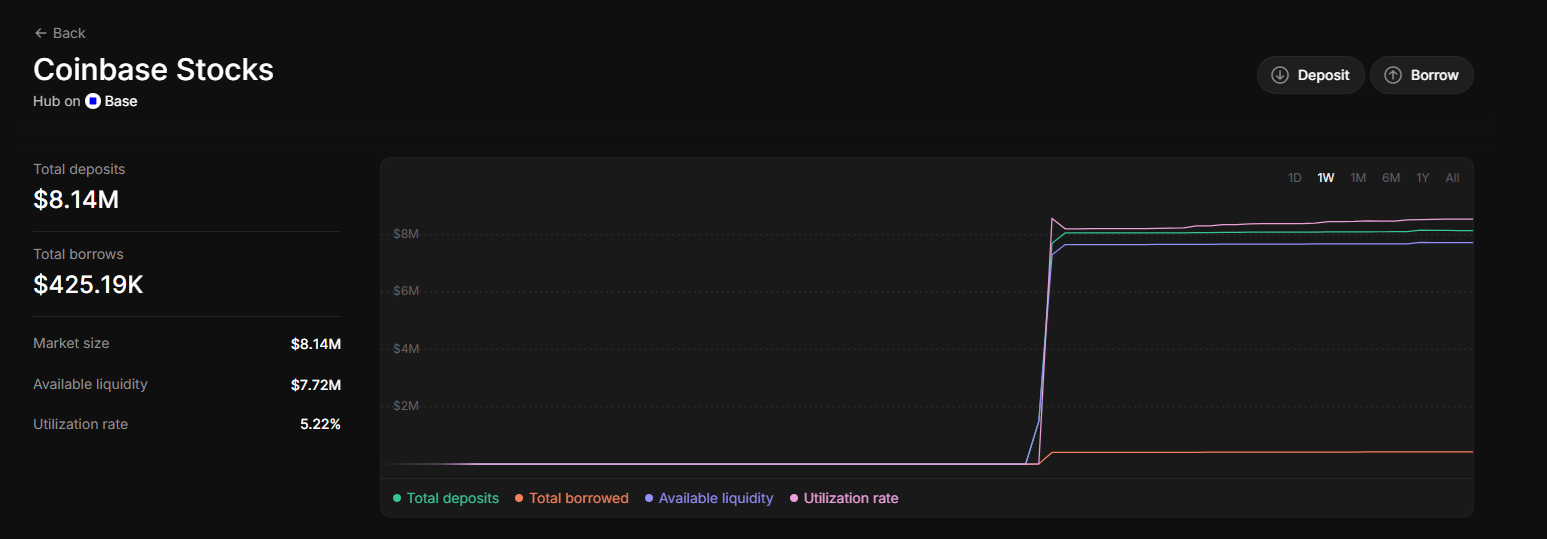
The vault already holds $8.14M in value based on current Coinbase tokenized valuations. For now, the lending utilization is relatively low at 5%. Only around $495K in loans has been issued from the vault. Aave’s goal is to offer much easier access to equity-backed loans, a process that is longer and more involved in traditional finance.
Most of the Magnificent 7 stocks have made double-digit gains in the past month, with the exception of AMZN. The launch arrives just as markets are showing an upward trend again, and US equities are bringing the S&P500 close to new records.
Will Aave be able to set the right price?
The problem with tokenized equities as collateral is that the Coinbase token price is supplied based on official stock trading. The Chainlink oracles do not update during the weekend, meaning loan collateral cannot be priced the same as crypto-based loans.
Stani Kulechov, the founder of Aave, explained Aave’s approach to balancing its lending vault.
‘We measure the volatility properties of an asset, set liquidation thresholds against the bad debt buffer the market is prepared to defend, and calibrate a liquidation bonus that incentivizes to profitably clear liquidatable positions before the price can travel past the safety margin,’ explained Kulechov in an X post.
The approach is similar to the way Aave handles crypto volatility and prevents liquidations. The goal is to avoid loan liquidations, even if the underlying stocks receive negative news over the weekend.
In the case of tokenized shares on Coinbase, the actual assets are held with Alpaca Securities LLC, a regulated broker-dealer. The custodian will not lend or move the shares in any way, and they only serve to back the traded tokens.
In the case of dividends, they will be reinvested and not paid out. Token holders will just have a claim on a growing number of shares.
AAVE trades near three-year peak
The addition of stocks as collateral arrives as Aave increased its relevance in the DeFi space. The recovery of ETH and the expansion of tokenized asset trading boosted demand for lending.
Aave recovered its total value locked to over $19B, the highest level since the hack of Kelp DAO. The protocol achieves over $5M in monthly earnings.
Aave carries over $13B in tokenized loans, most of which use ETH as their main collateral. Most loans are denominated in USDT and USDC.
As a result, AAVE tokens trade close to their three-month peak and near the upper range for 2026. AAVE traded around $148.08, with $255M in daily volume. AAVE open interest fluctuates around $233M, after a recent drop of 9% following liquidations.
Don’t just read crypto news. Understand it. Subscribe to our newsletter. It's free.
0
0

 Manage all your crypto, NFT and DeFi from one place
Securely connect the portfolio you’re using to start.


