
Stablecoin News: Tether Extends Its Lead Over Circle in August

0
0

Stablecoin News: Comparing Tether and Circle Across Every Timeframe
Today's stablecoin news confirms a pattern that's held for years: Tether continues to out-earn every other stablecoin issuer by a wide margin, with the company a distant but growing second. Fee data spanning the past 24 hours, 7 days, and 30 days all show the same ranking, though the size of Tether's lead shifts depending on the window measured.
Tether vs. Circle Across 24h, 7d, and 30d
Per market dashboard data, Tether generated $14.6 million in fees over the past 24 hours, representing 35.7% of all stablecoin issuer fees tracked, compared to Circle's $6.0 million, or 14.5% of the category. Over the past 7 days, Tether's lead scaled proportionally: $102.6 million in fees (31.8% share) against Circle's $42.2 million (13.1%). Across the past 30 days, The USDT provider generated $439.5 million (31.3% share) versus Circle's $183.4 million (13.0%) — meaning Tether has consistently earned roughly 2.4x what the USDC provider earns across every timeframe measured.
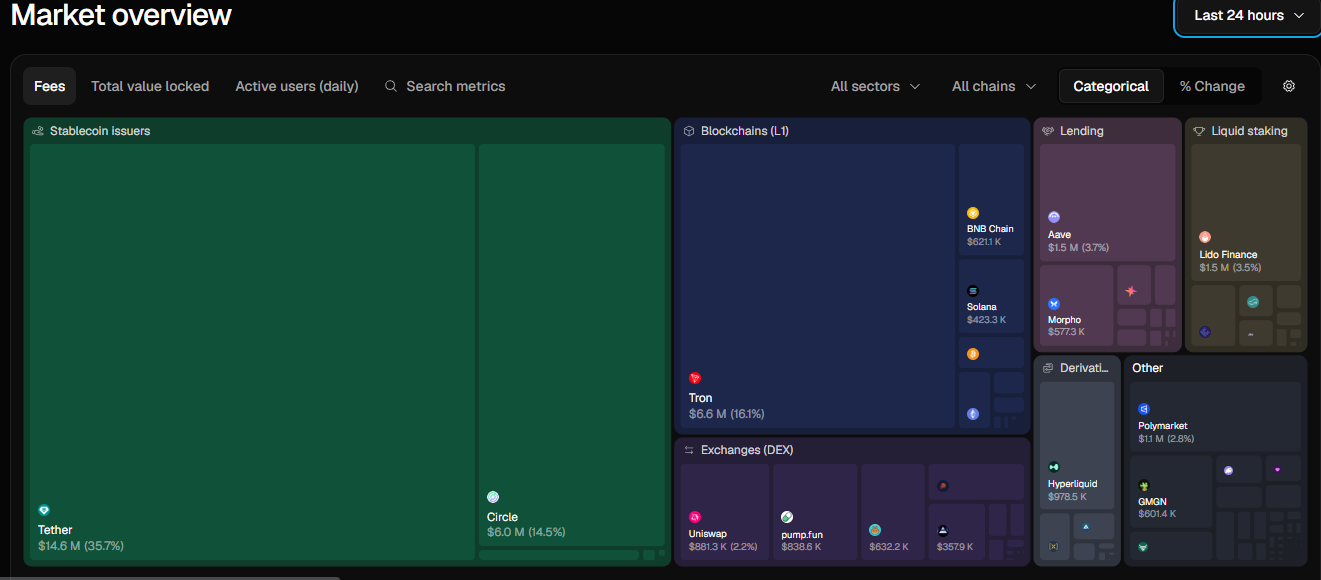 Source: Token Terminal
For broader context, DefiLlama separately tracks Tether's trailing 30-day fee total at approximately $480.96 million with an annualized run rate near $5.94 billion, figures that put Tether's earnings ahead of most DeFi protocols entirely, not just other stablecoin issuers.
Why Tether's Fee Lead Persists
Tether's advantage comes down to a structural business model difference, not simply a larger user base. Both companies earn the bulk of their revenue the same way — interest income on reserves held largely in U.S. Treasury bills — but the USDT issuer keeps far more of what it earns. Tether avoids the heavy distribution costs Circle carries, including hundreds of millions of dollars the USDC issuer has historically paid to exchange partners like Coinbase to support USDC distribution. Tether's reserve composition also skews more diversified, with roughly 81% in cash and cash equivalents alongside secured loans, gold, and Bitcoin, compared to Circle's more conservative, cash-and-Treasury-focused reserve structure.
Scale plays a role too. USDT's circulating supply of roughly $184 billion remains substantially larger than USDC's, and Tether's dominance on networks like Tron, where it functions as a de facto digital eurodollar across emerging markets, continues to generate high transaction-driven fee volume that the USDC issuer hasn't matched at the same scale.
Stablecoin News: Where Circle Is Actually Gaining Ground
Fees and TVL don't tell the full story, though. Per Visa's onchain analytics data, USDC accounted for roughly 70% of adjusted stablecoin transaction volume during the first half of 2026, compared to about 25% for USDT — a dramatic reversal from 2020, when USDT handled nearly 90% of adjusted volume. That shift reflects Circle's institutional positioning: USDC has picked up integrations from Standard Chartered and BNY, and the USDC issuer holds regulatory licenses across the U.S., EU, and Singapore, including MiCA authorization in Europe that the USDT issuer has chosen not to pursue, resulting in USDT being delisted from several European exchanges for EEA users.
In short, The USDT issuer wins decisively on fees, revenue, and total supply — the metrics reflected in today's TVL dashboards — while Circle is building its case around regulatory reach and transaction-level usage, a different kind of lead that doesn't show up in a fee-share chart.
Conclusion
Today's stablecoin news shows Tether firmly ahead of Circle across every fee window measured — 24-hour, 7-day, and 30-day data all point the same direction, with Tether earning roughly 2.4 times what Circle generates. That gap is rooted in Tether's leaner cost structure and larger reserve base, even as Circle continues gaining ground on regulatory compliance and transaction volume share.
Disclaimer
This article is for informational purposes only and does not constitute financial or investment advice. All figures are based on publicly available market dashboard data and DefiLlama as of August 3, 2026, and are subject to change. Always conduct independent research before making any investment decision.
0
0

 Manage all your crypto, NFT and DeFi from one place
Securely connect the portfolio you’re using to start.

0
0

0
0

0
0

0
0