
EU MiCA Regulation Update: Why Circle Wants to Change 30% Bank Rule?

0
0
EU MiCA Regulation News: Perpetual Futures and Stablecoin Rule Changes
The European Commission is reviewing its crypto rulebook, and two major players have now sent feedback. The Hyperliquid Policy Committee (HPC) wants on-chain perpetual futures covered by existing derivatives rules. Circle wants changes to stablecoin issuance and reserves. This EU MiCA Regulation Update centers on one question: how can Europe regulate on-chain derivatives and stablecoins while protecting investors and keeping markets open?
At a Glance
-
HPC wants on-chain perpetual futures treated under the existing MiFID II framework.
-
Circle supports keeping the stablecoin multi-issuance mechanism.
-
Circle also proposes changes to reserve liquidity and concentration rules.
-
Both submissions call for targeted adjustments, not a rebuild.
Why Is the EU Reviewing the MiCA Regulation?
The EU adopted the Markets in Crypto-Assets Regulation (MiCA) in 2023. It became the first major framework built for crypto-asset markets. It sits beside MiFID II, which covers securities and derivatives.
In May, the Commission opened a targeted consultation on how MiCA should evolve. Its questions go beyond the current rules. They cover perpetual futures, stablecoins, and how much access EU investors should have to global liquidity.
Hyperliquid Pushes for MiFID II Rules for On-Chain Perpetual Futures
HPC filed its response on October 1, 2026. It says this is its first policy filing outside the United States. The group argues that classification should follow an instrument's economic features, not the technology that records it.
HPC says ESMA guidelines already treat perpetual futures as MiFID II instruments. It asks the Commission to confirm this through those guidelines, with no new law needed.
The group also says perpetual futures differ from contracts for difference (CFDs). A CFD provider usually sets the price and takes the other side of the trade. A perpetual future trades on a central order book against other participants. HPC argues the strict retail limits written for CFDs should not be copied over.
Finally, HPC wants regulators to recognize that public blockchains are verifiable. It says firms should not have to file reports on data that is already public. These are HPC's recommendations, not confirmed changes.
MiCA vs. MiFID II: How Could On-Chain Derivatives Be Classified?
Classification decides which rules apply, which supervisor oversees a product, and which investors can reach it.
| Area | MiCA | MiFID II |
| Main focus | Crypto-asset markets and covered services | Financial instruments, including derivatives |
| Relevance | Defines the scope of crypto-asset regulation | HPC argues perpetual futures fit here |
| Key question | Does the product fall within MiCA's scope? | Should it be treated as a financial instrument? |
The right framework depends on a product's legal classification. The two are not always mutually exclusive.
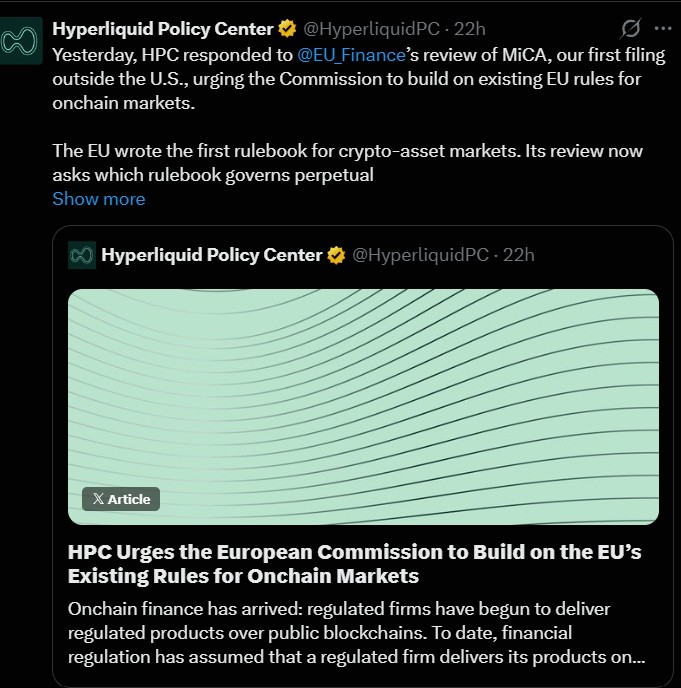
Source: Hyperliquid X Post
Circle Proposes Changes to MiCA Stablecoin Issuance Rules
Circle says it is the largest MiCA-authorised e-money token issuer. Its response asks the Commission to keep multi-issuance. Under this model, a global stablecoin is co-issued by an EU-authorised entity and a foreign-regulated one.
Circle notes that only three of the top 25 stablecoins by market value are MiCA-regulated: USDC, USDG, and EURC. It argues that restricting multi-issuance could push users to offshore providers outside EU protections.
For the longer term, Circle suggests an equivalence and recognition regime for foreign-regulated stablecoins. Home regulators would keep primary oversight. EU-licensed institutions would handle local distribution. These are Circle's arguments, not outcomes.
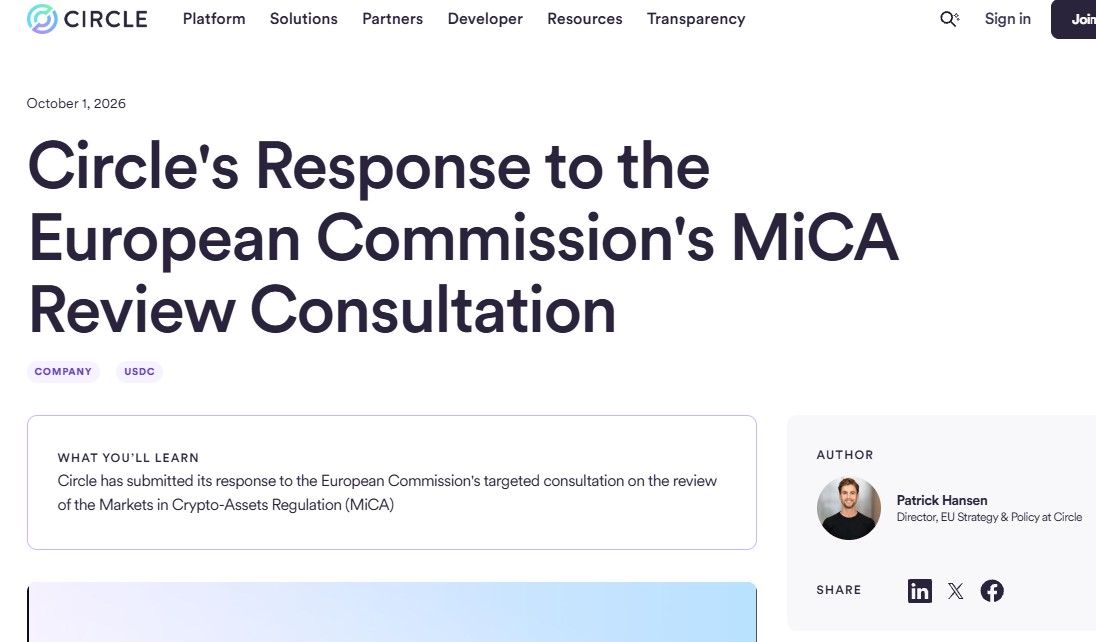
Source: Circle X Post
Stablecoin Reserve Requirements and Liquidity Concerns Explained
MiCA crypto regulation now requires e-money token issuers to hold at least 30% of reserves in commercial bank deposits. For significant tokens, the minimum rises to 60%. Circle says this raises exposure to bank credit and counterparty risk. It suggests a minimum asset liquidity requirement instead.
Circle also wants two EBA technical limits removed. The first is the 35% cap on exposure to a single sovereign asset. The second limits exposure to any one bank to 1.5% of that bank's total assets. Circle says the bank rule could force large issuers to work with dozens of banks, which adds operational complexity. Regulators have not accepted these proposals.
What Could the MiCA Review Mean for Crypto Traders and Stablecoin Users?
If some ideas were adopted, EU users might see more regulated on-chain derivatives venues. Perpetual futures could be supervised under MiFID II rather than a separate regime. Stablecoin reserve management and distribution could also change.
Regulators must still balance investor safeguards, market liquidity, and compliance costs. None of this is confirmed. No access improvements or price effects should be assumed until the Commission announces decisions.
EU MiCA Regulation Update: Key Timeline and Next Steps
-
2023: MiCA is adopted.
-
May 2026: The Commission opens a targeted consultation.
-
October 1, 2026: HPC's submission is reported.
-
October 2, 2026: Circle's submission is reported.
-
Next: The Commission and EU authorities review the feedback. No decision date has been set in the sources.
Submissions are part of the consultation. They do not amend MiCA.
Conclusion: What Happens Next for the EU MiCA Framework?
HPC and Circle both ask for focused adjustments to existing rules. HPC targets derivatives classification. Circle targets stablecoin issuance and reserves. The final result depends on the Commission's review and any later guidance or rule changes. Traders, stablecoin users, and crypto businesses should follow official EU announcements.
Disclaimer: This article is for informational and educational purposes only. It is not financial, investment, or legal advice. Regulatory proposals may change. Crypto assets carry high risk. Check official EU publications and consult qualified professionals before making financial or compliance decisions.
0
0

 Manage all your crypto, NFT and DeFi from one place
Securely connect the portfolio you’re using to start.


