
Singapore Adds Hyperliquid to Investor Alert List Over Licensing

0
0
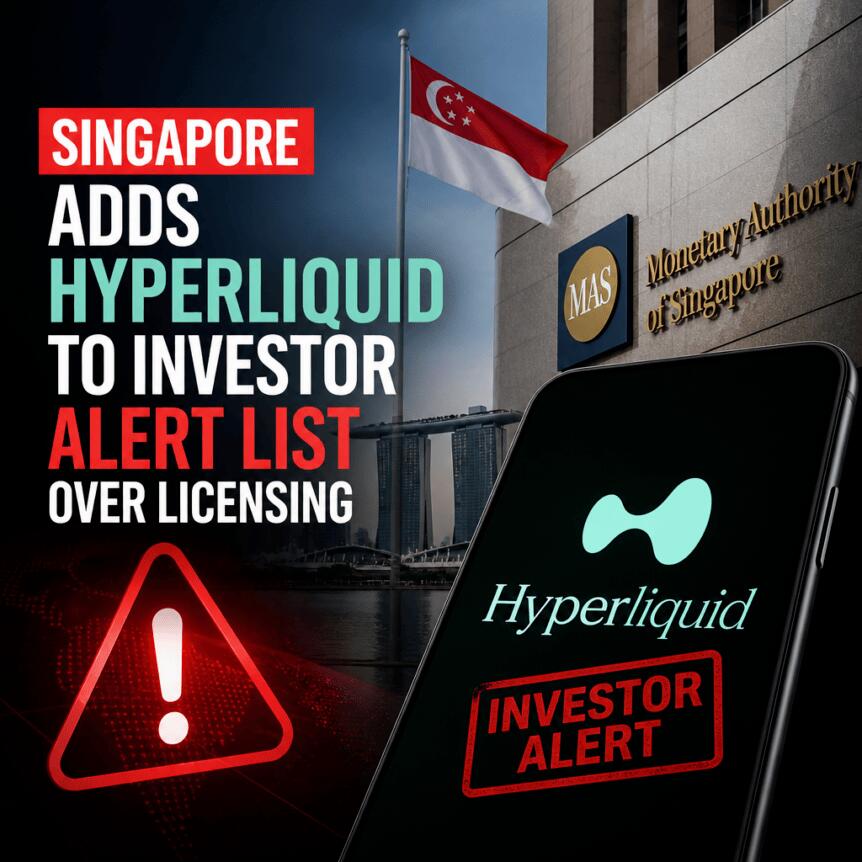
The Monetary Authority of Singapore (MAS) has added Hyperliquid—an exchange platform focused on perpetual trading—to its Investor Alert List, a consumer-protection tool used to flag entities that the public may mistakenly perceive as being licensed or authorized by the regulator.
MAS stated that the new entry covers the Hyper Foundation website and the Hyperliquid trading app. MAS previously expanded the same alert list to other crypto trading platforms, underscoring Singapore’s approach to reducing regulatory confusion and strengthening investor safeguards.
Key takeaways
- MAS added Hyperliquid and the related Hyper Foundation website/app to the Investor Alert List as a potential source of public misunderstanding about regulatory status.
- Inclusion on the Investor Alert List is not a ban and does not, by itself, indicate an enforcement action by MAS.
- MAS has recently tightened oversight of crypto firms that serve overseas customers, emphasizing licensing requirements and AML/CFT alignment.
- Hyperliquid says it has not represented itself as MAS-licensed or authorized and argues that its permissionless infrastructure has not changed.
What MAS’s Investor Alert List signals
MAS’s Investor Alert List is designed to protect consumers by identifying entities that may be wrongly viewed as licensed or regulated by the central bank and financial regulator. The regulator has repeatedly clarified that being listed does not automatically equate to prohibited activity under Singapore law.
MAS’s decision to include Hyperliquid specifies both the ecosystem’s website and the trading app. This level of detail matters for compliance teams and institutional counterparties that may perform due diligence using public regulatory signals—because alert-list entries often trigger internal review of marketing, representations, and risk controls tied to a platform’s perceived regulatory status.
MAS’s process also reflects a broader supervisory challenge in crypto: decentralized or non-traditional trading services can be difficult to categorize in conventional licensing frameworks, and customers may assume legitimacy based on branding, accessibility, or geographic association.
Hyperliquid’s response and the compliance angle
Hyperliquid said it has never claimed to be licensed or authorized by MAS. The platform added that nothing about its permissionless infrastructure has changed following the alert-list update.
From a regulatory monitoring standpoint, the statement is significant because it addresses a core risk highlighted by the Investor Alert List: whether public-facing material could lead users to believe that a platform is supervised by MAS.
For institutions—such as banks, payment providers, wealth managers, and regulated intermediaries—the practical question is not only whether a platform is “approved,” but how it is marketed and how counterparty engagements are documented. An investor alert can influence counterparty risk assessments, onboarding decisions, and ongoing third-party monitoring, particularly where customer communications or operational integration could create regulatory perception risk.
Singapore’s tightening crypto oversight: licensing and AML/CFT alignment
MAS has increasingly applied licensing and compliance expectations across the crypto sector. In May 2025, MAS ordered crypto companies serving overseas customers to either obtain licenses or cease operations. MAS described the step as consistent with its longstanding regulatory position, rather than a new shift in policy.
According to MAS, the directive closed a previously exploited gap where some Singapore-based firms avoided licensing by focusing on overseas customers. MAS said it had communicated its position since 2022 and moved to end a transition period for firms that continued operating without the required authorization.
MAS also framed its measures as part of strengthening consumer protection and aligning Singapore’s framework with international standards on Anti-Money Laundering (AML) and Countering the Financing of Terrorism (CFT). This emphasis is relevant for regulated entities assessing cross-border services, because crypto businesses may operate across jurisdictions while still relying on global infrastructure and customer access.
For compliance officers, these developments reinforce a key point: supervisory expectations can apply even where services are not marketed as being Singapore-centric, particularly when a firm’s Singapore footprint, corporate presence, or operational arrangements create regulatory reach.
Related regional context and unresolved distinctions
The use of an investor alert list, rather than immediate enforcement, highlights an important regulatory distinction in Singapore’s approach: MAS appears to differentiate between consumer-perception issues and licensing/authorization determinations. While alert-list inclusion is not itself an enforcement action, it can function as an early-warning mechanism that signals how MAS views the likelihood of public misunderstanding.
This also leaves several issues for ongoing clarification in the broader ecosystem. For example, decentralized or permissionless trading structures may challenge conventional definitions of “licensed activity,” particularly when users access the service through applications or websites tied to identifiable organizational entities. Regulators across multiple jurisdictions have grappled with how licensing obligations apply to decentralized finance interfaces, especially when consumer access is straightforward.
Separately, MAS’s enforcement posture on licensing for firms serving overseas customers suggests that jurisdictional boundaries may not shield entities from Singapore’s regulatory reach where licensing obligations attach through corporate structure or operational presence.
What to watch next
Hyperliquid’s alert-list addition is unlikely to settle questions about licensing classification or the regulatory treatment of permissionless services, but it does raise near-term compliance considerations for institutions engaging with or referencing the platform. MAS’s broader enforcement direction—especially around licensing obligations and AML/CFT expectations—will remain the key factor shaping how similar platforms are assessed in future regulatory updates.
This article was originally published as Singapore Adds Hyperliquid to Investor Alert List Over Licensing on Crypto Breaking News – your trusted source for crypto news, Bitcoin news, and blockchain updates.
0
0

 Manage all your crypto, NFT and DeFi from one place
Securely connect the portfolio you’re using to start.

0
0


0
0

0
0