
How to Send USDC Without Holding ETH for Gas Fees

0
0
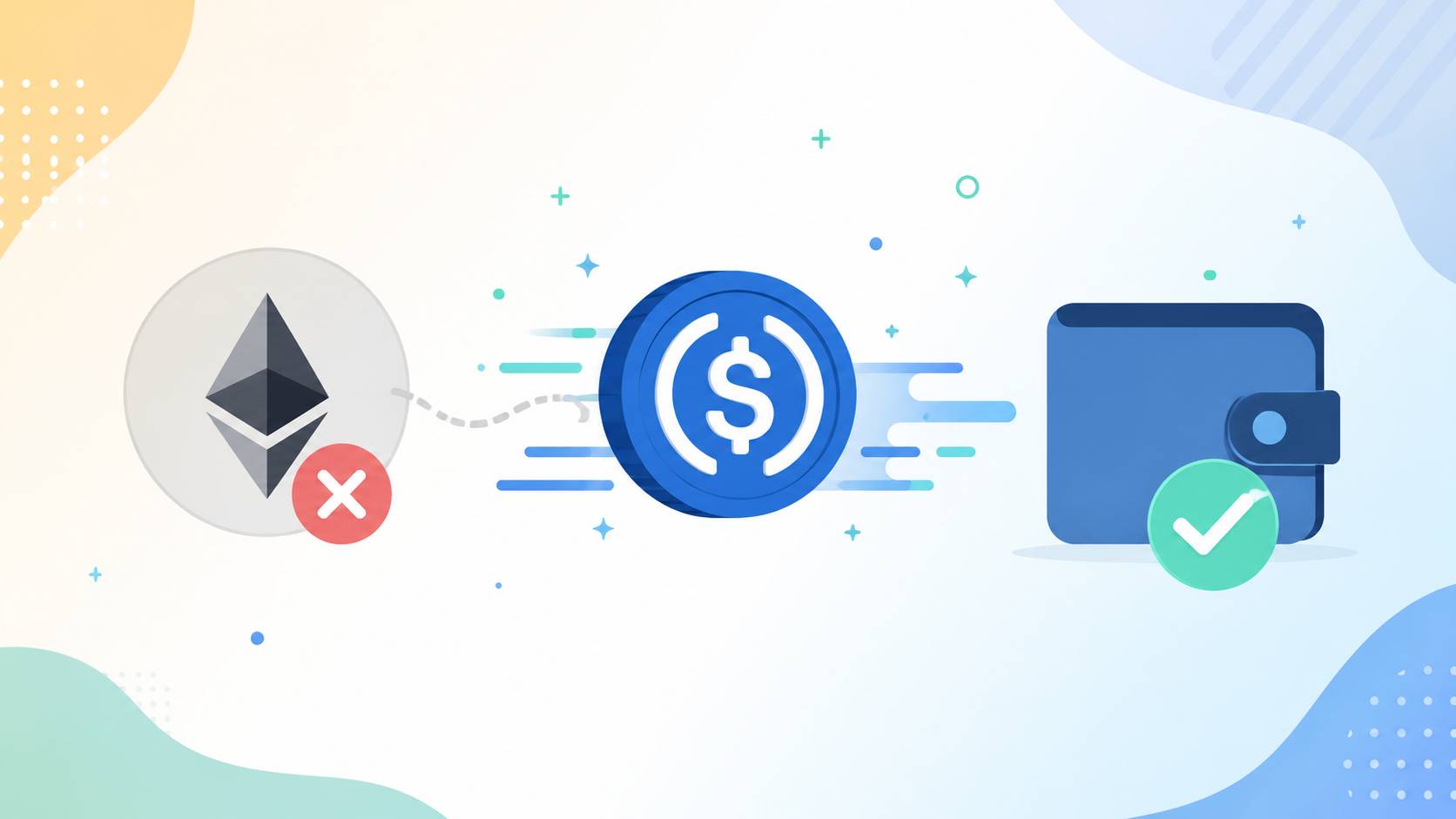
USDC sits in millions of wallets across Ethereum without ever moving because the holder doesn't have ETH for gas. The friction has been a known problem since Ethereum's earliest days. In 2025 and 2026, that problem will finally have a real fix at the protocol level, and a small group of wallets now lets users send USDC without holding ETH at any point.
What Changed in 2025 With Pectra and EIP-7702
Ethereum's Pectra upgrade went live on mainnet on May 7, 2025. The upgrade activated EIP-7702, a proposal that lets standard wallet addresses temporarily behave like smart contract accounts during a single transaction.
The shift is technical, but the user-facing effect is direct: a wallet with only USDC can now send that USDC, with the network fee paid in USDC instead of in ETH.
Before Pectra, sending USDC required ETH for gas. The wallet checked for an ETH balance, used it to pay the validator, then transferred the USDC. If the wallet had USDC but no ETH, the transfer failed with an "insufficient funds for gas" error.
This blocked stablecoin-only users from any on-chain activity, which was a major barrier to broader stablecoin adoption.
EIP-7702 removes the barrier by letting an externally owned account delegate to a smart contract for one transaction. The delegation enables a paymaster system to pay the gas fee in ETH on the user's behalf, then deduct the equivalent value in USDC from the transaction itself.
The Paymaster Architecture
A paymaster is a smart contract that pays gas on behalf of users. The user signs an authorization that grants the paymaster permission to deduct a small amount of USDC from their balance.
The paymaster pays the gas in ETH at the moment of execution. The user never holds ETH at any step. This approach lets users pay gas in USDC without ever touching the native token.
Circle, the issuer of USDC, runs an official Circle Paymaster service available across Ethereum, Arbitrum, Avalanche, Base, OP Mainnet, Polygon PoS, and Unichain.
Wallet providers integrate the paymaster directly into their send flow, so users see a single confirm screen with the gasless USDC option already selected.
Three components handle the gasless USDC transfer:
-
EIP-2612 permit: the user signs a message authorizing the paymaster to spend a small amount of USDC
-
EIP-7702 delegation: the wallet temporarily acts as a smart contract for the transaction
-
Paymaster contract: pays the ETH gas fee and deducts the equivalent in USDC
The whole process happens in one click from the user's perspective. The technical layer runs in the background.
Wallets Supporting Gasless USDC in 2026
The question of how to send USDC without ETH has multiple working answers in 2026, depending on which wallet a user chooses. Several wallets now ship send USDC without ETH support, with EIP-7702 wallet integration becoming standard across major providers:
IronWallet integrates gasless USDC transfers on Ethereum, with the fee deducted directly from the USDC balance. The wallet handles routing automatically when the user has no ETH balance.
Trust Wallet rolled out gas sponsorship in November 2025, covering up to four swaps per day on Ethereum, BNB Chain, and Solana. Ethereum swaps require a $50 minimum per transaction.
MetaMask offers a Gas Station feature that lets users pay swap fees in approved tokens, including USDC on Ethereum. The wallet charges a 0.875% in-wallet swap fee. Bitget Wallet uses EIP-7702 to let users pay gas in stablecoins, including USDC on Ethereum.
Each wallet has trade-offs on chain coverage, fee structure, and supported transaction types.
Sending USDC Without ETH Through IronWallet
The six steps below walk through a complete gasless USDC transfer using IronWallet.
-
Download IronWallet from the App Store or Google Play. The app runs on iOS and Android.
-
Create or import a wallet. No email, no phone number, no KYC, no verification step. The app generates a 12-word seed phrase locally on your device.
-
Back up your seed phrase securely. Write it down offline. IronWallet uses double-key encryption on the device, and the seed phrase is the recovery method if the device is lost.
-
Add or select the Ethereum network inside the app. Copy your ERC-20 address and use it to receive USDC.
-
Open the send screen, enter the recipient address and the USDC amount. IronWallet routes the transfer through the gasless flow automatically when the wallet has no ETH balance.
-
Confirm with PIN or biometric login. The fee is deducted directly in USDC, not in ETH. No separate gas token balance is required at any step.
The same flow applies to gasless USDT on Tron. Add the Tron network in the app, copy your TRC-20 address, and send USDT without holding TRX.
Layer 2 as an Alternative for Lower Costs
For users open to switching networks, Layer 2 chains like Base, Arbitrum, and Optimism offer USDC transfers at fees well below Ethereum mainnet even before gasless features apply.
Base gas runs at 0.006 gwei as of May 2026, which translates to fractions of a cent per USDC transfer.
Gasless USDC works on Layer 2 chains too. Circle Paymaster supports Arbitrum, Base, OP Mainnet, and Polygon PoS, so users can combine the lower L2 base cost with the paymaster mechanism for the cleanest experience.
Conclusion
How to send USDC without ETH is no longer a workaround in 2026. Ethereum's Pectra upgrade and EIP-7702 turned gasless USDC transfers into a default option across multiple wallets, with Circle Paymaster providing the protocol-level infrastructure.
IronWallet, Trust Wallet, MetaMask, and Bitget Wallet all offer different implementations of the same idea: users send USDC with no ETH balance at any point.
The shift turns gasless stablecoin transfers from a niche feature into a default capability across the self-custody category, with no ETH for gas required at any step.
The gas token barrier that blocked stablecoin-only users for years is mostly gone. What replaced it is a small fee paid in USDC and a one-click signing flow that handles the technical layer in the background.
FAQ
Which wallets let me send USDC without ETH?
In 2026, several wallets offer gasless USDC transfers on Ethereum. IronWallet deducts the fee directly from the USDC balance. Trust Wallet provides gas sponsorship for swaps with a $50 minimum. MetaMask offers a Gas Station feature with USDC as a supported gas token. Bitget Wallet uses EIP-7702 to pay gas in USDC across eight chains. Each implementation has different trade-offs on chain coverage and fee structure.
How much does a gasless USDC transfer actually cost in 2026?
A typical gasless USDC transfer through a paymaster costs slightly more than underlying ETH gas, since the paymaster takes a small premium. With Ethereum gas at 0.4 gwei in May 2026, a standard transfer costs $0.05 to $0.10 in ETH. A gasless version typically runs $0.20 to $0.50 in USDC.
Can I use gasless USDC on Layer 2 networks like Base or Arbitrum?
Yes. Circle Paymaster supports Arbitrum, Base, OP Mainnet, and Polygon PoS in addition to the Ethereum mainnet. Layer 2 fees are already low enough that gasless USDC on L2 is mostly a user-experience improvement, not a cost-saving measure. Users moving USDC frequently on L2 may find the convenience worth the small paymaster premium.
Do I need to hold any ETH at all when using gasless USDC?
No. A wallet with only USDC and zero ETH can complete gasless USDC transfers through any paymaster-supporting wallet. The paymaster covers all gas costs in the background. This makes USDC-only wallets fully functional for the first time in Ethereum's history, which removes the longstanding requirement to acquire ETH just to participate in on-chain activity.
Disclaimer: This article is provided for informational purposes only. It is not offered or intended to be used as legal, tax, investment, financial, or other advice.
0
0


 Manage all your crypto, NFT and DeFi from one place
Securely connect the portfolio you’re using to start.


0
1


0
0