
Balaji Pushes for Malaysia Deal, Warns of Exit After Network School Probe

0
0
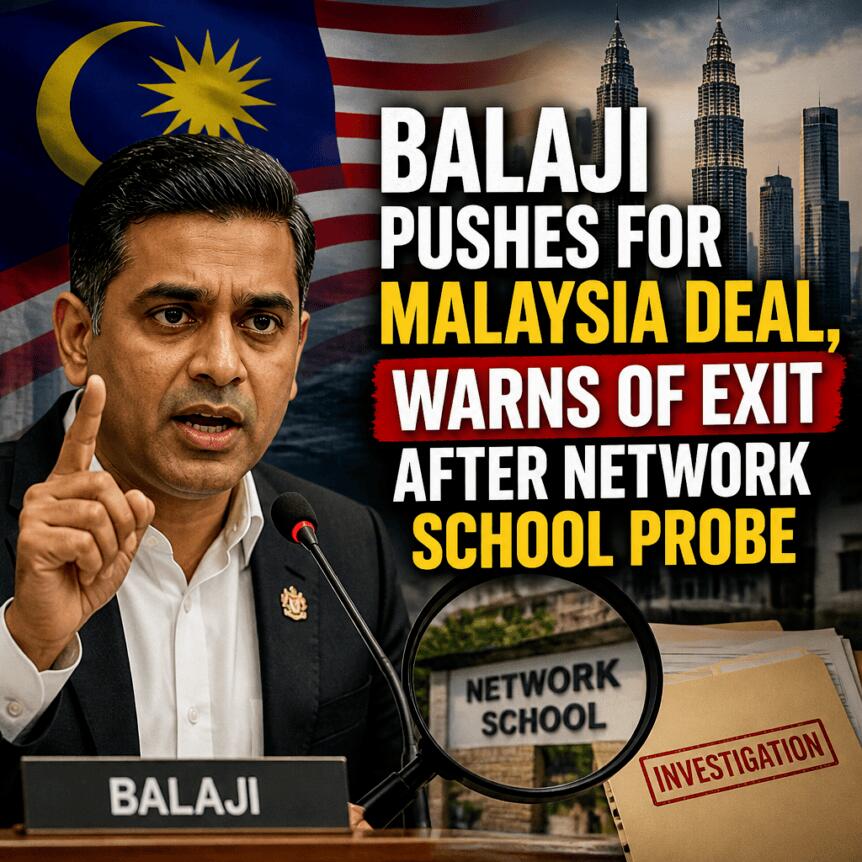
Balaji Srinivasan, the founder of Network School—an in-person tech community in Malaysia—says he is seeking an official memorandum of understanding (MoU) with Malaysia after authorities opened an investigation into allegations that the community was sheltering Israeli citizens using second passports.
Malaysia’s Home Affairs Ministry said it is checking the Forest City project in Johor after reports claimed Israelis were present in violation of immigration rules. The ministry said initial checks found that all 266 foreign nationals linked to the community were holding valid travel documents, while the investigation continues.
Key takeaways
- Malaysia is investigating Network School after claims that it included Israelis who would be in breach of immigration requirements.
- The Home Affairs Ministry reported that preliminary document checks for 266 foreign residents showed valid paperwork.
- Srinivasan is requesting an MoU to provide “legal certainty” for future investment and operations in Malaysia.
- He has paused planned expansion spending in Malaysia pending assurance that the allegations will not repeat.
- The case underscores how “crypto utopias” and digital-native communities still rely on conventional state frameworks for legality.
An MoU aimed at legal certainty
Srinivasan framed the request for a formal agreement as a solution to uncertainty around the legal standing of Network School’s residents and investors. He said that without a document clarifying that the community is welcome, Network School could shift its capital elsewhere.
In a video directed to Malaysian Prime Minister Anwar Ibrahim, Srinivasan said he wants something more concrete than broad assurances that “tech is welcome,” arguing that the community needs personal confirmation that it is legally and politically accepted. He did not detail the final structure of the agreement, but suggested it could take the form of a memorandum of understanding or involve an adjustment to a special economic zone provision.
According to Srinivasan, the MoU is also intended to ensure that additional capital commitments do not become hostage to future immigration disputes. He said he is putting further investments in Malaysia, including a $122 million expansion plan for the community, on hold until he receives “sufficient assurance” that the situation will not recur.
Malaysia’s investigation: initial checks show valid documents
Malaysia’s Home Affairs Ministry said Tuesday that it is investigating the Network School project in Johor following allegations that the community included Israelis in a way that would violate immigration law. The ministry reported that its initial checks reviewed documents for 266 foreign nationals connected to the effort and found that they were all in possession of valid travel documents.
While the preliminary findings suggest paperwork compliance at least on the documentation front, the fact that a probe has been initiated indicates that authorities are still looking beyond the mere existence of valid travel documents—particularly in relation to nationality-specific entry requirements and the underlying claims prompting the scrutiny.
How the allegations surfaced
The claims appear to have originated from social media. The article reports that the allegations were traced back to a post on Instagram from the activist group “Malaysian Protest 4 Palestine,” which accused Network School of operating as a “gathering place for Israeli entrepreneurs.”
Under Malaysia’s rules, Israeli passport holders are reportedly not allowed to enter without written permission from the Malaysian Ministry of Home Affairs, and Malaysia does not recognize Israel or maintain diplomatic relations with the country. This policy forms the basis for why the allegations—if true—would raise legal concerns.
It also highlights a recurring challenge for projects that present themselves as international or border-agnostic communities: even when members hold valid documents, eligibility and entry permissions can still hinge on a broader framework of state policy.
The broader tension for border-dependent “crypto utopias”
Network School is marketed as a physical community for tech builders and founders, and Srinivasan has previously positioned it as part of a more ambitious vision for technology-driven institutions. The current dispute reflects a tension many similar communities face: they may want to create digital-native ecosystems—complete with their own norms, networks, and economic activity—yet their continued operation ultimately depends on conventional government permission and legal clarity.
The episode is therefore more than a single-country immigration story. It raises questions about how quickly digital communities can institutionalize without first securing stable legal frameworks for their participants—particularly when public allegations or geopolitical sensitivities intersect with immigration rules.
In Srinivasan’s account, the need for an MoU is not about asking for special treatment, but about reducing uncertainty that can immediately affect capital plans. That dynamic is a practical issue for builders and investors alike: expansion timelines, residence planning, and onboarding of international participants can all become difficult if the legal status of the community or its membership composition remains in dispute.
While Malaysia’s ministry has stated that initial document checks found valid papers for the 266 foreign nationals involved, the investigation’s outcome—and whether an MoU will satisfy the “assurance” Srinivasan is demanding—will determine whether Network School can proceed without further interruptions.
Readers should watch next for the scope of Malaysia’s continuing review and whether Srinivasan’s requested agreement clarifies how immigration requirements will be applied to Network School residents going forward.
This article was originally published as Balaji Pushes for Malaysia Deal, Warns of Exit After Network School Probe on Crypto Breaking News – your trusted source for crypto news, Bitcoin news, and blockchain updates.
0
0

 Manage all your crypto, NFT and DeFi from one place
Securely connect the portfolio you’re using to start.


0
0


0
0