
Greece Welcomes First MiCA Crypto Entrants as Watchdog Rebuts Binance-Lagarde Claim
0
0
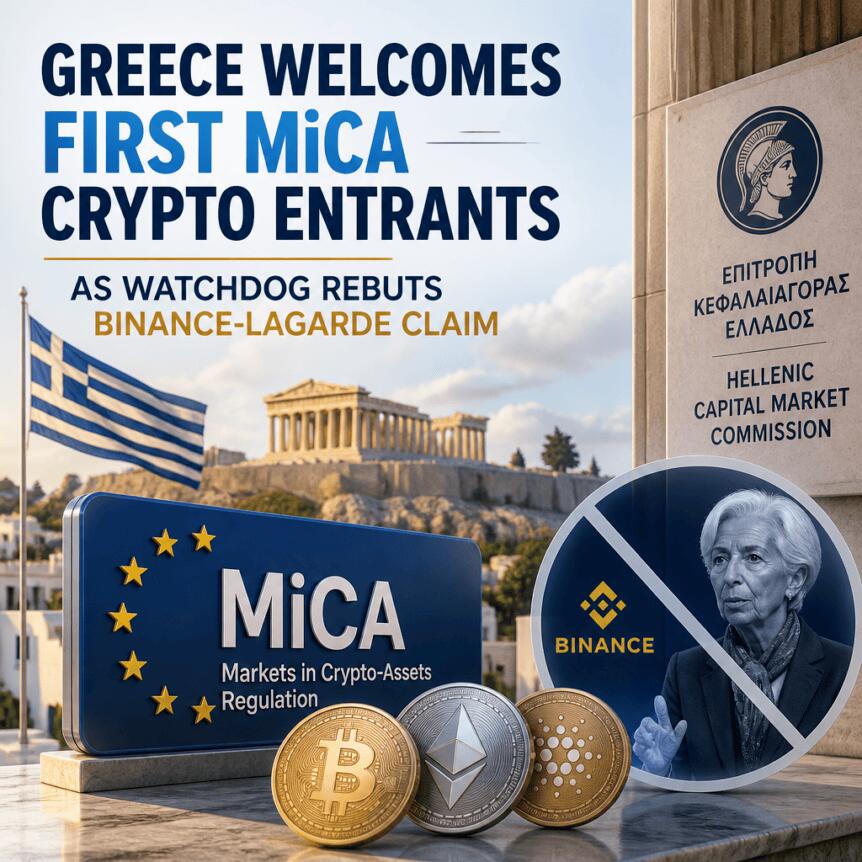
Greece has added its first crypto-asset service providers to the EU’s Markets in Crypto-Assets (MiCA) register, with four firms now appearing on the list updated by the European Securities and Markets Authority (ESMA). The move marks a fresh step in the country’s rollout of MiCA supervision and highlights how regulatory responsibilities can be split across different Greek institutions.
ESMA’s updated register, posted Thursday, lists four Greek providers—BCash, Xenios Blockchain Group, Capital Wallet Greece and Piraeus Bank—bringing the total number of unique providers on the MiCA register to 359. The additions also raise questions investors may be watching closely: how quickly Greek regulators approve new entrants, and what that could mean for larger exchanges considering EU-wide “passporting” under MiCA.
Key takeaways
- ESMA’s MiCA register now includes four Greek providers: BCash, Xenios Blockchain Group, Capital Wallet Greece and Piraeus Bank.
- The Greek entries bring the EU-wide total to 359 unique crypto-asset service providers on the register.
- In Greece, MiCA supervision is split: HCMC is the competent authority for three providers, while the Bank of Greece oversees Piraeus Bank.
- HCMC has reiterated a denial of reported remarks linked to Binance’s MiCA application following earlier coverage by the Wall Street Journal.
Greece’s first MiCA-listed providers enter the EU register
With the latest ESMA update, Greece joins the ranks of EU member states that already have crypto-asset service providers formally listed under MiCA. The four newly listed providers are not just symbolic additions—they indicate that Greece has moved from setting up the framework to enabling specific regulated services to operate within the EU passporting regime.
ESMA maintains the MiCA register of crypto-asset service providers across the bloc, updating it as authorisations are granted. According to ESMA’s updated listing, six additional providers from Germany, France and Slovenia were also added alongside the Greek names, contributing to the register’s growth to 359 unique providers.
For market participants, the practical significance is straightforward: a provider listed under MiCA can operate under EU-wide rules, which reduces legal uncertainty for users and counterparties across borders. It also serves as a reference point for compliance expectations—particularly around governance, customer protection and operational controls—when assessing the maturity of local ecosystems.
Why the “passporting” question still matters for major exchanges
While Greece’s first MiCA entries establish local regulatory momentum, they also reignite attention on how other major market players navigate the same framework. Binance, the world’s largest crypto exchange by trading volume, was previously seen as a candidate for a Greek authorization that could have supported broader EU access under MiCA’s passporting system.
However, Binance withdrew its application before a formal decision by Greece’s Hellenic Capital Market Commission (HCMC). Cointelegraph previously reported that Binance withdrew its application on June 24 prior to the HCMC issuing a decision (as referenced in earlier coverage: Cointelegraph).
Nearly three months later, the Wall Street Journal reported that European Central Bank (ECB) President Christine Lagarde had intervened to block the application. The publication said HCMC denied that officials made the comments attributed to them, but it did not provide further detail. The report has since remained part of the background to Greece’s evolving MiCA approvals.
HCMC and the central bank split MiCA oversight in Greece
Greece’s first MiCA additions also offer a window into how the country structures regulatory responsibility. ESMA’s listing reflects that HCMC is designated as the competent authority for BCash, Xenios Blockchain Group and Capital Wallet Greece. The Bank of Greece, meanwhile, is listed as the competent authority for Piraeus Bank.
This arrangement is consistent with MiCA’s flexibility: ESMA’s documentation on the framework notes that member states may designate more than one competent authority and divide responsibilities accordingly. In other words, Greece’s approach is not an anomaly so much as a permitted model within the EU’s regulatory design (for context, see ESMA’s rulebook on competent authorities: ESMA).
For investors and compliance teams, this split can matter operationally. Different competent authorities may prioritize different risk concerns or compliance interfaces, even though they operate under the same MiCA regime. As more providers seek authorization, market observers will want to see whether the approval cadence and conditions remain consistent across the two oversight pathways.
HCMC expands its denial on reported Lagarde-linked remarks
Earlier coverage by the Wall Street Journal—published Sept. 18—suggested that Lagarde intervened after Greek officials indicated HCMC planned to approve Binance’s Greek MiCA application. The report further stated that an HCMC vice chair told Binance that Lagarde asked Greek Prime Minister Kyriakos Mitsotakis not to approve the application. The regulator has now elaborated on its denial in communications with Cointelegraph.
According to Cointelegraph’s report, HCMC said it categorically rejects the assertions attributed to it and maintains that no HCMC official made the reported remarks. In its written response to Cointelegraph, the regulator stated that it received no communication about Binance’s application from Mitsotakis, his office, the Finance Ministry or other Greek government officials, and that no HCMC official had communicated with any ECB official on the matter. HCMC also confirmed that its denial covers the specific claim that a vice chair made the remarks to Binance.
Cointelegraph further notes that Binance previously declined to address the reported intervention, telling Cointelegraph it would “not comment on speculation,” while reaffirming its commitment to securing MiCA authorization in Europe. The ECB also declined to comment on the report, and Cointelegraph said it contacted Mitsotakis’ office for comment without receiving a response.
The practical takeaway for the market is not simply the dispute over who said what, but how regulators are managing the political and institutional sensitivity around major exchange licensing. Even if the substance of an authorization decision is rooted in regulatory criteria, high-profile narratives can influence perception of process fairness and transparency—issues that matter to businesses planning EU expansion.
For readers following MiCA implementation, Greece’s first register entries are concrete evidence of regulatory progress, while the Binance episode underscores that the path to authorization for the largest players can still be shaped by both regulatory process and public scrutiny.
Going forward, the key thing to watch is whether more Greek crypto-asset service providers appear on ESMA’s MiCA register in the coming updates—and whether future authorisations continue to demonstrate consistent oversight outcomes between HCMC and the Bank of Greece.
This article was originally published as Greece Welcomes First MiCA Crypto Entrants as Watchdog Rebuts Binance-Lagarde Claim on Crypto Breaking News – your trusted source for crypto news, Bitcoin news, and blockchain updates.
0
0

 Manage all your crypto, NFT and DeFi from one place
Securely connect the portfolio you’re using to start.


