
Bitget after the hack: withdrawals are back and the Protection Fund is above $300 million

0
0

Six days after the attack on its hot wallets, Bitget is back with good news. Withdrawals for Bitcoin, Ether and USDT are running again, the customer Protection Fund is back above $300 million, and the new proof of reserves shows coverage above 100 percent for all 19 audited coins. According to the exchange, $231 million in deposits also came in within 24 hours.
We checked the figures against Bitget's own publications and show what applies to customers now and what comes next.
Withdrawals for Bitcoin, Ether and USDT are running again
Bitget paused withdrawals as a precaution after the incident on 24 September, while trading and deposits kept running throughout. Since 28 September the exchange has been reopening withdrawals in fixed steps, each at 8:00 UTC. The first three stages are done, so the three most widely held coins are flowing again.
| Date | Coin | Networks | Status |
|---|---|---|---|
| 28 September | Bitcoin (BTC) | Bitcoin | live |
| 29 September | Ether (ETH) | Ethereum, BSC, Arbitrum, Base, Optimism | live |
| 30 September | Tether (USDT) | Ethereum, BSC, Solana, Tron | live |
| 2 October | all other coins, fiat, P2P | all | announced |
According to Bitget, customer balances were never affected. The loss of around $388 million was absorbed by the exchange's Protection Fund, not by user accounts. We described the reopening in our overview of the phased plan, and the dates are listed in the Bitget support center.
Protection Fund refilled two days ahead of its own deadline
On 28 September Bitget pledged to bring the Protection Fund back to at least $300 million within one week. By 30 September it was done, two days earlier than promised. The fund was set up in 2022 with 5,500 bitcoin and exists for exactly this kind of situation. Its wallet addresses are public on the Bitget Protection Fund page, so anyone can verify the balance on-chain.
CEO Gracy Chen said the fund was created for moments like this and absorbed the financial impact of the incident. Bitget had promised to restore it to at least $300 million within a week, and it has done that (Bitget announcement). The day before, Chen explained in detail what had happened in a livestream on X. Customer balances are once again backed by a buffer of more than $300 million that steps in if needed.
Proof of reserves shows 131 percent coverage
Bitget also published its 47th proof of reserves, a report it has released every month since December 2022. The snapshot was taken on 29 September at 9:00 UTC. Overall coverage is 131 percent across 19 coins, and every single coin is above 100 percent. Bitget holds 142 percent of customer holdings for Bitcoin, 110 percent for Ether, 107 percent for USDT and 154 percent for USDC.
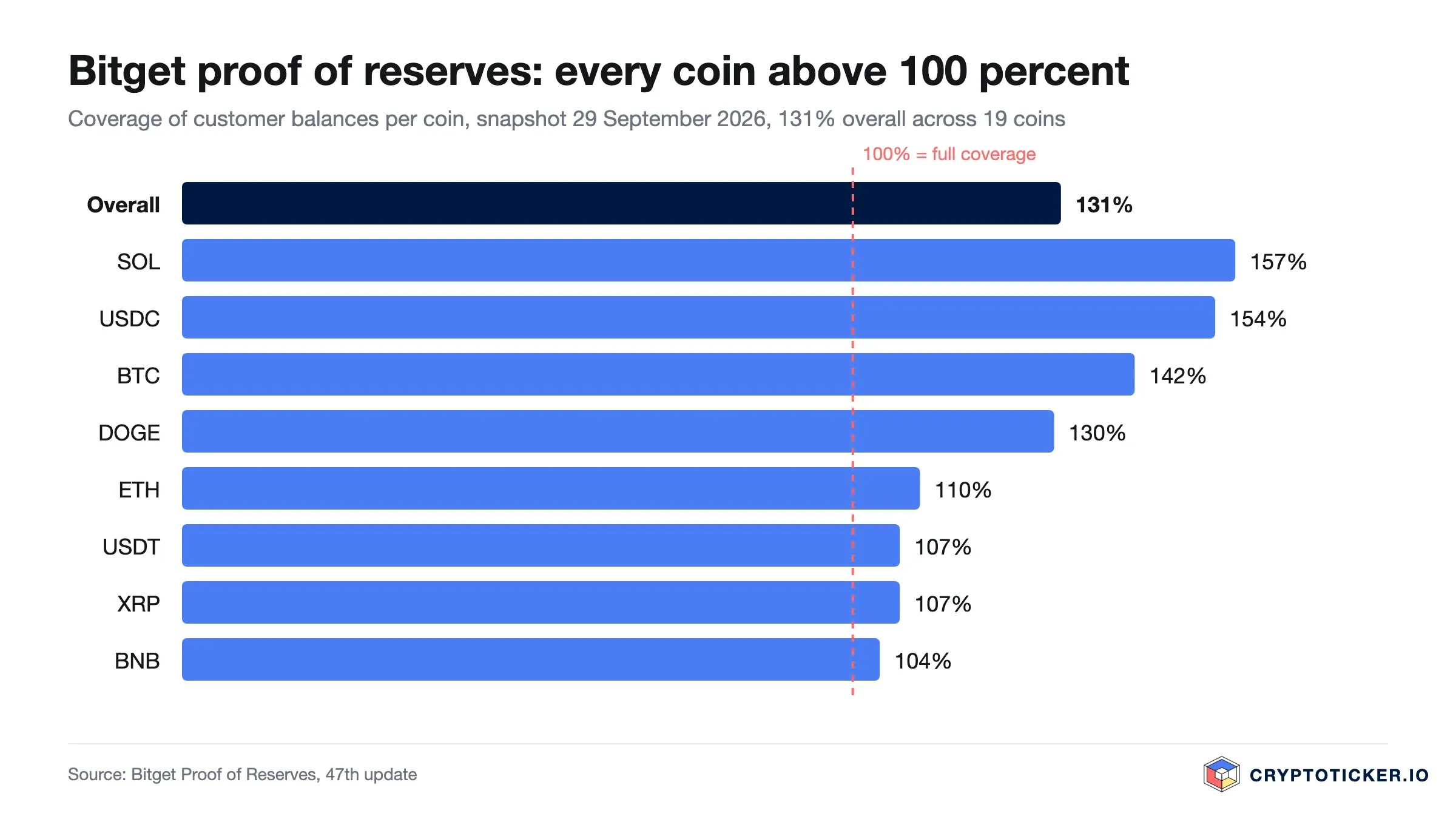
Coverage above 100 percent means that for every bitcoin customers hold on the exchange, Bitget keeps more than one bitcoin in its wallets. With a Merkle tree you can check yourself whether your balance is included in the snapshot, without seeing anyone else's. At the start of September the report covered four coins, now it covers 19. All figures are in the Bitget proof of reserves.
Deposits of $231 million in a single day
The clearest signal comes from customers themselves. According to Bitget on X, deposits of $231 million came in within 24 hours. The figure measures deposits rather than the net balance, but it shows that customers are bringing money back to the exchange. As recently as 29 September we reported net outflows of $463 million.
There is progress on the stolen funds too. NEAR Intents blocked around $50 million from the attack, as we reported. Bitget pays anyone whose tip leads to funds being frozen or recovered 5 percent of the secured amount. Security firms Mandiant and SlowMist are supporting the investigation.
What Bitget customers can do now
- Check your balance: compare the balance in the app with your own records and use the Merkle check in the proof of reserves.
- Pick the right network: BTC, ETH and USDT go out via the networks listed in the table above, all other coins follow on 2 October.
- Secure your account: switch on two-factor login and a withdrawal address whitelist if you have not done so yet.
- Keep long-term holdings in your own wallet: this applies to every exchange. Suitable devices are in our hardware wallet comparison.
You can open an account or log in via this link to Bitget. Bitget ranks first in our crypto exchange comparison, where you can also see fees and features of the alternatives side by side.
What comes next for Bitget
The cause has been contained. According to Bitget, the attack ran through a flaw in a bought-in third-party security product, and further unauthorized transfers are no longer possible. The background is in our analysis of the attack path.
The next date is 2 October at 8:00 UTC, when Bitget reopens withdrawals for all remaining coins, fiat and P2P trading. Until then, three things Bitget has already delivered count most: a Protection Fund above $300 million, 131 percent reserve coverage and withdrawals that are back on schedule.
0
0


 Manage all your crypto, NFT and DeFi from one place
Securely connect the portfolio you’re using to start.


