
Benjamin Cowen Reveals Why The Altcoin Season Never Came

0
0

For most of 2025, altcoin holders were waiting. Watching Bitcoin climb to a new all-time high near $126,000, they expected what had always followed — the familiar rotation, the altcoin surge, the season that rewards patience with explosive gains. It never came.
Benjamin Cowen, founder of IntoTheCryptoverse, wasn’t surprised. He had a name for what was happening, and it changed everything.
“This is a cycle where Bitcoin topped on apathy rather than euphoria.”
That single phrase explains more about the 2025 cycle than any price target or on-chain metric. And to understand why, you need to follow the data across four charts — from social sentiment, through market structure, all the way to the deepest layers of the global macro economy.
The Top That Looked Normal, But Wasn’t
Bitcoin did exactly what it always does. It peaked in Q4 of the post-halving year, right on schedule, consistent with every prior four-year cycle. On the surface, nothing was broken. Look closer, however, and something was fundamentally different.
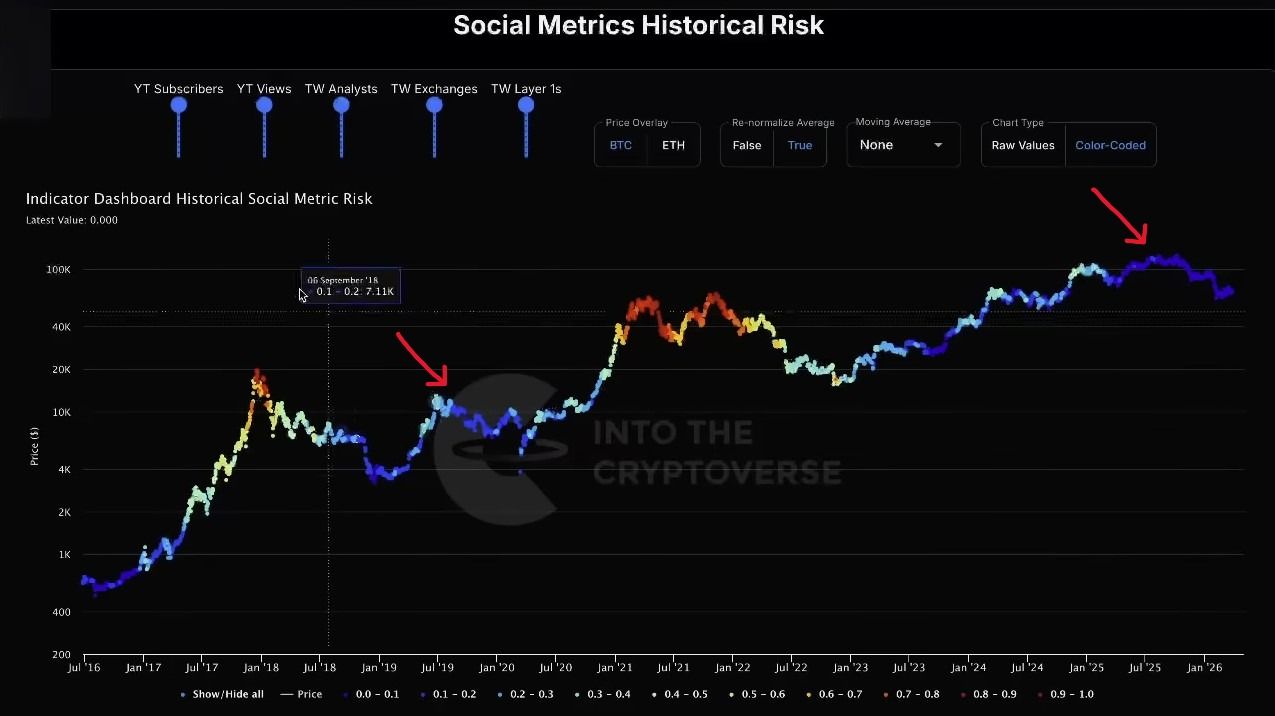
Cowen’s Social Metrics Historical Risk chart tells the story visually. The chart color-codes Bitcoin’s price history by the level of social engagement at each point in time — warm colors (red, orange) for high engagement, cool colors (blue) for low.
In 2017 and 2021, Bitcoin topped in a blaze of red and orange. Social interest was at peak levels. Retail was flooding in. Everyone was talking about crypto.
 Social Metrics Historical Risk chart / Source: YouTube
In 2025, Bitcoin printed its all-time high in cold blue. Social engagement was near-historic lows at the exact moment the market reached its peak.
No retail frenzy or mainstream headlines are driving fresh money in. Just a quiet, almost invisible top — what Benjamin Cowen defines as apathy.
“In 2017 and 2021 we topped on euphoria and because we topped on euphoria there was a rotation into the higher risk assets — altcoins. But when you top on apathy you don’t get that same rotation.”
The only other time this happened was in 2019. That observation is where everything begins.
Benjamin Cowen: Why Apathy Kills the Altcoin Season
In a euphoric cycle, the sequence is predictable. Bitcoin tops, early investors take profits, and that capital rotates into higher-risk assets — altcoins. The crowd, still buzzing with excitement, chases the next opportunity. Alt season follows almost mechanically.
Apathy breaks that sequence entirely. When Bitcoin tops on indifference rather than excitement, there is no crowd waiting to rotate.
The retail wave that normally fuels altcoin rallies simply never arrived. And without new buyers entering the market, altcoins have nowhere to go but down.
Cowen puts it with characteristic bluntness:
“But when you top on apathy, like in 2019, you don’t get that rotation. And the reason you don’t get that rotation is that there’s just no one left to sell the altcoins to.”
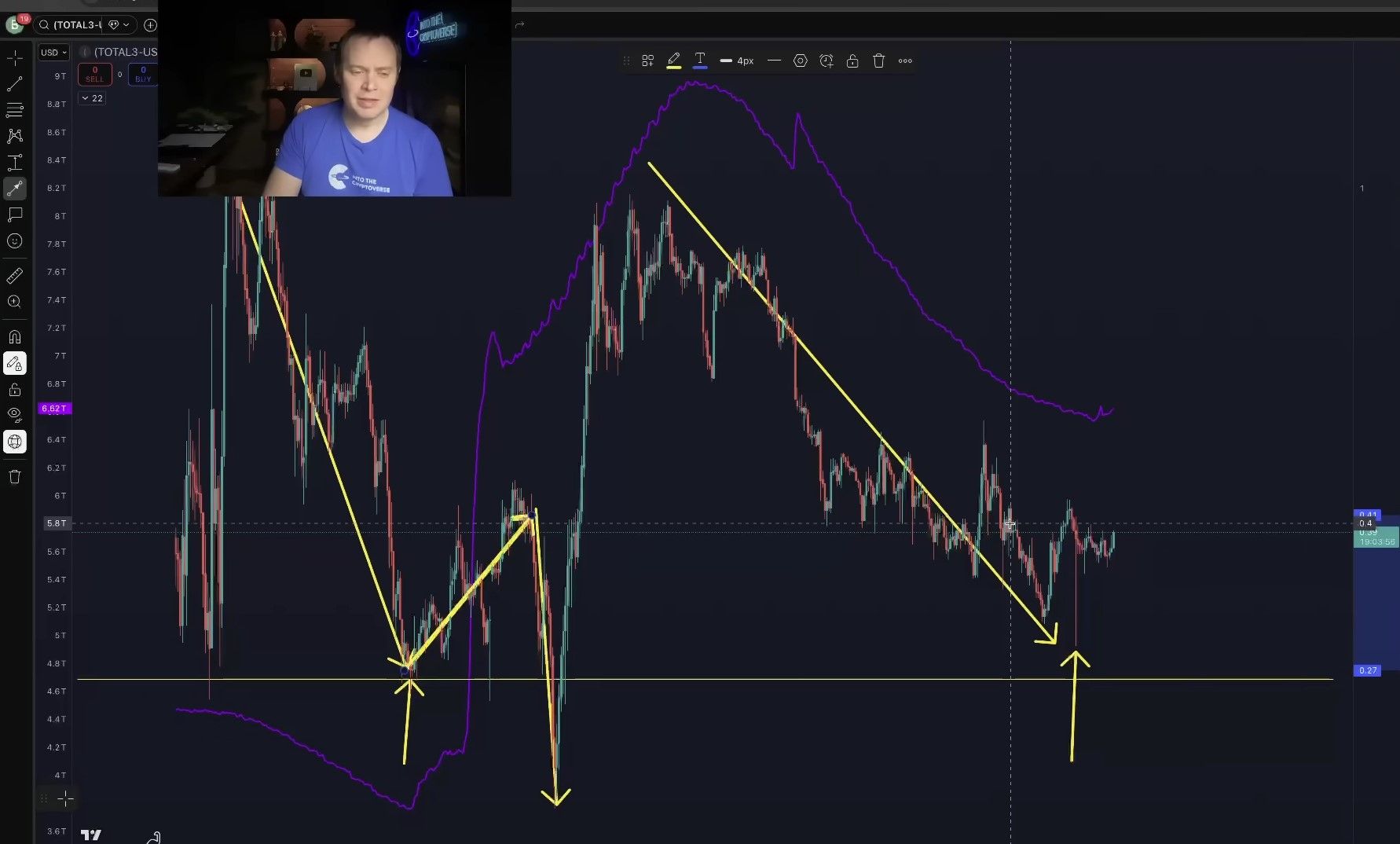
The consequence is visible in the altcoin total market cap chart. Rather than the sharp post-Bitcoin rotation that altcoin holders were expecting, the chart shows something more painful — a slow, relentless bleed. Altcoins losing ground to Bitcoin not just in the bear market, but throughout the entire cycle, both during the bull run and after it ended.
 TOTAL3 vs Bitcoin Dominance Chart. Source: YouTube
This is not a coincidence or bad luck. It is a direct consequence of the macro environment in which this cycle occurred.
The Macro Context: 2019 and 2025 Show the Same Story
Most crypto analysts treat Bitcoin as its own ecosystem, governed purely by halving cycles and on-chain mechanics. Benjamin Cowen argues that it is only half the picture.
The global business cycle — the broader rhythm of economic expansion, late-cycle stress, and recession — shapes not when Bitcoin tops, but how investors behave when it does.
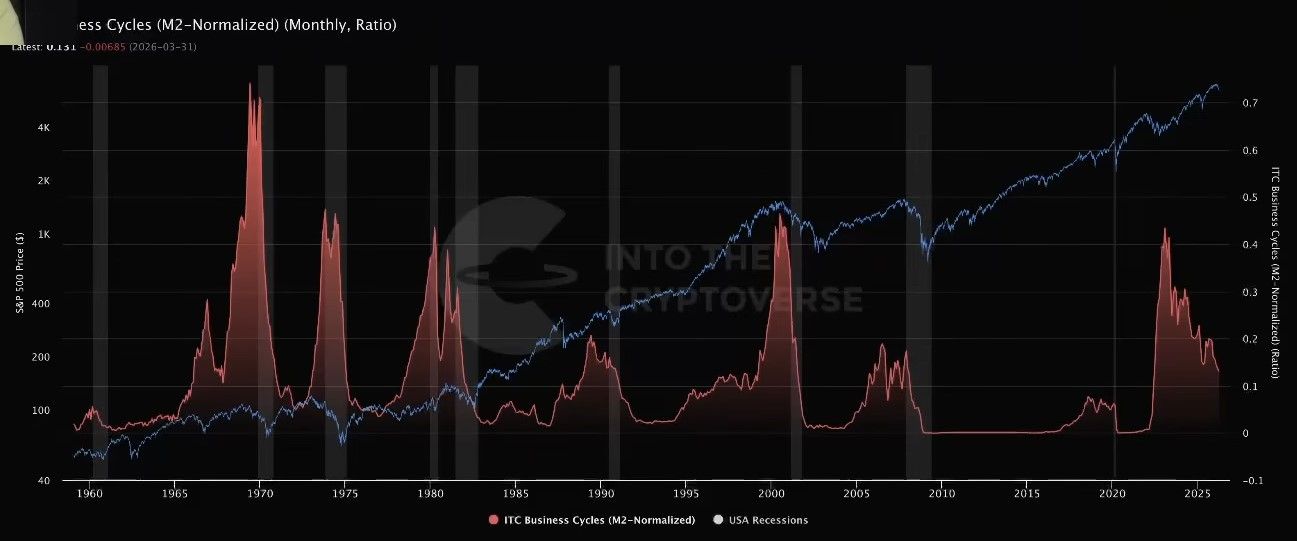
His Business Cycles chart, built by normalizing a composite of S&P 500 performance, unemployment, interest rates, inflation, and M2 money supply, makes the argument visually.
From Bitcoin’s earliest days through approximately 2019, the macro environment was in an early business cycle phase — the long recovery following the 2008 financial crisis. Risk appetite was structurally high. Investors were willing to climb the risk ladder, moving from equities to Bitcoin to altcoins.
 Business Cycles M2-Normalized chart / Source: YouTube
In a late business cycle environment, that risk appetite reverses. Investors don’t reach for more risk — they pull back from it. They consolidate into quality. In crypto terms, that means Bitcoin, not altcoins. It explains why, in both 2019 and 2025, altcoins bled to Bitcoin even as Bitcoin itself was still rising. The macro environment was actively working against the rotation altcoin holders had been counting on.
“The reason why this cycle feels different is because this is a late business cycle environment. And the only other time we had a late business cycle environment where altcoins bled out to Bitcoin even after Bitcoin topped without a rotation was actually in that 2019 phase.”
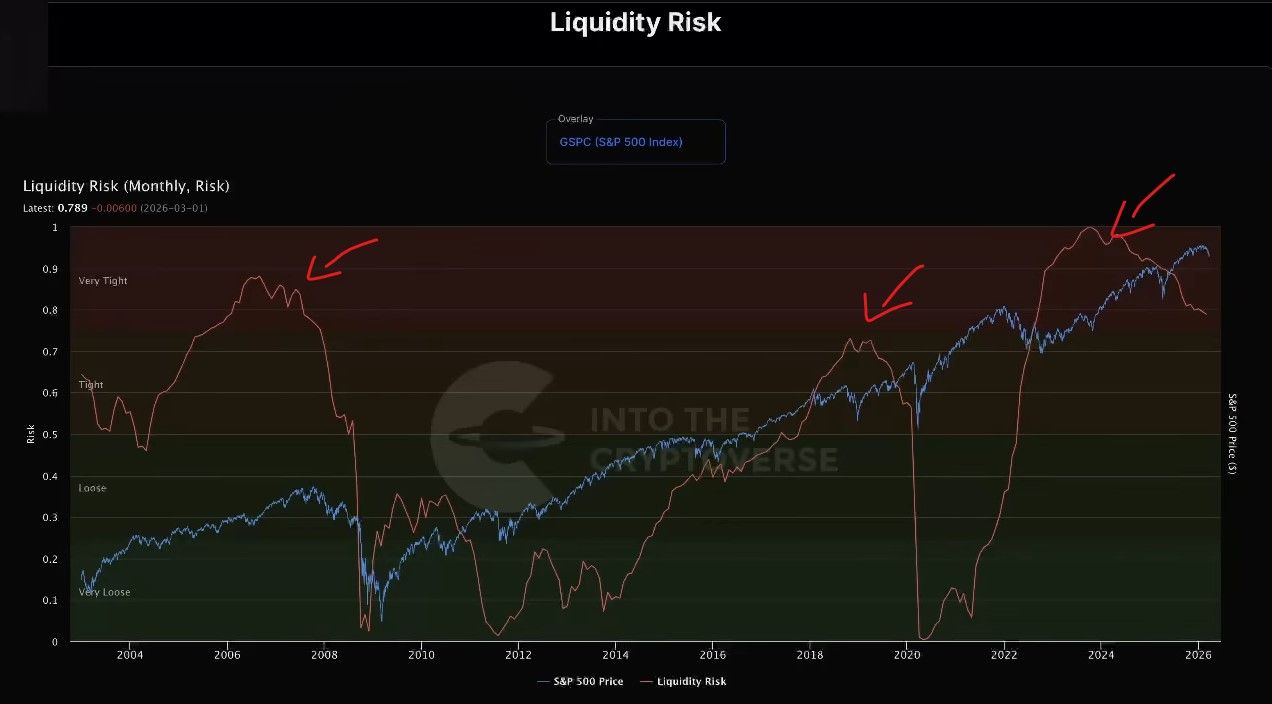
The Liquidity Risk chart adds a second layer of confirmation. With liquidity risk currently sitting at 0.789 — firmly in the “Very Tight” zone — the conditions mirror those of the 2008 financial crisis and the 2018-2019 period almost precisely. Tight liquidity environments are not environments where investors chase speculative assets. They are environments where capital retreats to safety.
 Liquidity Risk chart / Source: YouTube
The symmetry between 2019 and 2025 goes deeper still. In 2019, Bitcoin topped in June — two months before quantitative tightening ended in August. In 2025, Bitcoin topped in October — two months before quantitative tightening ended in December. Same pattern, same spacing, larger scale.
“What’s happening now is just a larger version of what happened in 2019. It just happens to all line up.”
What Comes Next for Benjamin Cowen
The 2019 parallel is not a perfect map, but it is the most honest one available. The four-year cycle remains intact — Bitcoin tops when it always tops, and it will bottom when it historically bottoms, approximately one year after the peak. That places the base case for a cycle low in October 2026.
What this cycle has revealed, more clearly than any before it, is that the crypto market does not exist in isolation. The business cycle, liquidity conditions, and investor risk appetite are not background noise — they are the environment in which every crypto decision plays out. In an early cycle, rising risk appetite carries altcoins higher.
In a late cycle, retreating risk appetite leaves them behind.
Benjamin Cowen’s thesis is not a bearish call for its own sake. It is a framework for understanding why this cycle felt different — and why, for those who understood the macro context, it was never really a surprise.
The altcoin season didn’t fail. It was never going to arrive. Not in this environment. Not in this cycle.
0
0


 Manage all your crypto, NFT and DeFi from one place
Securely connect the portfolio you’re using to start.

0
0

0
0

0
0

0
0