
Solana News Today: New MPL-3643 Standard Unlocks RWA Tokenization

0
0
Solana News Today: How MPL-3643 Could Transform RWA Tokenization?
There's a significant piece of Solana News Today worth breaking down in full.
Metaplex has introduced MPL-3643, a new permissioned token standard designed to let real-world assets—think securities, real estate, and private funds—be issued natively on Solana with built-in compliance, rather than relying on wrapped versions of assets that originated elsewhere.
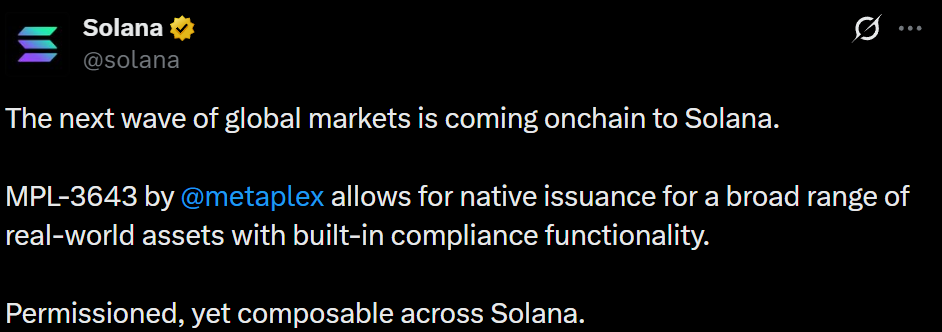
Solana's own account reposted the announcement, calling it the infrastructure for the next wave of global markets coming on-chain.
What MPL-3643 Actually Is
Per Metaplex's official announcement thread and its detailed documentation, MPL-3643 is described as the Solana equivalent of ERC-3643, the widely used Ethereum standard for permissioned tokens.
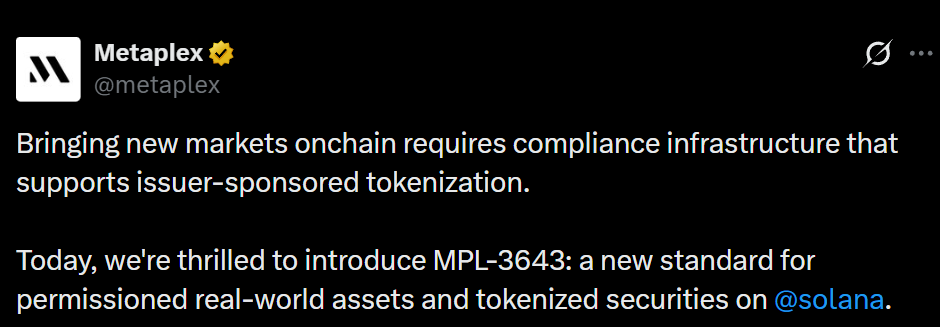
Rather than being a brand-new type of token, MPL-3643 is a compliance layer sitting on top of Solana's existing Token-2022 standard, meaning wallets, explorers, and decentralized exchanges can integrate through infrastructure they already support.
The system ensures only wallets meeting an issuer's pre-defined conditions, like KYC verification, jurisdiction, or accreditation status, can actually hold the token.
Why This Matters: Solving the Compliance Gap
According to Metaplex, real-world asset tokenization has already seen real growth on-chain, but many of the world's largest markets still can't be issued natively because they require issuer controls and compliance functionality that can adapt across different jurisdictions.
As the documentation puts it, every issuer trying to launch a regulated token on Solana today has effectively had to build that compliance assembly from scratch.
MPL-3643 exists specifically to supply that missing piece, and Solana's own repost framed it as being permissioned, yet still composable across the broader network.
How the Technical Architecture Works
This is where Solana News Today gets genuinely detailed. MPL-3643 is built from four separate, independently auditable programs layered over three existing Solana components, Token-2022, Token ACL (sRFC 37), and the Solana Attestation Service:
| Program | What It Handles |
| Identity Registry | Claims, trusted attestors, and per-token trust scope |
| Compliance Module | Offering rules like holder caps, jurisdictions, lockups, and volume limits |
| Gate Program | Combines identity and compliance checks to decide every freeze and thaw |
| Lifecycle Manager | Yield, vesting, corporate actions, and guardrailed recovery |
One key structural detail: unlike Ethereum's ERC-3643, which checks compliance inside every transfer, Solana has no equivalent transfer hook by default.
So MPL-3643 instead enforces eligibility at freeze and thaw time, token accounts are actually born frozen, and only a wallet that passes compliance checks can thaw one.
Rules that need per-transfer checking, like lockups or volume limits, use a Token-2022 transfer hook instead.
Built for Composability, Not Isolation
A core design goal Metaplex emphasized directly is that "permissioned shouldn't mean siloed."
Because MPL-3643 tokens remain standard Token-2022 mints under the hood, they can plug into existing Solana infrastructure rather than requiring entirely separate, isolated markets.
Early integrations already announced include Solflare, Raydium, Orca, Phantom, and Jupiter Exchange, giving issued assets a real path into wallets, DEXs, and trading venues from day one rather than sitting in a walled garden.
Current Availability and What's Next
MPL-3643 is currently live on the Solana mainnet in a limited-access Alpha phase, and per the official documentation, it remains unaudited and listed as "Experimental" on Metaplex's own Stability Index, meaning issuers shouldn't custody real assets without directly coordinating with Metaplex first.
Protocol fees are flat and paid in SOL rather than as a percentage of assets, covering asset configuration (0.063 SOL), holder account activation (0.034 SOL), and distribution execution (0.00085 SOL per recipient).
Interested issuers, tokenization platforms, KYC providers, and developers can currently request alpha access directly through Metaplex.
Conclusion
This round of Solana News Today marks a meaningful infrastructure step for how regulated, real-world assets could eventually move onto the network at scale.
By building compliance directly into the token layer rather than requiring issuers to reinvent it each time, and by keeping everything composable with existing Solana tooling from wallets to DEXs, MPL-3643 positions itself as a genuine bridge for markets that have so far stayed off public blockchains due to jurisdictional and regulatory complexity.
With early integrations already lined up and mainnet access currently gated to Alpha partners, the real test will be how quickly issuers actually adopt the standard once it moves beyond this early access phase.
Disclaimer
This article is for educational and informational purposes only and should not be considered financial or investment advice. Always conduct your own research before making investment decisions.
0
0


 Manage all your crypto, NFT and DeFi from one place
Securely connect the portfolio you’re using to start.


