
Tom Lee ether $250,000 prediction points to a $30T valuation

0
0
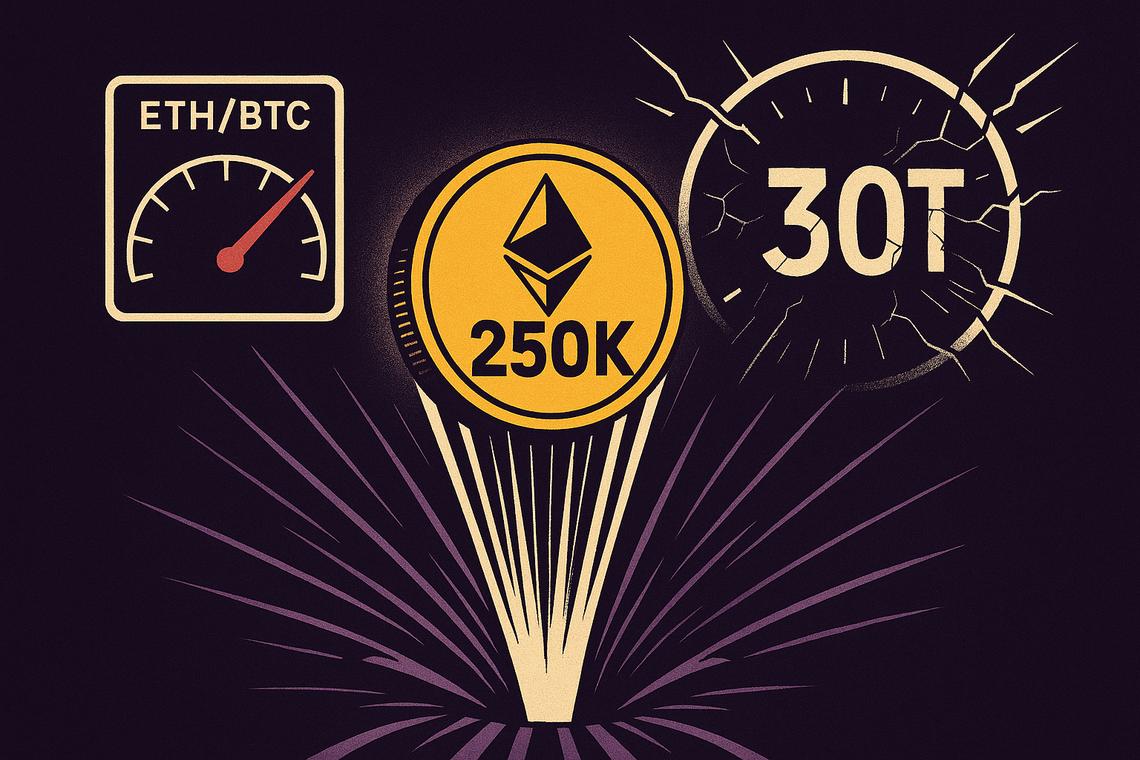
Tom Lee’s Tom Lee ether $250,000 prediction is as bold as it sounds: a $250,000 price for ether, or roughly a 50-fold jump from current levels. However, the math behind that call points to an even bigger story, because at that price Ethereum would carry an implied network valuation of about $30 trillion.
That figure would put Ethereum in the same conversation as the total value of all the gold ever mined and above the entire U.S. Treasury market. Lee, who chairs Bitmine, laid out the target at the Proof of Talk conference in Paris, tying it to corporate validator growth and rising demand. Still, the scale of the claim invites a hard look at the numbers.
The bottom line is simple: Lee’s forecast depends on several things happening at once. Ethereum would need stronger demand, a much steeper ETH-to-bitcoin price ratio, and a larger role for corporate Ethereum validators. Right now, the market data does not show those conditions in place.
What Tom Lee’s $250,000 ether target implies
Why the valuation math matters
A 50x move in any asset is unusual. In practice, ether would need more than a favorable market cycle; it would need a major shift in how the Ethereum network is valued, used, and secured.
At $250,000 per coin, the implied valuation reaches about $30 trillion. That matters because no single asset in modern financial history has reached that level. In addition, the global gold market sits at roughly that scale after centuries of demand.
So while the price target is not impossible in theory, it rests on assumptions that are hard to satisfy at the same time.
The key assumptions behind the forecast
Lee’s case rests on three linked ideas: a dramatic rise in corporate validators, a sharp increase in demand for ether, and a steep move in ether’s value relative to bitcoin. Each one is demanding on its own. Together, they make the target far more difficult to reach.
Ethereum supply inflation after the Dencun upgrade
Why ether is no longer acting like a deflationary asset
One of the most important shifts in Ethereum’s recent history came after the Dencun upgrade in 2024. Before that, many ether bulls argued that Ethereum could become a deflationary asset, with supply shrinking as usage grew.
That story has changed. Ethereum’s circulating supply now stands at 121.75 million ETH, and it is growing at about 0.82% per year. At a $250,000 ether price, that would mean roughly $250 billion of new ether entering the market every year.
To be fair, 0.82% annual growth is not extreme by historical standards. Gold expands at a similar pace, and the U.S. Treasury market grows faster. Even so, the framing matters because the Dencun upgrade redirected most fee activity to cheaper layer-2 chains, which reduced the fee-burning mechanism that once supported Ethereum’s deflationary narrative.
The collapse of the burn mechanism
That change is visible in the numbers. The burn rate has fallen to about 29,000 ETH per year, while issuance is around 1.03 million ETH annually. As a result, Ethereum is no longer getting the supply help that once supported the “ultrasound money” thesis.
Instead, supply is growing slowly but consistently. That means any path to $250,000 now depends almost entirely on demand. There is no supply compression doing part of the work.
Why the ETH-to-bitcoin price ratio is the biggest test
The ratio needed for Tom Lee’s ether forecast
Perhaps the clearest stress test for the Tom Lee ether $250,000 prediction is the ETH-to-bitcoin price ratio. Historically, that ratio has never moved above 0.15, a level it briefly touched during the 2017 market peak.
For ether to reach $250,000 at bitcoin’s current price of about $63,872, the ETH-to-bitcoin ratio would need to rise to 3.91. That is more than 25 times the historical high, and it would mark one of the most dramatic repricings in digital asset history.
There is another way to look at it. If ether were to reach $250,000 while the ETH-to-bitcoin ratio stayed within its historical range, bitcoin itself would need to trade between $1.67 million and $2.94 million at the same time.
In other words, Lee’s target requires either a huge break from historical pricing patterns or a parallel surge in bitcoin. For now, neither is happening.
Corporate Ethereum validators still lag the thesis
Who holds ether and who actually secures Ethereum
Lee has pointed to a growing role for corporate ether holders. The Ethereum Foundation has fallen to about 0.1% of supply, while corporate entities such as Bitmine and SharpLink collectively control about 7% of circulating ether. Public companies and governments together hold about 7.43 million ETH across 32 entities. Bitmine alone holds 5.42 million ETH, and SharpLink holds 869,000.
That is a meaningful level of accumulation. However, holding ether is not the same thing as running validators. Validators are the entities that secure the Ethereum network and earn staking yield.
Lido dominates staked ether
Of the 39.25 million ETH currently staked, Lido controls 19.4% of staked ether. That puts the decentralized staking protocol ahead of Binance, ether.fi, Coinbase, and Figment. Notably, Lido alone validates more ether than every public-company holder combined.
That distinction matters because Lee’s thesis depends on corporate validator growth. Yet the data shows that corporate treasuries have not turned their ether holdings into validator control at the scale needed for the forecast.
In practice, moving from treasury accumulation to validator infrastructure requires technical commitment, operational overhead, and a clear strategic choice. So far, the largest corporate holders have not made that shift in a way that changes the validator picture.
What would need to happen for ether to reach $250,000
For ether to reach $250,000, several conditions would need to line up at once:
- The burn mechanism would need to outrun issuance again.
- The ETH-to-bitcoin ratio would need to recover far beyond its historical range.
- Corporate holders would need to build validator infrastructure at massive scale.
- Demand would need to absorb about $250 billion of new ether issued each year at the target price.
None of those conditions is currently in motion. That does not mean the forecast is impossible forever, because Ethereum has surprised markets before. Even so, the distance between today’s data and Lee’s target is much larger than the headline 50-fold number suggests.
The ETH-to-bitcoin ratio would need to show a sustained trend, not just a brief bounce, before the market could start treating this thesis as credible. Until then, the numbers do not yet support the story Lee is telling.
FAQ
What is Tom Lee’s ether price prediction?
Tom Lee predicts ether could reach $250,000, which would be about a 50-fold increase from current levels. At that price, Ethereum’s network valuation would be roughly $30 trillion.
How does the Dencun upgrade affect Ethereum supply inflation?
The Dencun upgrade shifted most fee activity to cheaper layer-2 chains, which weakened Ethereum’s burn mechanism. As a result, Ethereum’s supply is now growing at about 0.82% per year, with burn running near 29,000 ETH annually against issuance of 1.03 million ETH.
What ETH-to-bitcoin price ratio would be needed for ether to hit $250,000?
At current bitcoin prices, ether would need an ETH-to-bitcoin price ratio of 3.91 to reach $250,000. That is more than 25 times the historical high of about 0.15.
What role do corporate validators play in Tom Lee’s forecast?
Lee’s forecast depends on corporate validator growth, but holding ether and operating validators are different functions. Lido currently controls 19.4% of staked ether, more than all corporate holders combined, and corporate treasuries have not built validator infrastructure at the scale his thesis requires.
Why does the current data not support the $250,000 ether target?
The current data does not support the assumptions behind the forecast. Ethereum is inflationary rather than deflationary, the ETH-to-bitcoin ratio is far below the level needed for the target, and the validator set remains dominated by Lido and other non-corporate operators.
0
0


 Manage all your crypto, NFT and DeFi from one place
Securely connect the portfolio you’re using to start.

0
0


0
0

0
0