
Vitalik Buterin Challenges DeFi Liquidations With Options-Based Proposal

0
0

This article was first published on The Bit Journal.
Ethereum co-founder Vitalik Buterin has come up with a new framework that has the potential to change how decentralized finance handles market downturns.
In a recently published research paper, Buterin argued that DeFi liquidations which is the automatic process that closes down undercollateralized positions, shouldn’t be the default way to protect lending protocols. Instead, he outlined a system based on options that is designed to get rid of forced liquidations altogether and cut reliance on real-time price feeds.
Just recently, Bitcoin falling below $68,000 triggered hundreds of millions of dollars in liquidations across crypto derivatives markets.
Why DeFi Liquidations Are Still a Problem
Most big DeFi lending platforms rely on collateralized debt positions. Users deposit crypto assets, borrow against them and have to keep a required collateral ratio. If the value of the collateral falls below a certain threshold, the protocol will automatically liquidate the position to protect the lenders.
That system helps keep the lending platforms solvent, but it often forces users to sell into already falling markets, which can just make things worse.
The end result is a vicious cycle where falling prices trigger liquidations, liquidations increase selling pressure and m that makes the prices drop even further. Thus has been a recurring pattern in crypto market stress events, especially during periods of really sharp volatility.
Buterin is of the opinion that the industry has been so focused on making DeFi liquidations faster and more efficient that we’ve forgotten to question whether the liquidation model itself is really the right one to use in DeFi.
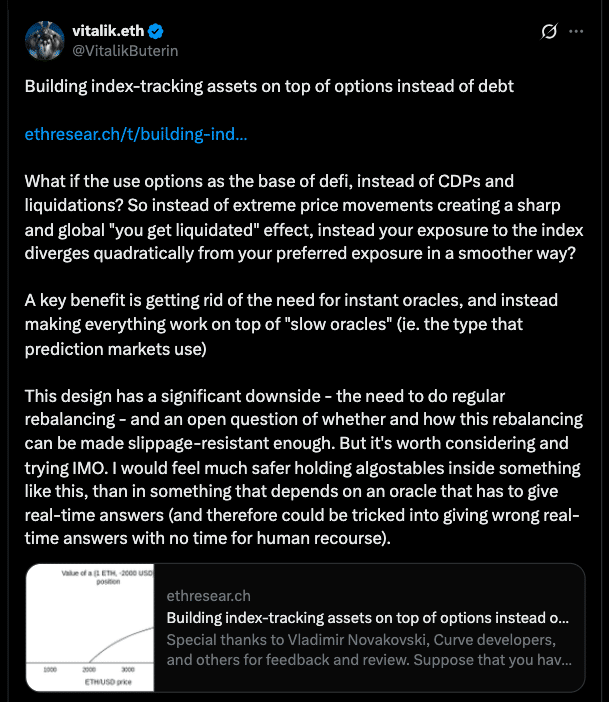
An Alternative Built on Options Instead of Debt
The proposal replaces debt-backed positions with a new system that uses options instead. Instead of borrowing against collateral, users would split one ETH into two separate assets tied to a strike price and a maturity date. He calls these assets “P” and “N”.
At the end of the maturity period, an oracle would decide how the ETH value gets distributed between the two positions based on a reference index.
The main difference to note is that both assets will always add up to one ETH. Because there’s no debt position that can become undercollateralized, liquidation becomes a non-issue by default.
In practical terms, users avoid those sudden forced closures that characterize traditional DeFi liquidations. Instead of getting a liquidation hit, their exposure will gradually drift away from the target if they fail to rebalance the position.
The Tradeoff: Drift Instead of Forced Selling
The model does come with some compromises. Current lending systems tend to provide stable exposure until a liquidation threshold is breached, whereas the options-based framework removes that cliff but introduces a gradual tracking error.
For example, a user seeking dollar-like exposure would have to regularly adjust their positions as market conditions change. Buterin did acknowledge that the exposure drift might range from around 1% to 4% a year depending on the markets. While that might be acceptable for users who are after purchasing power stability, it might be less so for stablecoins that are meant to function like exact dollar equivalents.
The challenge basically changes from preventing DeFi liquidation to managing the costs of rebalancing and keeping an eye on the exposure over time.

Oracle Security: Some Room for Improvement
Another important aspect of the proposal involves oracle design.
The problem with the current DeFi liquidations is they rely so heavily on real-time price feeds. If an oracle gives bad data or gets gamed during a volatile stretch in the market, liquidations can occur unnecessarily.
Over the years, there have been quite a few DeFi incidents that have brought up concerns about oracle reliability during periods of low liquidity and rapid price movement.
However, with Buterin’s framework, the oracle decision is made just once at contract maturation instead of all the time.
That would let projects use the slower, more open-to-challenge oracle methods similar to those used in prediction markets. The additional time could reduce vulnerability to oracle manipulation and eliminate the need for immediate protocol responses.
Conclusion
Right now, it is just a proposal, not an actual roadmap. There’s no word on when or if there will be an Ethereum upgrade, new protocol release, or any sort of implementation.
The one question that’s still unanswered is market structure. Users need inexpensive and easy ways to rebalance their positions without having to worry about excessive slippage. If those costs become too high, the benefits of avoiding DeFi liquidations could be offset by ongoing maintenance expenses.
Still, the proposal addresses a long-standing criticism of decentralized finance, which is that a lot of systems are vulnerable to cascading selloffs when the market gets stressed.
Glossary
DeFi Liquidations: The automatic closure of undercollateralized borrowing positions in decentralized finance.
Collateralized Debt Position (CDP): A borrowing structure where users lock up some collateral and borrow cash from it
Oracle: A service that provides outside data on prices or markets to blockchain applications.
Synthetic Asset: A digital asset on the blockchain that tracks the value of another asset or index.
Options Contract: A financial instrument that derives value from an underlying asset and includes a strike price and expiration date.
Rebalancing: Adjusting a portfolio to keep the exposure you want.
Slippage: The difference between an expected transaction price and the actual execution price.
Undercollateralization: A situation where collateral value falls below the amount required to secure a loan.
Frequently Asked Questions About DeFi Liquidations
What are these DeFi liquidations all about?
DeFi liquidations happen when a borrower’s collateral starts to fall short of what the protocol needs, and the protocol automatically sells their collateral to pay off the debt.
What is Vitalik Buterin proposing?
Vitalik is suggesting replacing the debt-based synthetic assets for an options based system that removes the need for automatic liquidation altogether.
How would users then avoid getting liquidated?
The proposed design ensures positions always remain fully backed by ETH, eliminating the undercollateralization risk that normally triggers liquidations.
What is the main tradeoff?
Users will have to deal with gradual exposure drift and the need to rebalance their positions periodically instead of getting liquidated all at once.
Is this live on Ethereum?
No. It is just a concept right now and hasn’t been implemented on Ethereum or on any of the major DeFi protocols.
References
Read More: Vitalik Buterin Challenges DeFi Liquidations With Options-Based Proposal">Vitalik Buterin Challenges DeFi Liquidations With Options-Based Proposal
0
0

 Manage all your crypto, NFT and DeFi from one place
Securely connect the portfolio you’re using to start.

0
0


0
0

0
0