
Ethereum Staking Rewards Proposal Could Redirect 10% to Ecosystem Funding

0
0

Reward mechanisms associated with Ethereum staking rewards are currently being deliberated by a significant governance issue that will influence the way the Ethereum ecosystem will be financing its future development. A newly proposed initiative would permit Ethereum validators to allocate up to 10% of their staking rewards towards ecosystem development, public goods, infrastructure enhancements, and research projects.
Ethereum is still one of the biggest blockchain platforms in the digital assets market. As of the date of writing, ETH is priced at around $1,688.79, while the 24-hour trading volume has exceeded $12.3 billion, and market capitalization stands at over $203.8 billion. Even though traders are constantly tracking prices of this token, increasing attention is currently paid to the way the Ethereum staking rewards could be used for future ecosystem sustainability.
This initiative has rapidly turned into one of the hottest topics of discussion in the Ethereum community as it could become a new funding mechanism for important network development projects in the upcoming years.

Explanation of the Ethereum Staking Rewards Proposal
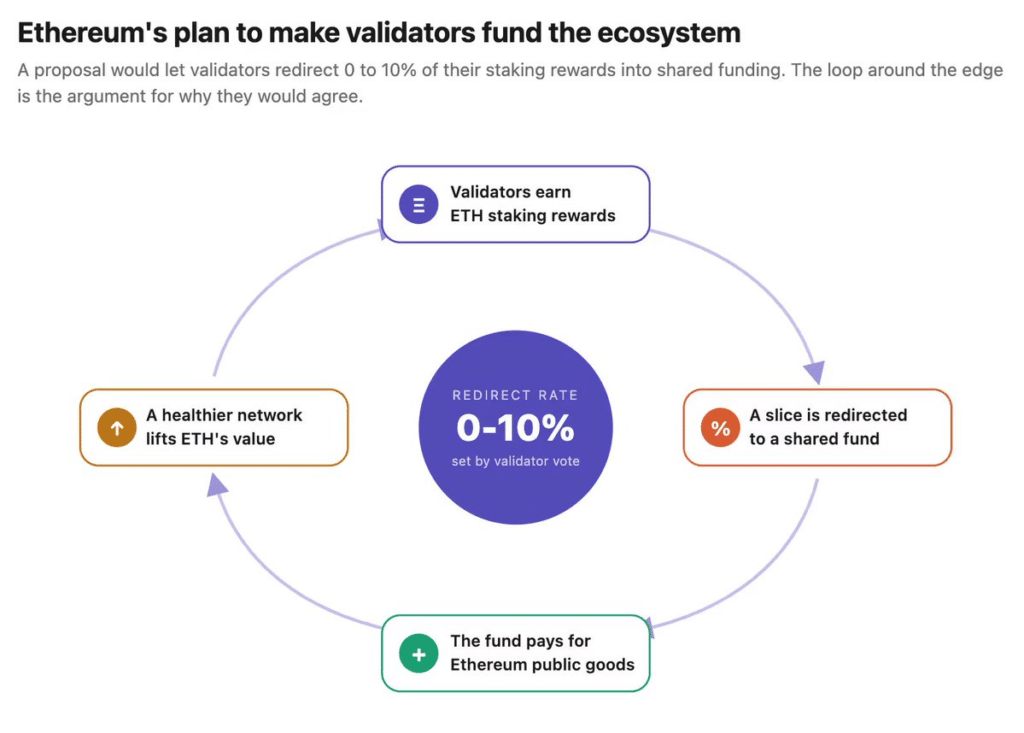
The new proposal by Ethereum suggests a system through which the validators can channel part of the money earned into projects which help build the wider network. Relying less on donations and funding from foundations, the proposal aims at ensuring a constant flow of finances to help fund the essential development initiatives.
It is expected that the Ethereum staking rewards will be a consistent source of money that will help the network. The current proposal is still voluntary and up to the validator to participate or not.
Ethereum’s Strategy to Finance the Growth of the Ecosystem
One of the main problems of mature blockchain ecosystems is the issue of consistent financing of innovations. The funding of the Ethereum ecosystem has always been achieved through grants, venture financing, and donations from the community.
In the new scheme, a certain share of rewards from the ETH staking process would be directed toward the development programs. It was suggested that such an approach is justified since there is a connection between all participants of the network and its healthy development will positively affect everyone.
The Reason Why Ethereum Validators Have an Important Role to Play
There is no doubt that Ethereum validators are important players in the process of protecting and processing the transactions in the network using the proof-of-stake approach. As a compensation for performing their duties, they receive some kind of rewards due to the work of the network.
The implementation of the new system will have its impact on the way these rewards will be used. Although participation will stay voluntary, some market analysts think that if Ethereum validators will sponsor development of the ecosystem, it will make it stronger in the long run.

Ethereum Validator Redirected Revenue Model Gets Noticed
At the heart of the debate lies the idea of Validator Redirected Revenue (VRR). The Ethereum Validator Redirected Revenue model seeks to establish a predictable source of funding for projects which generally find it difficult to access stable funding sources. Some of these projects include open-source code, security checks, learning material, and research.
According to advocates of the initiative, funding of public goods in the Ethereum network is an important factor in ensuring its competitiveness. Through the redirection of some income, the advocates hope to ensure a secure future for Ethereum.
Possible Advantages for the Development of the Ethereum Network
The proponents of this initiative have listed a number of possible benefits that may appear should the adoption rate be high. For instance, the use of ethereum staking rewards for supporting public goods could speed up the process of infrastructure development, create better tools for developers, and boost security.
In order to develop a long-term strategy for the Ethereum network, there is a need for years of investments, and it is crucial to make these investments sustainable. In case of success, the proposed initiative can be used as an example by other blockchain systems.
Issues Regarding Incentives and Governance
Even though there has been growing interest in this scheme, the idea has sparked controversy throughout the Ethereum community. The main issue raised is that Ethereum validator incentives belong to validators, and cannot be used without their consent. Issues related to the governance structure, transparency, and accountability need to be addressed.
The issues raised in connection with the Ethereum governance scheme as a whole concern issues of fairness, decentralization, and stakeholder power.
Ethereum Validators Funding for Network Development
At the core of this debate lies an intriguing question: Can Ethereum validators fund network development sustainably? Proponents think the answer to this is affirmative. They hold that Ethereum ecosystem funding via staking rewards helps create harmony between network supporters and network developers.
Still, naysayers are wary of how low voluntary participation levels can hinder resource creation. Yet, one thing is clear: the debate itself shows increasing interest in non-traditional means of funding for blockchain networks.
Ethereum Staking Rewards and Ecosystem Sustainability
Sustainability has emerged as one of the most important issues for the entire cryptocurrency sector. A number of blockchain ventures encounter difficulties once their early funding sources start to wane. The novel system proposed by Ethereum regarding the distribution of validator rewards is trying to solve this problem right away. It will be possible to use this funding scheme for future research, infrastructure development, security enhancement, and education efforts.
Market Impact and What Comes Next
Although the proposal remains under discussion, its implications extend beyond governance alone. Analysts note that Ethereum staking rewards could become an influential factor in future development strategies across the broader blockchain sector. Some estimates suggest the initiative could eventually generate up to $120 million annually if participation reaches meaningful levels.
Ethereum staking proposal could generate $120 million annually, creating one of the largest community-driven funding pools in the cryptocurrency market. Whether adoption occurs remains uncertain, but the conversation is already shaping future policy discussions.
Conclusion
The idea of allocating up to 10 percent of Ethereum staking rewards for the purposes of supporting the ecosystem initiatives is definitely a big step forward in terms of blockchain funding models. While the supporters see the idea as a sustainable way to finance innovation, infrastructure, and public goods, there are still some valid arguments raised by critics. No matter what will be the outcome of this debate, it is clear that Ethereum is very concerned about its sustainable development and flexibility. Investors, developers, and validators must watch all changes carefully.
Appendix: Glossary of Key Terms
Ethereum Staking Rewards: Earnings received by validators for securing the Ethereum network.
Ethereum Validators: Participants who verify transactions and maintain network security through staking.
ETH Staking Rewards: Compensation distributed to validators for participating in Ethereum’s proof-of-stake system.
Frequently Asked Questions About Ethereum Staking Rewards
What are Ethereum staking rewards?
Ethereum staking rewards are incentives earned by validators who stake ETH and help secure the Ethereum blockchain.
What is the new Ethereum staking proposal?
The proposal would allow validators to voluntarily redirect up to 10% of their staking rewards toward ecosystem development and public goods funding.
How would Ethereum ecosystem funding benefit the network?
Additional funding could support infrastructure, research, security audits, developer tools, and educational initiatives that strengthen Ethereum.
References
Read More: Ethereum Staking Rewards Proposal Could Redirect 10% to Ecosystem Funding">Ethereum Staking Rewards Proposal Could Redirect 10% to Ecosystem Funding
0
0

 Manage all your crypto, NFT and DeFi from one place
Securely connect the portfolio you’re using to start.

0
0

0
0

0
0

0
0