
Standard Chartered’s Chainlink price forecast: $200 by 2030, a 25x leap

0
0
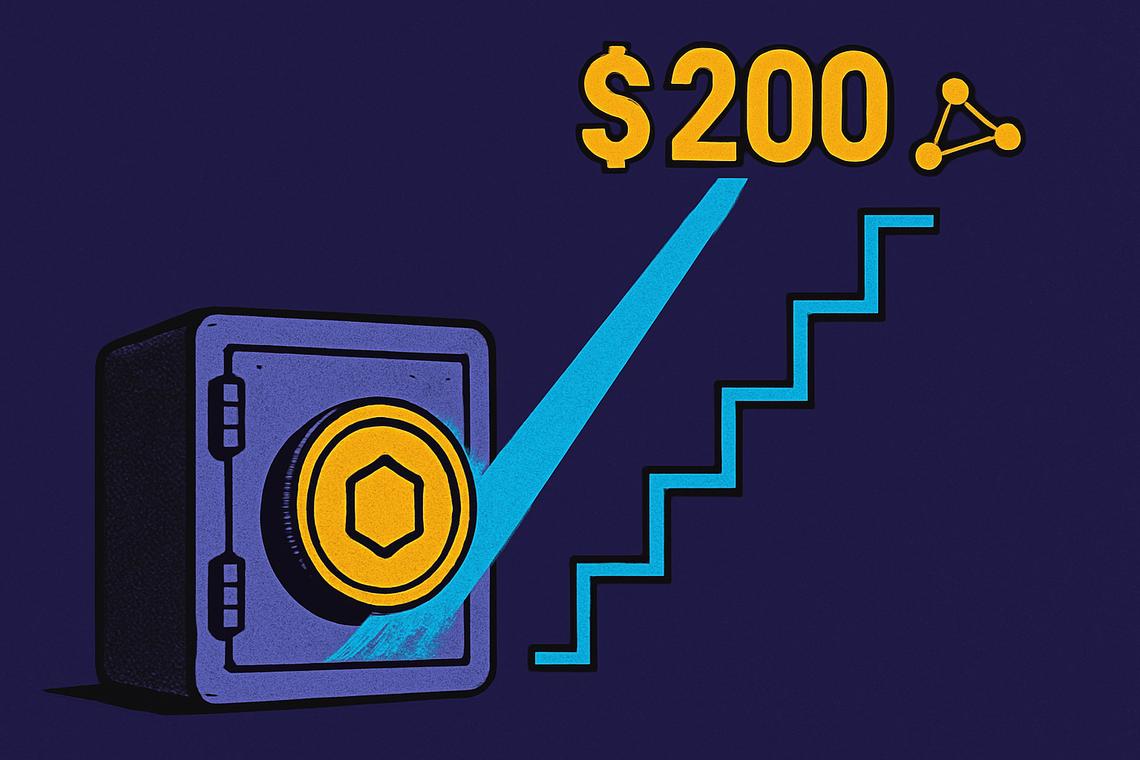
Standard Chartered has put a number on how far it thinks Chainlink can climb, and the figure is striking enough to turn heads across crypto markets: a $200 price target for LINK by the end of 2030, roughly 25 times its price near $8 at the time the bank published its coverage. The call, led by Geoff Kendrick, the bank’s Global Head of Digital Assets Research, ties Chainlink’s fortunes directly to the growth of tokenized finance and decentralized lending, arguing that as more real-world assets and DeFi activity move on-chain, demand for Chainlink’s data and interoperability services should climb with them. This Chainlink price forecast marks one of the more detailed institutional valuations yet published for an oracle network.
Key takeaways
- Standard Chartered set a $200 LINK price target for the end of 2030, about 25 times its price near $8 at the time of the report.
- LINK is projected to reach $13 by the end of 2026, then climb through $41, $82 and $133 before hitting $200 in 2030.
- Chainlink secures more than $110 billion in value, representing roughly 70% of oracle-dependent DeFi value globally.
- CCIP quarterly volume hit $4.9 billion in the second quarter, up 353% year-over-year.
- Standard Chartered expects tokenized assets on blockchains to grow from $340 billion to $4 trillion by 2028, and DeFi deployed assets to increase 37-fold to $2.7 trillion by 2030.
Standard Chartered’s Chainlink Price Forecast to 2030
Standard Chartered’s Chainlink price forecast is built in stages rather than a single leap, with LINK expected to climb gradually as tokenization and DeFi adoption scale up over the coming years. Kendrick’s model links LINK’s valuation to projected growth in Chainlink’s fee revenue, which the bank estimates could increase about 25 times by 2030 as tokenized assets and decentralized finance expand. The token According to CoinGecko data, the asset was valued at $8.25 during the report period, representing a 0.8% decline compared to the preceding 24-hour interval.
Stepwise Price Targets from 2026 to 2030
Rather than jumping straight to its 2030 target, Standard Chartered lays out a staircase of milestones. LINK is expected to reach $13 by the end of 2026, then progress to $41, $82 and $133 in the years that follow, before finally arriving at $200 by the end of 2030. That staged path suggests the bank sees the bulk of Chainlink’s valuation gains as being tied to specific adoption milestones rather than a straight-line market rally.
Comparison with Bitcoin and Ethereum Projections
Notably, the projected 25x gain for LINK would outpace Standard Chartered’s own return expectations for the two largest cryptocurrencies over the same period. The bank has separately projected Bitcoin reaching $500,000 and Ethereum reaching $40,000 by the end of the decade, meaning Chainlink’s forecasted upside, at least in percentage terms, is positioned as steeper than either major asset in the bank’s broader crypto outlook.
Market Position and Usage Metrics Underpinning the Forecast
The forecast rests heavily on Chainlink’s current grip on the oracle market and the fast-growing usage of its cross-chain infrastructure. Standard Chartered estimates that Chainlink currently secures more than $110 billion in value, equal to roughly 70% of oracle-dependent DeFi value worldwide and more than 80% of such value on Ethereum specifically. Aave V3 alone accounts for about 44% of the value secured through Chainlink, according to the bank’s figures.
Chainlink’s Dominance in Oracle-Dependent DeFi
That dominance matters because Kendrick’s valuation model assumes Chainlink keeps its market share as tokenization scales. If a rival oracle or interoperability provider chips away at that 70% figure, the fee growth underpinning the $200 target would shrink accordingly. This is part of why the report frames Chainlink’s Chainlink institutional adoption story as central to the bull case rather than a side detail.
Usage data on the cross-chain side has also been climbing fast. CCIP, Chainlink’s Cross-Chain Interoperability Protocol, processed $4.9 billion in quarterly volume during the second quarter, a 353% increase from a year earlier. That growth followed a $292 million exploit in April tied to legacy bridge infrastructure, after which more than $7 billion in token value migrated from older bridges toward CCIP, according to Kendrick’s note.
Institutional demand adds another layer to the thesis. Standard Chartered named Swift, DTCC, Euroclear, JPMorgan, Mastercard, UBS, Fidelity and S&P Global among institutions using Chainlink’s services. Kendrick expects customers outside crypto-native markets to make up a growing share of Chainlink’s fees as tokenization pilots move into production, since tokenized funds, bonds and other financial products often require recurring data such as net asset values, interest rates and reserve attestations. During June, Chainlink became part of Project Pangea, collaborating with FairSquareLab, UniKA and Qivalis to conduct trials of stablecoin-denominated foreign exchange settlement operations connecting Europe with South Korea, a pilot Chainlink said involves more than 50 banks representing over $10 trillion in assets under management.
Expanding Tokenization and DeFi Markets Fueling Demand
The scale of tokenization and DeFi growth Standard Chartered is forecasting explains why the bank sees so much room for Chainlink’s fees, and by extension LINK’s price, to expand. The bank projects the value of tokenized assets held on blockchains to grow from roughly $340 billion currently to $4 trillion by the end of 2028. On the DeFi side, deployed assets are expected to increase 37-fold to $2.7 trillion by 2030. Chainlink stands to benefit from both trends because its infrastructure feeds blockchain applications external data and enables transfers between different networks, according to the report.
Kendrick has applied that same 37-fold DeFi growth assumption across several other recent research notes. In June he set a $100 target for Uniswap’s UNI and a $3,500 target for Aave’s AAVE, followed by a $60 target for Morpho in July. UNI posted a double-digit gain after that coverage was published, though LINK’s market reaction to its own report has stayed comparatively muted so far.
Cross-Chain Interoperability and Infrastructure Migrations
Chainlink’s cross-chain interoperability business has become one of the clearest signs of real-world adoption behind the price forecast, even though the bank notes Chainlink still trails LayerZero in this niche overall. On Aug. 4, BitGo designated Chainlink CCIP as the exclusive cross-chain infrastructure for Wrapped Bitcoin, transitioning away from LayerZero for WBTC transfers. At that moment, WBTC commanded a market capitalization of approximately $7.4 billion, establishing it as the switch one of the largest publicly announced migrations to Chainlink’s infrastructure. BitGo said it would standardize WBTC deployments around Chainlink’s Cross-Chain Token standard and use CCIP by default for future digital assets it issues, while retaining control over token contracts, transfer limits and other operational settings.
Significant Protocol and Token Migration Examples
Counting earlier moves by Mantle, Lombard, Aave and Kraken, publicly announced migrations from LayerZero to Chainlink infrastructure reached roughly $14.6 billion after BitGo’s decision. That wave of migrations followed the KelpDAO exploit, in which KelpDAO blamed LayerZero’s bridge for the $292 million loss and said it planned to rebuild using Chainlink; LayerZero disputed that characterization.
Existing DeFi partners have also deepened their use of Chainlink rather than switching providers outright. In July, Aave expanded its use of CCIP to become the default cross-chain infrastructure across the Aave App and Stable Vaults, extending a setup that already handled transfers of Aave’s GHO stablecoin and cross-chain governance messages. Aave said the expanded deployment lets CCIP process deposits, withdrawals, vault rebalancing, yield optimization and asset transfers, with Stable Vaults moving deposits between Ethereum, Base and Arbitrum without users needing to manually bridge assets. GHO and Savings GHO now use Chainlink’s Cross-Chain Token standard too, with GHO available across eight blockchain networks as of July. Separately, United Stables adopted Chainlink’s Data Feeds and Proof of Reserve for its U stablecoin after it surpassed $1 billion in circulating supply and $2.5 billion in daily trading volume, and the company said it plans to integrate CCIP for future cross-chain transfers.
Risks and Challenges to Chainlink’s Growth and Adoption
None of this guarantees LINK reaches Standard Chartered’s targets, and the bank is upfront about what could derail the thesis. Kendrick flagged that institutional tokenization could develop more slowly than expected, with pilot projects failing to graduate into recurring production workflows. He also pointed to competition from specialist data and interoperability providers as a threat to Chainlink’s current market share, along with the possibility that technical failures could damage confidence in Chainlink’s oracle and cross-chain infrastructure, particularly as more financial assets come to depend on it.
Those risks matter because the entire valuation model hinges on Chainlink holding, or growing, its roughly 70% share of oracle-dependent DeFi value while fee income scales in step with tokenization volumes. Any slowdown in institutional adoption, a security incident, or a rival provider gaining ground could each chip away at the assumptions behind the staged path from $13 to $200. Under Kendrick’s framework, LINK’s next checkpoint is the end of 2026, when the token would need to reach $13 before advancing toward $41, $82 and $133 on the way to the bank’s 2030 target.
FAQ
What is Standard Chartered’s price target for Chainlink by 2030?
Standard Chartered projects Chainlink’s LINK token to reach $200 by the end of 2030.
What intermediate price milestones does Standard Chartered expect for LINK before 2030?
LINK is expected to hit $13 by the end of 2026, then progress to $41, $82 and $133 before reaching $200 in 2030.
Which institutional clients are using Chainlink’s services?
Institutions including JPMorgan, Mastercard, UBS, Fidelity and S&P Global are among those using Chainlink’s oracle services, alongside Swift, DTCC and Euroclear.
What risks could affect Chainlink’s forecasted growth?
Risks include slower-than-expected institutional tokenization, competition from other data and interoperability providers, and potential technical failures affecting Chainlink’s infrastructure.
Article produced with the assistance of artificial intelligence and reviewed by the editorial team.
0
0

 Manage all your crypto, NFT and DeFi from one place
Securely connect the portfolio you’re using to start.


0
0