
Dogecoin Price Prediction: Which Levels Decide the Fourth Quarter

0
0

Dogecoin traded at $0.0973 on September 27, 2026 at 19:45 UTC, roughly 0.0854 euros. Anyone searching for a Dogecoin price prediction today is served numbers between $0.085 and $5, and both ends come from people who call themselves analysts. This piece therefore does something other than add one more price target. It names the three levels that can actually be measured on the chart, tests the circulating targets against the September that has now been measured, and sets out which checks an investor in Germany should clear before the quarter turns.
Dogecoin price prediction in brief: where the price stands on September 27
The starting position in numbers, all retrieved from CoinGecko on September 27, 2026 at 19:45 UTC: $0.0973 per DOGE, a gain of 12.2 percent over seven days and of 15.4 percent over thirty days. Measured over twelve months the coin is down 57.6 percent. Market capitalisation stands at $15.18 billion, rank twelve, and turnover over the past 24 hours at $809 million. There are 156.09 billion DOGE in circulation.
That combination is the core of any honest Dogecoin price prediction. Over the short run the price is running strongly; over the medium run it sits low. The all-time high of $0.7316 dates from May 7, 2021, and today's price is 86.7 percent below it. Seeing that high again would take an eightfold move. A forecast that treats the all-time high as a near-term destination is advertising.
The three levels that frame the fourth quarter
Levels are not an opinion. They are points at which the price demonstrably turned over the past months, and exactly three of them carry weight in the fourth quarter.
- $0.1004, the resistance. This is the high of September 23, 2026 and at the same time the highest daily value of the past ninety days. The price turned there on September 23 and fell back to $0.0927 within a single day. As long as that value is not cleared on volume and then held, every forecast above it is an expectation and not a finding.
- $0.0800, the next floor. The low of September 16, 2026. From there came the move that carried the price a quarter higher by September 23. Should the price drop back below that value, the September advance has been worked off.
- $0.0690, the floor of the quarter. The low of August 7, 2026 and the lowest daily value of the past ninety days. Anyone holding a leveraged position calculates their liquidation point against that value and not against today's price.
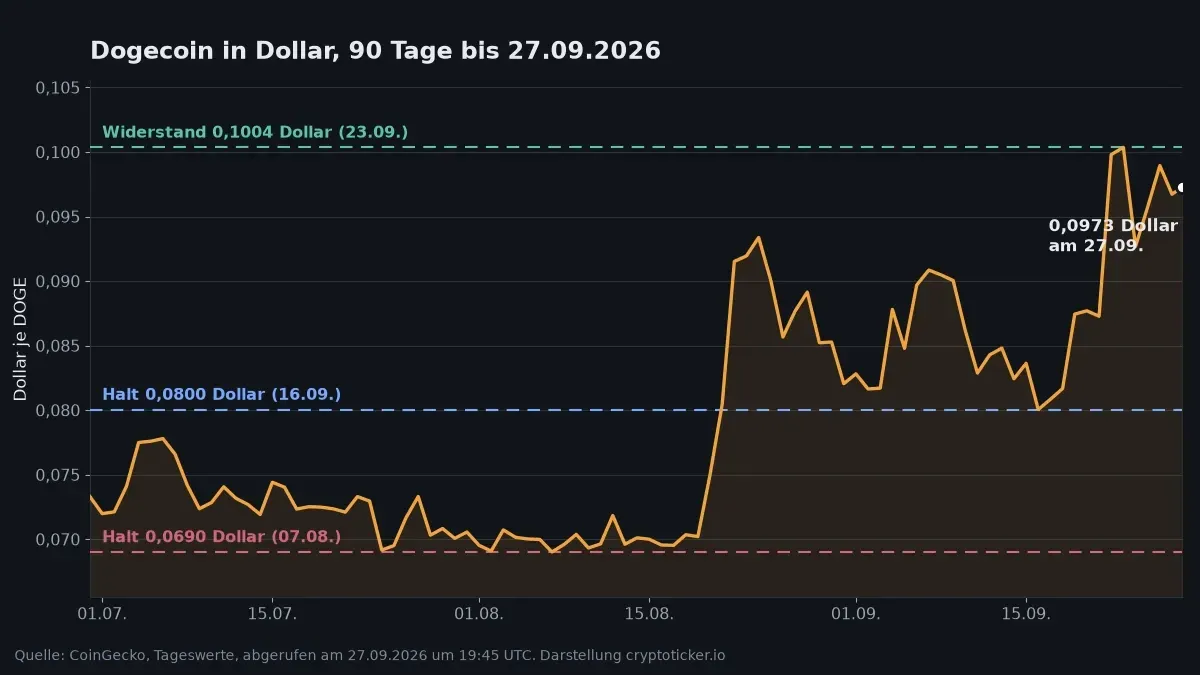
The distance from today's price to those levels can be worked out and belongs in any plan: 3.2 percent up to the resistance, 17.8 percent down to the first floor, 29.1 percent down to the floor of the quarter. The risk therefore currently sits considerably further away than the opportunity, by a factor of five to nine. That asymmetry is the most important sentence in this section, and it appears in none of the forecasts circulating online.
What sits behind the jump of September 22
The move everyone is writing about right now is a single day. On September 21 DOGE stood at $0.0873, on September 22 at $0.0998. That is 14.3 percent in one day. Four sideways days between $0.0927 and $0.1004 followed. A breakout consists of the jump and of the confirmation; so far only the jump is on the table.
Two things fell into that window. First, the American spot products on Dogecoin reported their strongest week since launch. According to figures from the data service SoSoValue, quoted in trade reporting, net inflows of roughly $2.89 million arrived in the week to September 25, with almost all of it going to Grayscale's GDOG product after competitor Bitwise announced it was closing its own. Second, the wider market was friendly in that same week; Bitcoin has held the $84,000 mark since September 27.
How large that inflow really is relative to Dogecoin's daily new issuance is something we calculated separately on September 26 and wrote up in Dogecoin forecast: daily new issuance exceeds the ETF inflows. The short version for this piece: according to the project, the protocol permanently emits around five billion new DOGE per year, which at today's price is a good $1.3 million on every single day. A record week of $2.89 million covers roughly two days of that.
Which price targets are circulating and how far off they were in September
The most honest test for a forecast is yesterday's forecast. Several models were publicly available for September 2026, and the month is almost over. The targets one by one, each attributed to its source and not smoothed:
- The model calculator at CoinCodex named a value of $0.0965 for September 26, 2026. What was measured that day was $0.0990. Deviation: 2.5 percent. That is the best hit in the field.
- An expert estimate kept at Changelly expected a monthly high of $0.106 for September at an average of around $0.102. The high was narrowly missed at $0.1004, the average clearly so: for long stretches of the month the price sat below $0.09.
- A range of $0.10 to $0.17 for September, argued on technical and historical grounds, was touched at its lower edge on precisely two days. As a range for a whole month it was useless.
- One model saw the month ending at around $0.085. For that the price would still have to fall 12.6 percent from today, and three days remain for it.
The lesson is not a reckoning with the models but an instruction for use. Point targets tied to a date are noise. Ranges only serve when they are wide enough to capture the actual swing, and then they say little. What can be forecast are conditions: what has to happen for a scenario to materialise. The two sections that follow are built exactly that way.
The bull case and the bear case for the fourth quarter side by side
The bull case. It begins not with a price target but with a condition: the price closes above $0.1004 for several days, and turnover stays above the average of recent weeks while it does. Only then does the jump of September 22 become a trend. The next visible station above that sits at around $0.11, after which there is little structure until the area around $0.13. The estimates circulating for the full year 2026 of $0.145 in the cautious, $0.183 in the middle and $0.249 in the friendly case require rises of 49, 88 and 156 percent from today's price. That is possible within a quarter, and Dogecoin has shown such moves several times, but it is a statement about the wider market and not about Dogecoin alone.
The bear case. It too hangs on a condition: the price falls back below $0.0800 and stays there. The whole September advance has then been worked off, and the next measured catch line sits at $0.0690, the low of August 7. Below that begins an area where there is no structure left in the period under review. The structural headwind remains unchanged throughout: Dogecoin has no cap on its money supply. According to the project, around five billion new coins come into existence permanently each year, which against today's circulating supply of 156.09 billion units means a good three percent of additional supply annually. A price that runs sideways loses relative weight under that mechanism.
Anyone wanting to trade one of those two scenarios writes down the condition and not the target. A target without a condition is a hope with decimal places.
The ETF channel in the United States: what it carries and what it does not
Ever since Dogecoin became accessible through exchange-traded products in the United States, that channel has been readily presented in forecasts as a turning point. The order of magnitude argues against it. Trade reporting puts cumulative inflows into Grayscale's GDOG in the low tens of millions of dollars at the end of September. For comparison: Dogecoin's turnover on a single day is $809 million. For now, the ETF channel is therefore a signal of institutional interest and not a driver of price.
For investors in Germany there is the added point that those American products cannot be bought here through regular channels. An exchange-traded product on Dogecoin admitted in the EU does not exist in the form Bitcoin and Ethereum investors know. Anyone wanting to hold Dogecoin in this country buys the coin itself, through an exchange with authorisation under the European markets-in-crypto-assets regulation. Which providers hold that authorisation, and how fees and spreads differ, is set out in our comparison of the best crypto exchanges. Since January 1, 2026, providing crypto services in Germany without the corresponding authorisation has been unlawful, because Germany brought the transition period forward to the end of 2025 with its crypto-markets supervision act. A provider without authorisation is therefore not a cheap provider but an unlawful one.
Custody on its own chain: the mistake that costs Dogecoin holders money
Dogecoin runs on a blockchain of its own. That sounds like a footnote and is the most frequent expensive misunderstanding with this coin. Withdraw DOGE from an exchange while entering an address that belongs to a different network, say an Ethereum address for a Dogecoin wrapped as a token, and the coins go to a place from which nobody can collect them. A Dogecoin address on the main chain begins with a D. An address beginning with 0x is a wrapped representation and not the coin itself.
Three checks that can be cleared in two minutes before any withdrawal. First, set the network in the exchange's withdrawal dialogue explicitly to the Dogecoin main chain, not to a variant with an addition in its name. Second, send a small amount ahead and wait for it to arrive before the rest follows; the network fee on this chain sits in the cents, so the trial costs almost nothing. Third, confirm that your own device supports Dogecoin at all, because not every wallet carries this chain. An overview of the devices with the chains each of them supports is in our hardware wallet comparison.
Leverage and liquidation: why one day at 7.6 percent is already enough
Dogecoin is traded on futures markets at high leverage, and that is exactly where the losses arise that nobody talks about afterwards. The arithmetic needs no theory; last Thursday is enough. On September 23 the price stood at $0.1004, on September 24 at $0.0927. That is a 7.64 percent decline within one day.
What that means for a leveraged position: at tenfold leverage, an adverse move of ten percent equals the complete loss of the collateral posted. The 7.64 percent of September 24 would have consumed roughly three quarters of it, and that without any news anyone could have anticipated. At twentyfold leverage the threshold sits at five percent; that position would have been closed on that day. The swing of a single day has lately been 3.6 percent between high and low, and considerably more than that on days with movement.
From this follows a plain test before any leveraged position. If your own liquidation point lies within the range the price has routinely run through over the past ninety days anyway, that is between $0.0690 and $0.1004, the leverage is too high. Anyone using these products should additionally know how funding fees and execution quality differ between venues; an overview is in our comparison of the best perp DEXs. For tax purposes, gains from such derivatives are also something other than the sale of the coin itself, and the holding period does not apply there.
Before the quarter turns: holding period, exemption limit and the report to the tax office
For the coin itself, section 23 of the German Income Tax Act continues to apply: hold Dogecoin for longer than a year and then sell, and no income tax is due on the gain. Within the year the exemption limit of 1,000 euros per calendar year applies, and it is an exemption limit and not an allowance; once it is exceeded, the entire gain is taxable and not merely the part above it. A reform of that rule was most recently in coordination within the federal government, with no bill before the Bundestag. How we assessed the state of play in detail is in our report on the fact that the crypto holding period was left untouched in the annual tax act.
Two dates hang on this. First, December 31, 2026 as the cut-off for the annual sum of short-term gains; anyone sitting just under or just over 1,000 euros decides the taxability of the entire amount with a single sale. Second, the Europe-wide reporting duty for service providers under DAC8, which applies from 2026: the data will be with the tax office anyway in future, so an incomplete return will stand out. Which purchases were made when decides both, and that schedule is better fetched now than in May. The tax side for Dogecoin holders is something we covered at length today in a separate piece on holding period and custody before the turn of the year.
What to settle before the quarter turns
The turn of the quarter moves no price by itself. It is, however, the date on which stocktaking can be done without much effort, and the following four cost half an hour together.
- Note the levels. $0.1004 on the upside, $0.0800 and $0.0690 on the downside. Anyone working with limit orders sets them at those values and not at round numbers nobody trades.
- Check the provider. Does the exchange being used hold authorisation under the markets-in-crypto-assets regulation for the European market? Since January 1, 2026 that is no longer a formality in Germany.
- Check custody. If holdings you intend to keep for longer than a year sit on an exchange, they belong on a device of your own. When withdrawing, verify the network and test with a small amount.
- Check the annual sum. Add up the short-term gains of the current year and set them against the exemption limit of 1,000 euros before the next sale breaches it unintentionally.
Dogecoin price prediction: What to take away
- Trade conditions, not targets. The bull case begins with several closes above $0.1004, the bear case with a slide below $0.0800. Anyone who still has to buy Dogecoin for that compares the fees beforehand in our overview of the best crypto exchanges, because at a price of barely ten cents the spread eats more return than with any large coin.
- Keep leverage below the swing. A single day has lately cost 7.64 percent. If the liquidation point sits closer than that, the position is not an investment but a bet on calm. Anyone using futures products checks funding costs and execution beforehand in our comparison of the best perp DEXs.
- Put custody in order before the turn of the year. Own chain, address with a D at the front, test amount first. Which devices carry Dogecoin is in our hardware wallet comparison; the holding period only runs cleanly if the holdings also sit where you can document them.
The protocol itself offers neither reassurance nor cause for panic. According to the project at dogecoin.com, it emits new coins permanently, around five billion every year. That mechanism does not change because of one good week.
(As of September 27, 2026. This article is not investment advice. Prices and fee structures change; check the terms with the provider before you buy.)
0
0


 Manage all your crypto, NFT and DeFi from one place
Securely connect the portfolio you’re using to start.


