
Senate Banking Democrats Split As CLARITY Act Faces Key Markup

0
0


CLARITY Act Enters A Democratic Vote Test
Senate Banking Democrats are heading into Thursday’s CLARITY Act markup with no unified posture, giving the crypto market-structure bill a narrow but visible path through committee if deal-makers hold the center.
The Senate Banking Committee has scheduled an executive session for May 14 at 10:30 a.m. to consider H.R. 3633, the Digital Asset Market Clarity Act of 2025. The session is the bill’s next major checkpoint after months of fights over stablecoin rewards, anti-money-laundering rules, bank lobbying, DeFi language, and political-conflict provisions.
A new Galaxy Research posture map places the committee’s key Democrats into four camps. Ruben Gallego and Angela Alsobrooks are flagged as constructive or pro-framework. Chris Van Hollen, Tina Smith, Jack Reed, and Elizabeth Warren are marked as known opponents or restriction-first members. Mark Warner, Catherine Cortez Masto, Andy Kim, and Raphael Warnock sit in the deal-maker or conditional lane, while Lisa Blunt Rochester is shown as the lone mixed or swing Democrat.
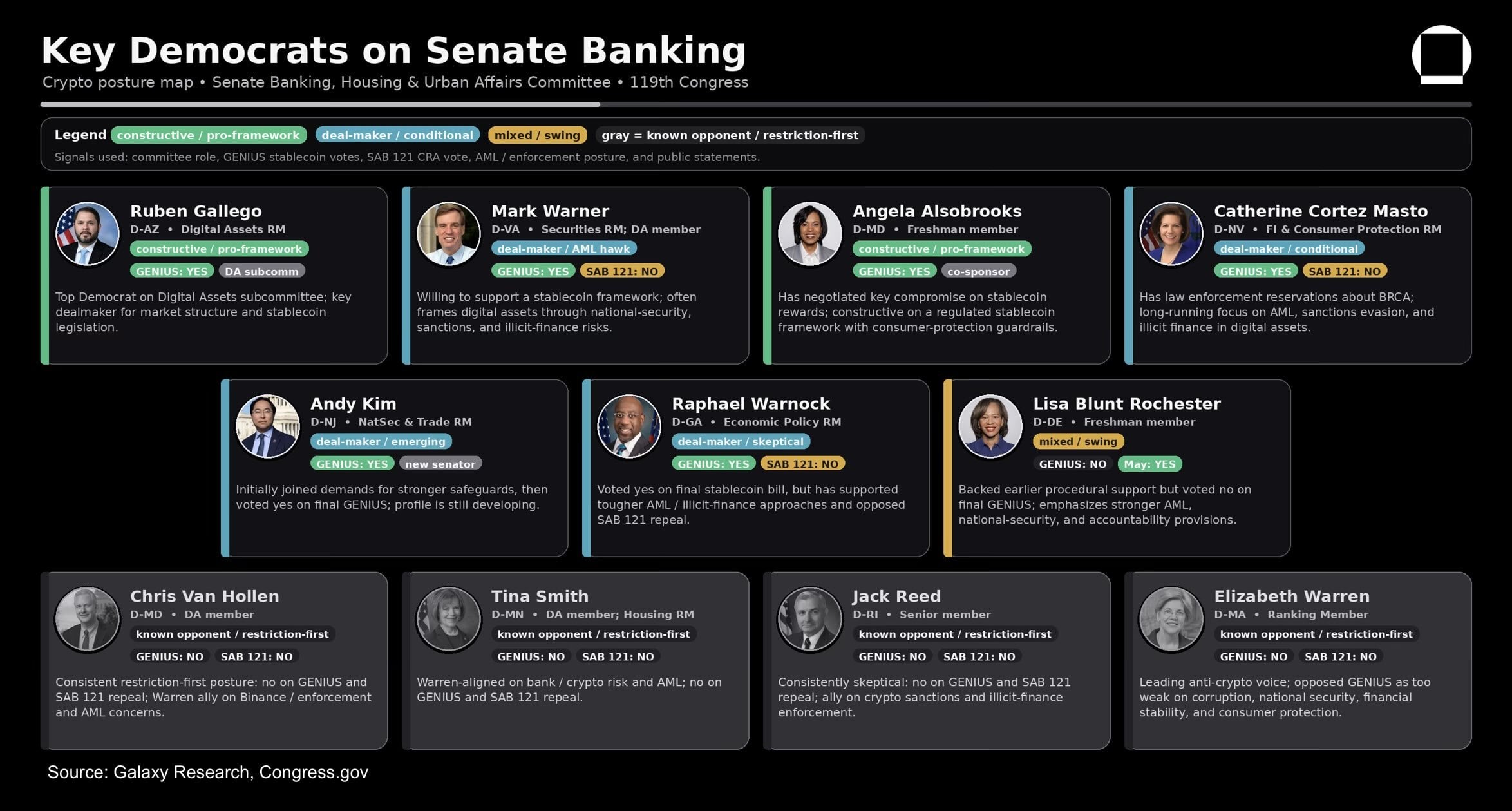
The layout shows why Thursday’s markup is not only a party-line test. Republicans can move the bill through committee if they remain united, but Democratic support would give CLARITY a stronger claim to bipartisan legitimacy before a much harder Senate floor fight.
Deal-Makers Become The Markup Battleground
Galaxy’s map puts the pressure on Democrats who have shown interest in a crypto framework but still want tighter safeguards. Warner and Cortez Masto are listed as deal-makers or conditional votes, with concerns around anti-money-laundering rules, sanctions evasion, and illicit finance. Kim and Warnock are also placed in the deal-maker lane, though their profiles are more cautious or still developing.
That middle group matters because CLARITY cannot become law by clearing committee alone. Galaxy’s April analysis put the odds of CLARITY being signed into law in 2026 at “roughly 50-50, and possibly lower,” citing the number of unresolved issues and the limited legislative calendar. After Banking, the bill still needs a 60-vote Senate floor path, reconciliation with the Senate Agriculture version, reconciliation with the House-passed bill, and a presidential signature.
The House passed its CLARITY version in July 2025 by a 294-134 vote, including 78 Democrats. That gave the industry a strong bipartisan marker, but the Senate version has carried more friction because it includes broader provisions around securities innovation, illicit finance, DeFi, banking activity, software developer protections, and customer property protections.
Stablecoin Yield And AML Remain The Pressure Points
The stablecoin rewards fight remains one of the most sensitive issues before the markup. A compromise tied to Thom Tillis and Angela Alsobrooks would prohibit rewards on idle stablecoin holdings when they resemble deposit interest, while allowing rewards linked to activity such as payments. Banking groups are still pushing for tighter language, arguing that crypto platforms could still draw deposits away from insured banks.
Crypto firms argue that broad reward bans would weaken payment competition and preserve the old banking stack at the expense of digital-dollar innovation. That dispute has already shaped the wider stablecoin-yield fight before the CLARITY markup, while Galaxy’s own research has challenged some bank warnings around deposit flight and yield incentives.
Democrats are also pressing for stronger AML, sanctions, consumer-protection, and political-conflict language. Reuters reported that many Democrats see the bill as too weak on anti-money-laundering provisions and want more limits around officials profiting from crypto ventures. That makes the markup less about whether Democrats support crypto in general and more about whether the current text gives them enough enforcement and ethics coverage to justify moving forward.
The committee vote will not settle the full CLARITY fight, but it will show whether a bipartisan center still exists after months of lobbying. A clean markup with visible Democratic support would push the bill closer to a Senate floor debate. A narrow or messy outcome would leave the 2026 passage odds exposed to the same pressures Galaxy flagged: floor time, unresolved amendments, stablecoin language, AML demands, and the political calendar tightening before midterms.
The post Senate Banking Democrats Split As CLARITY Act Faces Key Markup appeared first on Crypto Adventure.
0
0


 Manage all your crypto, NFT and DeFi from one place
Securely connect the portfolio you’re using to start.

0
0

0
0


0
0