
Is It a Good Time to Buy Crypto Right Now?

0
0

Crypto trading volume
On April 27 (09:00 UTC), the global cryptocurrency market capitalization stands at $2.67 trillion, 0.5% down since Sunday, April 26. However, compared to Monday, April 20, when it was $2.62 trillion, the market cap increased by 4.9%. Notably, it is also green in the 14-day and the 30-day periods, remaining red in the 3-month timeframe.
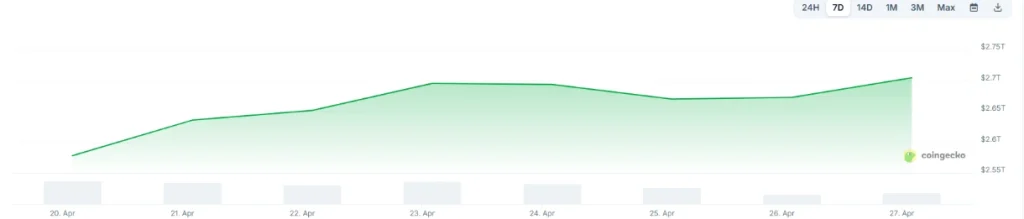
At the time of writing, the total crypto trading volume in the last day is at $79.3 billion, significantly lower than the level posted last Monday when it recorded $106.23 billion. Overall, it’s still quite low compared to the levels we’re used to seeing during the last bull run.
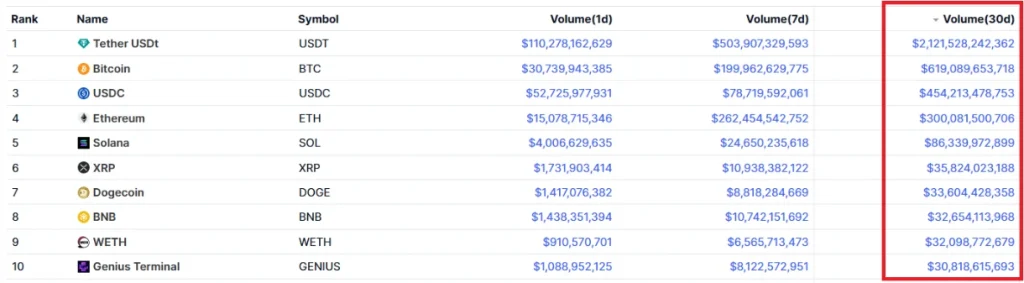
When it comes to the top coins by volume, four coins take the first three spots, depending on the timeframe: Tether (USDT), Bitcoin (BTC), Ethereum (ETH), and USD Coin (USDC). Tether is always at the top though. In the past day, USDT, USDC, and BTC recorded $110 billion, $52 billion, and $30 billion, respectively. Over the last week, USDT posted $503 billion, ETH $262 billion, and BTC $199 billion. Below you can see the ranking over the past month as well.
Altcoins post minor changes
Of the top 100 coins by market cap, 57 have seen their prices drop on Monday, April 27, while the rest have increased. Arbitrum (ARB) fell the most, 4.5% to the price of $0.1263, followed by Official Trump (TRUMP)’s 4.1% to $2.56. At the same time, Pudgy Penguins (PENGU) is the winner in this category, having risen 9.9% to $0.009702. Rain (RAIN) is next with an increase of 4.3% to $0.007435. The changes are a bit more notable in either direction compared to the week prior.
In the 7-day timeframe, we find 34 of the top 100 coins in the red. TRUMP lost the most in this category as well. Ethena (ENA) and World Liberty Financial (WLFI) follow with 3% and 2.2% drops to the prices of $0.1065 and $0.07337. On the other hand, nine coins recorded double-digit rises. Stable (STABLE) posted a 38.5% rise in this period to $0.0349, with PENGU following, having surged 9.8% in seven days.
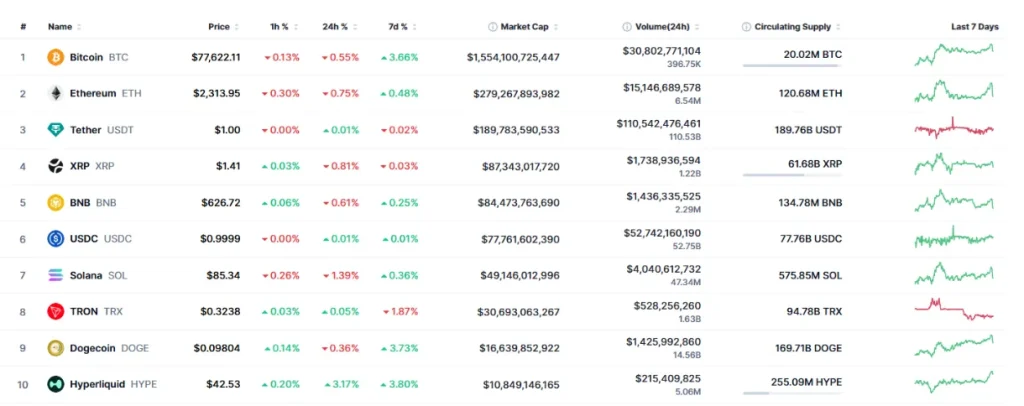
Now, let’s shift our focus to the top 10 coins. On April 27, we find that six were red and two green over the past 24 hours (not taking the two stablecoins into account). Neither side saw significant shifts for the second week in a row. The reddest coin is Solana (SOL), having dropped 1.39% to $85.34, but the rest are down by less than 0.9% each. On the green side, two coins that appreciated are Hyperliquid (HYPE), which rose 3.17% to $42.54 and Tron (TRX) is up just 0.05% to $0.3238, meaning it’s unchanged in a day.
In the 7-day period, six coins are green, the highest among which are HYPE’s 3.8% and Dogecoin (DOGE)’s 3.7% to $0.09804. TRX is the only red coin in this category, with a 1.87 drop.
Bitcoin stays in range
Bitcoin hasn’t really moved since Sunday, April 19, rising just 0.12% and standing at $75,189 on Monday. However, it’s the second-best performer in the 7-day category, posting a 6.2% jump. It rose 6.2% in the 1-month period, while it’s down 11% in a year. It’s also 40.5% away from its all-time high of $126,080.
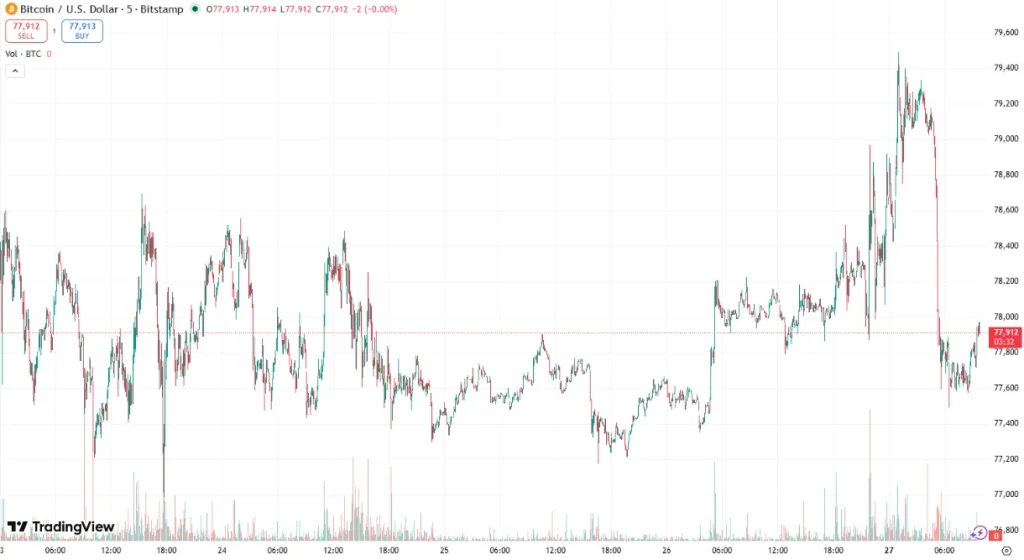
As the chart shows, the price did surge mid-to-late week and leading into the weekend, but it returned to the more-or-less the same level it had seen just prior to the surge. That’s not to underestimate its movement though, as it’s still significantly higher than last Monday’s $70,000 level. On April 17, it nearly entered the $78,000 zone, but it failed to maintain the level and the momentum.
The $76,800 price acted as a significant bear-market resistance level. Notably, it has historically capped relief rallies, meaning that the additional upsides get capped as holders who approach breakeven are incentivized to sell. We see $67,600 as the main near-term support now, in case the resistance holds, while we can see BTC returning into the $80,000 territory if the rally resumes.
Ethereum stays unchanged
Ethereum fell 0.75% in a day, and it’s currently changing hands at $2,313. It added just 0.48% to the price over a week, meaning that, much like BTC, it remained mostly unchanged in the 7-day period. Overall, it’s up 16.2% in a month and 28% in a year, while it also pulled back by 53.1% from its ATH of $4,946. BTC has seen a more notable approach to its ATH than ETH in this period.
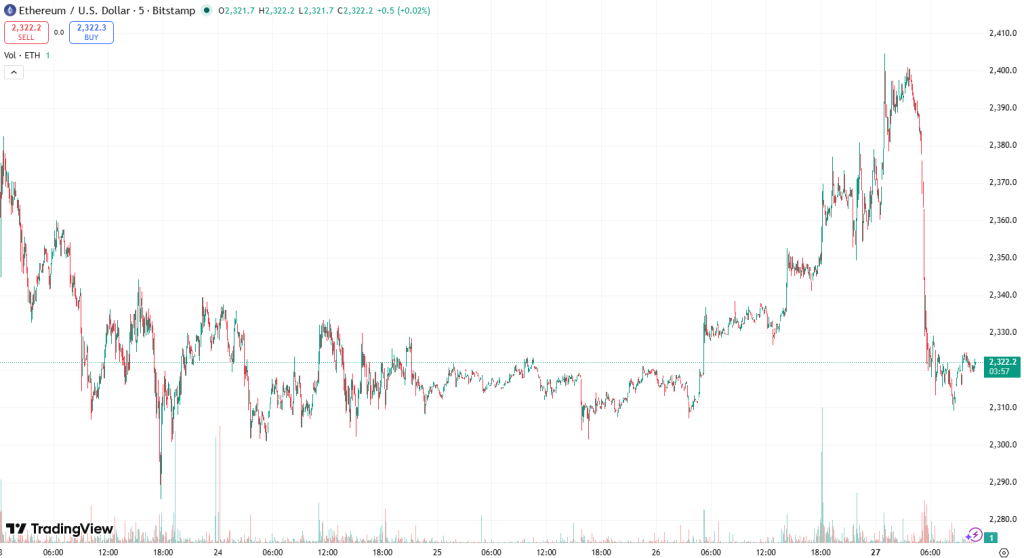
While it did jump earlier in the week, it swiftly dropped back to its previous price as well. It continued moving between the intraweek low of $2,289 and the intraweek high of $2,415. Its further moves will be decided most likely by the macro catalysts, and should the bull start running again, the price is set to climb to $2,500 fast, which could open doors to $2,670. Yet, a downturn could push it down to the $2,100 level.
Sentiment pulls back
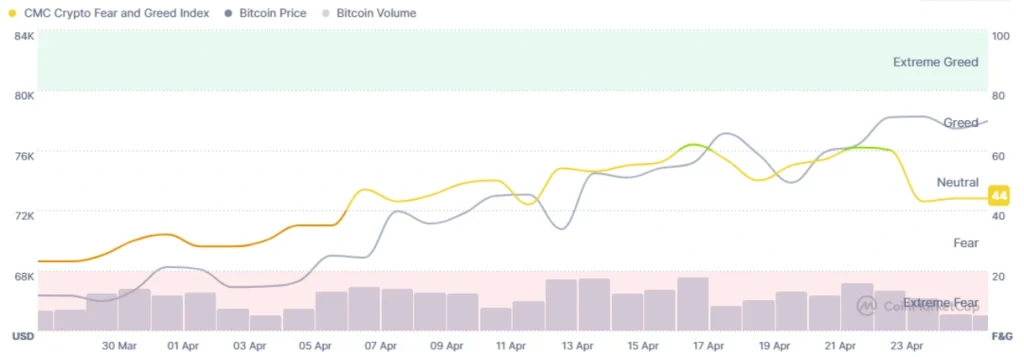
After posting a notable jump mid-week, the crypto market sentiment has pulled back within the natural zone. At the time of writing, this metric stands at 44, compared to 52 this time a week ago. The highest point in the past two weeks, as well as over the past 30 days, was 62 seen on April 17. While it decreased at the beginning of last week, it surged again to the optimistic 61 on April 22, which is the greed territory. Notably, the last time the sentiment briefly visited the greed zone was early October 2025, staying at 62 for a single day.
The current level indicates that the market is slightly risk-off, without selling pressure or capitulation. The investors aren’t confident, but hesitant instead. The market is stable, but largely undecided: it’s not fearful enough for panic selling, but also not greedy enough for euphoric buying. At least not yet. What it needs to make a decision is a strong emotional driver, be it a macro, news, or liquidity catalyst. This sentiment level also confirms our argument that the market is in a consolidation phase, but also guided by uncertainty around macro and geopolitics.
Key drivers behind market moves
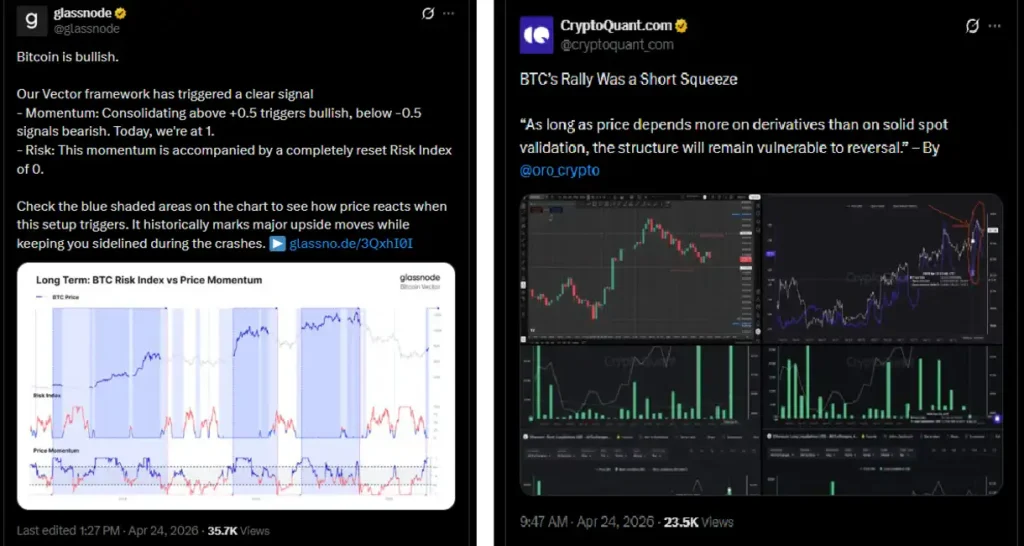
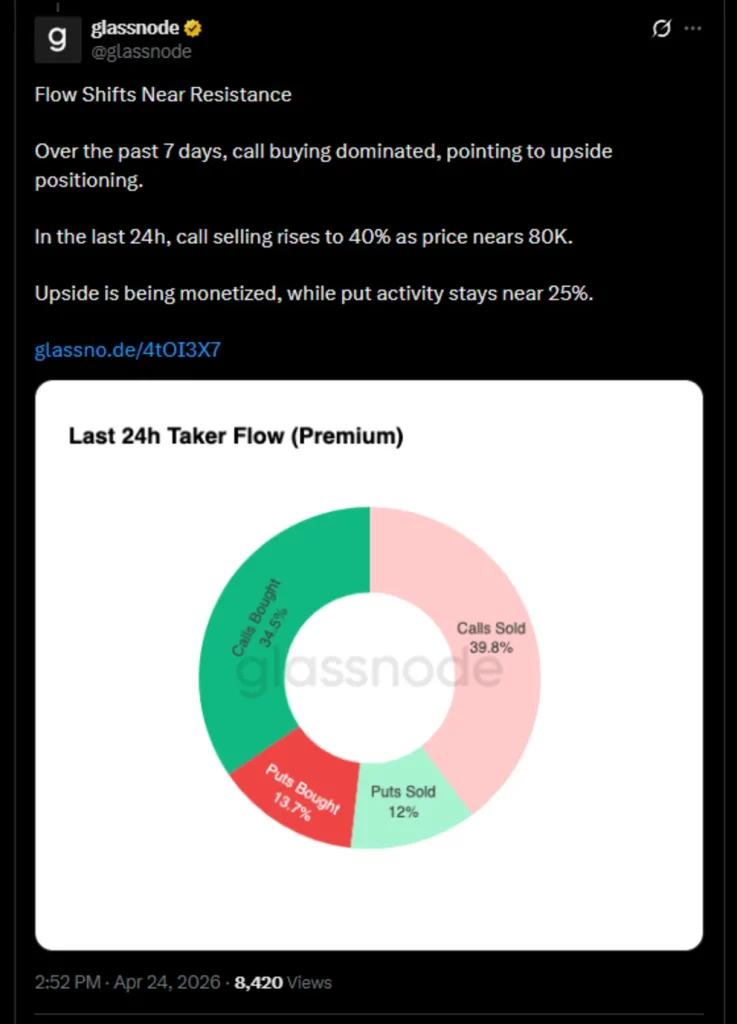
Ending the week, analysts found that the market is in the consolidation stage, with BTC having retested its February highs just below $80,000 and standing range-bound near this specific level.
As prices retested resistance, volatility was bleeding, Glassnode noted in its report. “Implied volatility keeps drifting lower,” they wrote on Friday. “1M to 6M compress steadily, while 1W spikes fade quickly. As price pushes into key levels, volatility is still being sold, not bid.”
Geopolitical factors: from spiking to stagnation
There was no major escalation in tensions in the Middle East. The ceasefire was extended on Tuesday, but Tehran and Washington are no closer to an agreement, and the Hormuz crisis continues. Also, the oil prices jumped last Wednesday, with the realization that the ceasefire extension doesn’t automatically mean an increase in oil exports through the strait.
The early week optimism surrounding the extension and potential Hormuz reopening resulted in a short-lived rally, followed by the market shifting from fear to very cautious relief, which further led to reduced volatility spikes over the rest of the week. All in all, the situation supported a gradual and minor upside and relative stability, following a particularly unstable period for the markets across the board. Keep an eye on the situation in the region, as any deterioration can produce significant volatility and bearish movement.
Macro factors remain mixed
The US Federal Reserve is not cutting rates, but the markets think that they may be at least a bit closer to doing so. The reports from different agencies that came out during the week presented data that couldn’t lead to rate cuts nor to a hawkish stance.
Nonetheless, the lack of movement for the past weeks has helped support a range-bound to mildly bullish bias, reduce downside pressure, allow the market to hold gains instead of rejecting, and stabilize sentiment.
Crypto-specific developments
Last week saw the release of Bitcoin Core version 31.0, as a new upgrade to the software that powers the Bitcoin network. The release includes new features and bug fixes, particularly the way the network handles transactions and data via the redesigned mempool structure.
Moreover, Charles Schwab announced that it would be launching direct Bitcoin and Ethereum trading to retail clients in the coming weeks, marking one of the clearest spot crypto moves by a major brokerage
Additionally, the U.S. military said it’s actively running a Bitcoin node as part of its cybersecurity and network protection strategy.

ETFs post an inflow streak
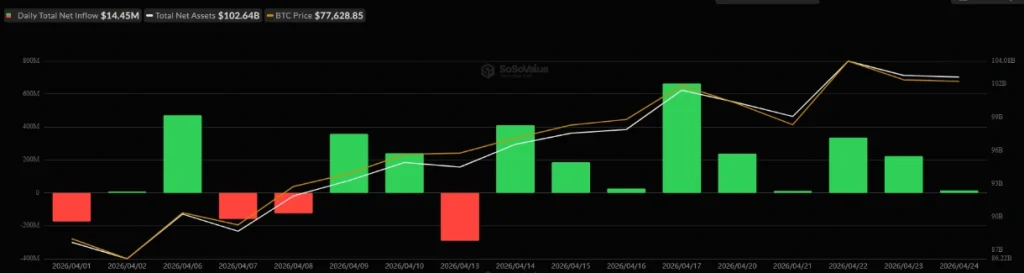
Exchange-traded funds (ETFs) are both a key market driver and an indicator of the market’s direction. When it comes to BTC spot ETFs, they posted a full week of positive flows, as well as a 9-day green streak. The highest over the past week was $335.82 million in inflows recorded on Wednesday, April 22.
Since the beginning of April, there were 13 days of inflows and 4 of outflows. The month’s highest point so far was a whopping $663.91 million on April 17, while the highest outflow amount was $291.11 million on April 13.
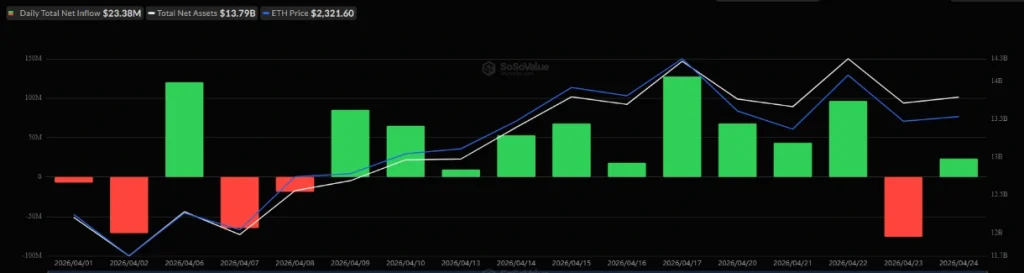
Unlike their BTC counterparts, the ETH spot ETFs did post a red day last Thursday, bidding farewell to $75.94 million. But a day earlier, it recorded the week’s highest inflows of $96.44 million.
Overall, since April 1, there were 12 inflows and 5 outflows. The highest positive flow is $127.49 million (April 17), while the negative flows hit the month’s peak at $71.17 million (April 2).
Moreover, Grayscale has filed an amended S-1 registration for its HYPE ETF, with listing planned on Nasdaq under the ticker “GHYP.” The amended filing, submitted on April 20, follows the initial registration submitted in March and reflects ongoing revisions required before approval.
$10 billion April options expiry
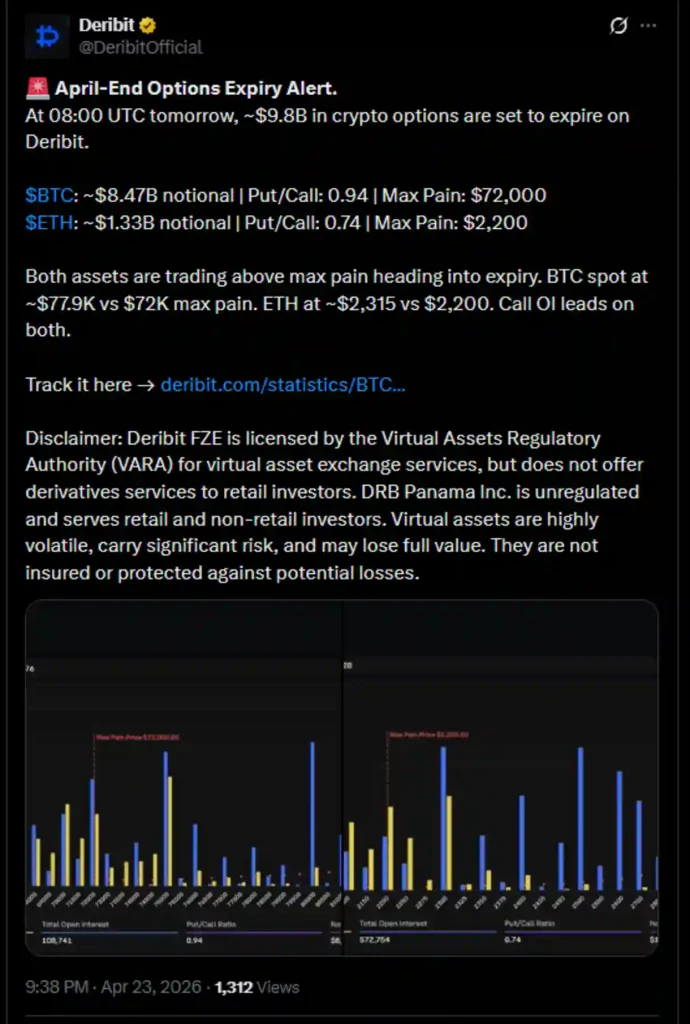
On April 24, Bitcoin and Ethereum saw a total of $9.87 billion in options contracts expire, which is April’s largest monthly settlement. It included 109,000 BTC contracts worth $8.55 billion and 563,000 ETH contracts with a notional value of $1.32 billion. Leading into the settlement, both assets traded above their max pain levels heading.
We saw suppressed volatility leading to the expiry, and volatility expansion immediately after it. Unlike macro or geopolitics, the expiry didn’t change the broader trend or decide direction. Instead, it contributed to controlled consolidation.
Events to watch
We have entered a high-impact macro week. Unlike last week, which was marked by relative stability, this upcoming one could produce clearer catalysts that have the ability to trigger direction. These are the key points to watch.
Macro: US FOMC, jobs data, and inflation signals
Macro data is still a core driver of crypto price direction. The macro is pretty much about one question: is the economy slowing enough for rate cuts? ‘Yes’ would be bullish for crypto, while ‘no’ would be bearish or range-bound (currently, likely the latter).
The week’s main macro event will be the FOMC meeting in the US, which is the regular gathering of the Federal Open Market Committee (a branch of the Federal Reserve) to set US monetary policy, primarily by determining interest rates. Keep an eye on both the interest rate decisions and the press conference, both of which could indicate potential future direction if the committee decides to sit still. This is the most important catalyst of the week, as the defined rate path and liquidity expectations will indicate a potential tone shift (hawkish (crypto bearish) vs dovish (crypto bullish)), as well as the timing of future cuts.
Next up, the US jobs data report also impacts crypto. Weakening labor suggests decreased inflation pressure, which could lead the Federal Reserve to cut rates sooner, and this is a bullish scenario for crypto. Lastly, and related to the previous point, cooling inflation is bullish for crypto, so watch those indicators as well (primarily PCE), particularly as the Federal Reserve does so too in order to gauge inflation.
Geopolitics: a wildcard
Despite the relative stability that has followed the (lack of) developments in the Middle East, this situation is still a powder keg. The ceasefire has been extended, but it will expire, and the tensions around the Strait of Hormuz remain high. While ceasefire optimism fueled the recent crypto rally, any additional escalation could result in an immediate risk-off selloff. Surprise headlines can easily override macro, at least in the short-term.
Spot Bitcoin ETF flows
This is still one of the strongest real demand signals. The flows are currently steady, instead of explosive, and spot BTC ETFs continue to act as a price floor. This absorbs sell pressure and prevents deeper corrections.
Is it a good time to buy crypto right now?
Based on what we’ve seen above, this is still a good time to buy crypto, but investors can also wait and see what happens after this week’s reports. Buyers are currently quite selective, but not aggressive. There is an evident downside risk, but it’s not extreme, and further rallies may struggle without a catalyst. While last week saw relative stability and lower volatility, with no major catalysts, this week, we can expect binary outcomes following the US FOMC meeting and the mentioned jobs report. The question is, will the Fed open the door to easier liquidity, or will it keep it firmly shut? Everything else is secondary to this macro factor.
Certain bullish forces are still strong, such as the continual ETF positive flows and the neutral-to-bullish sentiment. So keep an eye on the macro and geopolitical developments, as these may push the prices higher. But also remember that a short-term bearish move presents a good chance for those looking to buy.
Disclaimer: This article is for informational purposes only and does not constitute financial, investment, or trading advice. Cryptocurrency markets are highly volatile and involve significant risk. Always conduct your own research and consult with a qualified financial advisor before making any investment decisions. Never invest more than you can afford to lose.
The post Is It a Good Time to Buy Crypto Right Now? appeared first on TechGaged.com.
0
0

 한 곳에서 모든 암호화폐, NFT 및 DeFi 를 관리하세요
시작하는 데 사용하는 포트폴리오를 안전하게 연결하세요.

0
0


0
0

0
0