
Solana Traders Are Turning Bearish: Is SOL Price Heading Back to $78?

0
0

SOL price prediction sentiment weakened this week after Solana’s derivatives market shifted decisively bearish following the token’s rejection at the $98 level on May 11. The decline in bullish momentum came alongside falling decentralized exchange activity and slower network demand, pushing SOL into a nearly 15% correction that later tested support near $83.
Despite the recent weakness, Solana continues to maintain one of the largest decentralized finance ecosystems in the crypto market. SOL is currently trading around $84.83, down 0.51% over the past 24 hours, while traders continue monitoring whether the token can stabilize above key technical and psychological support zones.
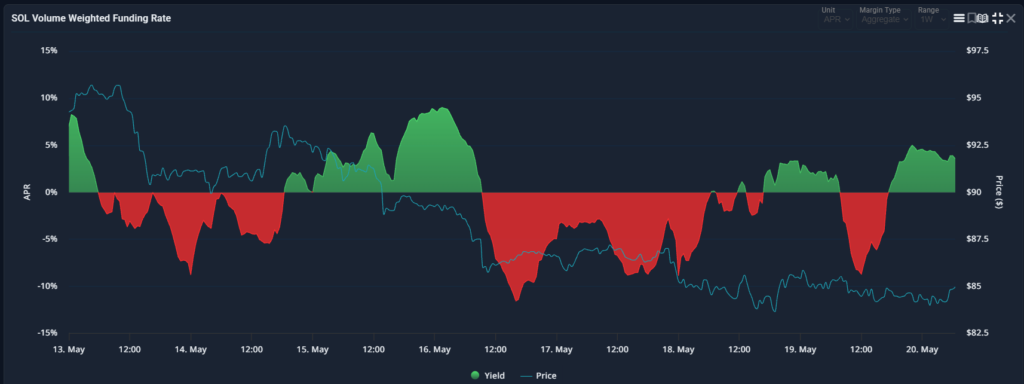
The latest derivatives data showed a major change in positioning behavior. Solana’s perpetual futures funding rate dropped to -3% on Tuesday after standing near +8% on Saturday. Under neutral market conditions, the metric generally remains close to +9% to reflect exchange risk and capital costs. The reversal suggested that traders increasingly shifted toward bearish leverage once SOL slipped below the $90 level.
What Do Current Indicators Suggest About SOL Price Prediction?
Technical indicators currently point toward weakening short-term momentum while stopping short of signaling a fully bearish breakdown. Solana’s Relative Strength Index (RSI) stood at 42.73, placing the token in neutral territory rather than oversold conditions. Meanwhile, the Average Directional Index (ADX) measured 17.69, also reflecting a neutral trend environment with limited directional strength.
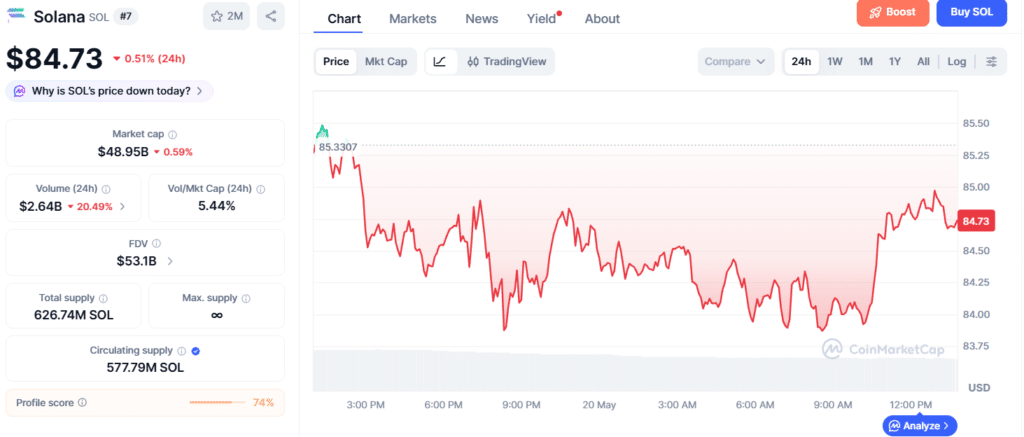
However, some indicators continued flashing caution signals. The MACD level stood at -0.13 with a sell indication, while the 50-day Simple Moving Average remained at 85.98, also signaling sell-side pressure. Analysts noted that the combination of neutral momentum indicators and bearish moving-average signals suggests traders remain cautious but not fully capitulating. The current SOL price prediction outlook therefore remains highly dependent on whether trading activity and market participation recover over the coming sessions.
Why Did Derivatives Traders Turn More Defensive?
The recent shift in perpetual futures positioning has become one of the biggest drivers behind the changing SOL price prediction outlook. Negative funding rates typically indicate that traders holding short positions are paying premiums to maintain bearish exposure. After SOL failed to hold above $98 earlier this month, leverage demand on the bullish side weakened sharply.
Market participants said the funding reversal reflected growing caution rather than panic selling. Analysts also stressed that negative funding rates do not automatically confirm a deeper crash scenario. In some cases, crowded short positioning can create conditions for short squeezes if sentiment unexpectedly improves. The recent pullback toward the $83 level reinforced defensive positioning, though SOL has since managed to stabilize near current levels.
How Much Has Solana’s Ecosystem Activity Slowed?
Declining activity across decentralized exchanges and decentralized applications has added additional pressure to market sentiment. Weekly DEX volume on Solana has fallen to around $11 billion compared with January’s average of $25 billion, representing a 56% decline over the period. Weekly DApp revenue also slowed to roughly $20 million after averaging close to $35 million earlier in the year.
The slowdown reflected cooling speculative demand across the broader crypto market, particularly after memecoin trading activity faded from earlier highs. Since Solana had been one of the primary beneficiaries of the memecoin surge, the network experienced a more visible decline once that speculative momentum weakened.
Still, Solana remains the leading blockchain for DApp revenue generation despite softer activity levels. Pump, Axiom Pro, Phantom, and Jupiter currently account for approximately 65% of ecosystem revenue over the past 30 days, continuing to support network usage across trading and decentralized finance.
Is Competition From Hyperliquid and Base Increasing?
Competition across decentralized finance infrastructure has intensified as alternative blockchain ecosystems expand into derivatives trading and retail onboarding. Hyperliquid has emerged as a growing competitor in perpetual futures markets by integrating trading infrastructure directly into its consensus layer. Its high-throughput design has increasingly attracted derivatives traders seeking specialized functionality.
At the same time, Base has expanded through its integration with the Coinbase ecosystem, helping attract both developers and retail users into decentralized finance applications.Even with rising competition, Solana remains one of the largest DeFi ecosystems by total value locked. The network currently holds around $5.905 billion in TVL, down 0.59% over the past 24 hours. That still places Solana ahead of BNB Chain at $5.482 billion and Base at $4.456 billion, which slipped 0.15% during the same period.
Ethereum continues leading the broader market with approximately $43.162 billion in total value locked despite recording a 0.62% decline over the past day. Protocols including Jupiter, Kamino, Sanctum, and Raydium continue anchoring Solana’s decentralized finance ecosystem. Analysts said that while competing chains are gaining traction in specific sectors, Solana still maintains substantial liquidity depth and ecosystem scale.
Did Automated Trading Activity Trigger New Market Concerns?
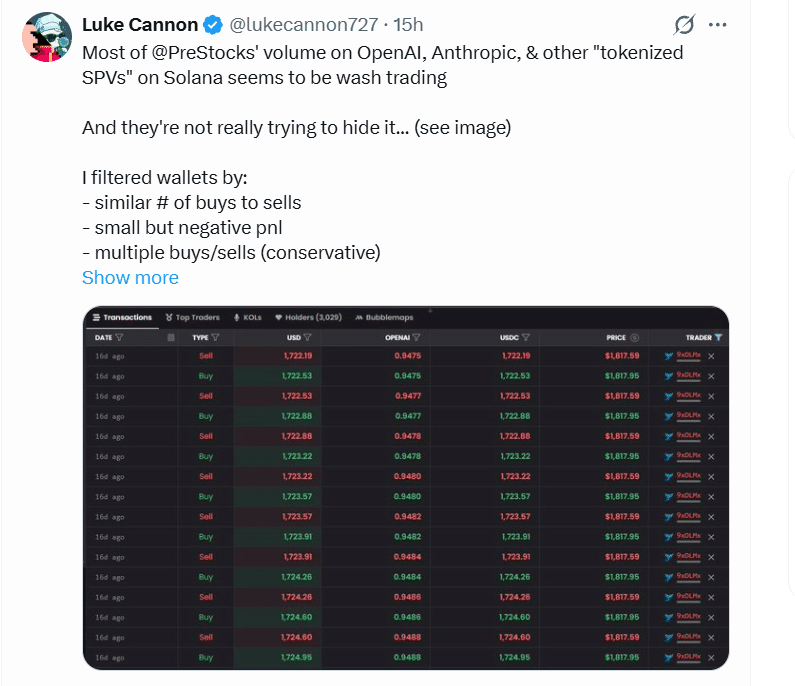
Fresh questions around trading activity also emerged after analysis shared by X user Luke Cannon examined transaction behavior tied to a Solana-based synthetic asset platform. The findings suggested that more than 1,600 wallet addresses accounted for nearly 63% of the platform’s reported trading volume, estimated at roughly $760 million.
The trading patterns reportedly involved balanced buy-and-sell behavior, high-frequency execution, and relatively small losses. Those characteristics are often linked to arbitrage strategies, though analysts noted they can also resemble artificial volume activity in certain market conditions. Researchers following the discussion stressed that the available data does not conclusively prove manipulation or wash trading.
Solana’s low transaction fees make the network highly attractive for automated trading systems and maximal extractable value strategies, both of which can generate elevated transaction frequency naturally. The discussion surfaced while derivatives traders were already increasing bearish positioning, adding another layer to the broader SOL price prediction debate.
Could SOL Still Revisit the $78 Range?
The recent correction has revived speculation over whether SOL could retest the $78 range seen earlier this year. However, analysts said current market signals still stop short of confirming an immediate move toward that level. Although bearish positioning increased in perpetual futures markets, Solana’s broader ecosystem metrics continue showing relative strength compared with competing blockchain networks.

SOL also managed to stabilize after briefly revisiting the $83 range during the latest correction. Analysts said a rebound in decentralized exchange activity or renewed speculative participation could improve short-term sentiment. At the same time, continued weakness in trading volumes may keep bearish pressure elevated across derivatives markets.
Conclusion
SOL price prediction trends currently reflect growing caution among traders as weaker network activity combines with rising competitive pressure from rival blockchain ecosystems. Negative funding rates, declining DEX volumes, and softer DApp revenue have all contributed to a more defensive market environment in recent sessions.
Even so, Solana continues to hold a dominant position within decentralized finance infrastructure. The network remains the leading blockchain for DApp revenue while retaining second place in total value locked behind Ethereum. For now, analysts said the market appears to be reassessing growth expectations rather than abandoning confidence in Solana’s broader ecosystem altogether.
Glossary
MEV Bots: Bots that profit from transaction timing.
MACD Indicator: A tool that tracks market momentum.
Short Position: A trade betting on price declines.
DEX Volume: Trading activity on decentralized exchanges.
DApp Revenue: Income earned by blockchain apps.
Frequently Asked Questions About SOL Price Prediction
Why did Solana fall below $90?
Solana fell below $90 after bearish sentiment increased and buying momentum weakened.
What is hurting Solana’s market sentiment?
Lower DEX activity, weaker DApp revenue, and growing competition are pressuring sentiment.
Why is SOL price prediction turning bearish?
SOL price prediction turned bearish after funding rates flipped negative and trading demand slowed.
Could SOL price fall to $78?
SOL could revisit $78 if bearish pressure and weak market activity continue.
Did automated trading raise concerns on Solana?
Yes, analysts raised concerns after unusual high-frequency trading activity appeared on the network.
Sources:
Read More: Solana Traders Are Turning Bearish: Is SOL Price Heading Back to $78?">Solana Traders Are Turning Bearish: Is SOL Price Heading Back to $78?
0
0

 Manage all your crypto, NFT and DeFi from one place
Securely connect the portfolio you’re using to start.

0
0

0
0

0
0
