
Arbitrum One in Practice: What Matters for Bridge, Gas and the Seven-Day Wait

0
0

Arbitrum One is the largest extension of Ethereum measured by the capital deposited on it. Anyone holding a balance there for the first time runs into three questions the price does not answer: how do you get there, where do you see your holdings, and why does the way back take a week. The short answer to the last one: that week is precisely the security promise you are paid for with low fees.
We measured the numbers on the chain ourselves today. A simple transfer on Arbitrum One cost around 0.001 euros on September 28, 2026 at about 6:55 UTC, while the same transfer on Ethereum itself cost roughly 0.007 euros in the same minute. The gap is narrower than usual because the main chain is currently unusually quiet, which is a good illustration of why blanket fee comparisons mislead. This guide belongs to our series on the major networks; the overview of networks, bridges and explorers sets out how the pieces fit together.
Setting Up Arbitrum One: Chain ID 42161 and Why No New Wallet Is Needed
Arbitrum One is an EVM chain. Addresses, signatures and contracts work as they do on Ethereum, which is why you do not need a separate wallet: your existing Ethereum address is the same address on Arbitrum. That is the big difference from networks with their own account model, where address formats and wallets are separate.
Most common wallets already carry Arbitrum One in their network list, and a single click is enough. If you do have to enter it by hand, the chain ID is the decisive detail. That identifier is 42161, and we checked it against a public node: the eth_chainId query to arbitrum-one-rpc.publicnode.com returned 0xa4b1 on September 28, 2026, which is exactly 42161. The network's currency is ETH and the block explorer is Arbiscan.
One warning about network setup: guides that hand you an RPC address are everywhere, and a manipulated RPC entry can show you fake balances or steer you to a phishing page. Take the entry from your wallet's built-in list, or fetch the address from the official documentation. Anyone holding larger amounts on Arbitrum pairs the wallet with a hardware wallet: the key then never leaves the device, and a tampered interface cannot sign anything.
What a Transaction Costs: 0.02 Gwei and an L1 Share of Three Percent
The fee on Arbitrum has two parts, and that explains its behaviour. The first part is execution on Arbitrum itself; every EVM instruction costs the same amount of gas as it does on Ethereum. The second part reimburses the cost of writing the transaction data to Ethereum in batches. Arbitrum compresses each transaction individually for this, converts the size into Ethereum gas and adds the result as extra gas units.
This can be made visible directly. On September 28, 2026 at about 6:55 UTC we had a simple transfer estimated via eth_estimateGas: the result was 21,647 gas. On Ethereum the same transfer costs exactly 21,000 gas. The difference of 647 units is the data share that lands on the main chain, so at this level roughly three percent of the total fee. The gas price stood at 0.02002 gwei, measured at block 509,629,810.
Add it up: 21,647 gas times 0.02002 gwei comes to around 0.00000043 ETH. At an ether price of 2,328.66 euros, or $2,648.88 (Kraken, September 28, 2026), that is about a tenth of a cent. For comparison, the same minute on Ethereum: 21,000 gas times 0.1472 gwei, so roughly 0.0000031 ETH or 0.7 cents.
Two things follow from this in practice. First, on Arbitrum you need ETH as the fee token, not ARB — more on that below, because it is one of the most common mix-ups. Second, your fee moves with Ethereum's load, not only with Arbitrum's. When the main chain gets expensive, the data share rises with it, and a transaction that cost a tenth of a cent yesterday costs ten times that tomorrow. We have shown in detail how gas on the main chain is read and planned using the example of Etherscan and gwei.
Getting There: Exchange Withdrawal and the Canonical Bridge Compared
The most convenient route to Arbitrum runs through an exchange. The large trading venues pay out ETH and USDC directly into the Arbitrum network; you select Arbitrum One as the network in the withdrawal form, paste in your usual address and normally have the amount within a few minutes. This generally costs a small flat fee and saves you the main chain fee entirely. Which venues bring a MiCA licence and SEPA deposits is set out in our exchange comparison.
The second route is the canonical bridge from Ethereum to Arbitrum. The amount is locked in a contract on the main chain and released on Arbitrum. In this direction it is quick, usually about ten to fifteen minutes, because no challenge period is needed: the main chain is treated as authoritative and Arbitrum follows it. You do, however, pay for a full Ethereum transaction.
The third route is intent bridges, where a service provider pays you out on the destination chain immediately and settles in the background. Such bridges are faster than the canonical one and, in the opposite direction, considerably faster than seven days, but you are relying on the operator rather than on the chain. For small amounts that is a defensible trade; for large ones it is not.
The Way Back: A Seven-Day Challenge Period and What Happens During It
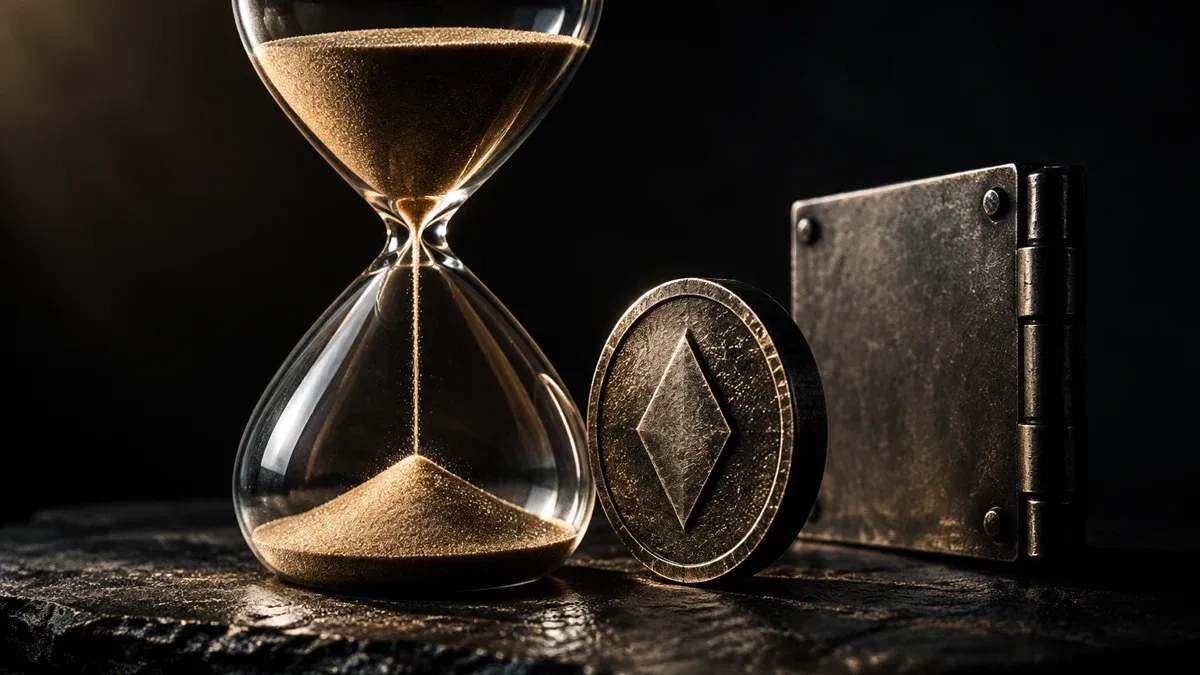
Here lies the quirk that surprises Arbitrum newcomers most. Anyone moving a balance back to Ethereum over the canonical bridge waits at least seven days before they can claim it there. This is not a bottleneck and not a server problem, but a design principle.
Arbitrum One is an optimistic rollup. The name is meant literally: the system first assumes optimistically that the submitted settlement is correct and publishes it on Ethereum. A window then runs in which any participant can challenge that settlement and refute it with a fraud proof. Only once the window passes without objection is the state considered confirmed, and only then may a withdrawal be executed on the main chain. That window is the seven-day period.
The Withdrawal Runs in Two Steps
In practice this means a two-stage process: you initiate the withdrawal on Arbitrum, wait out the period and then have to send a second transaction on Ethereum to collect the amount. That second transaction costs gas on the main chain, so keep ETH ready on your Ethereum address, otherwise the money sits there ready for collection and you cannot reach it. Anyone unwilling to wait takes an intent bridge or the route via an exchange, and pays the difference as a premium.
Reading Arbiscan: Transaction, Token Transfers and Granted Approvals
Arbiscan is the block explorer for Arbitrum One and is almost identical to Etherscan in structure. Every transaction has a hash; paste it in and you see the operation as the chain stored it. Four areas are useful day to day.
Four Areas That Explain the Operation
Status and block show whether the transaction went through. A failed transaction still costs gas, because the network executed it. Transaction Action translates the operation into plain language, for instance as a swap on a particular trading venue. Tokens Transferred lists which tokens actually moved — this is where you check whether a swap delivered what the interface promised. And under Token Approvals you find every approval granted for your address, sorted by contract.
One particularity compared with Ethereum: Arbiscan shows the itemised fee for every transaction, so the execution share and the data share separately. Anyone wanting to know why a transaction was more expensive than expected finds the answer there and not in the wallet.
Typical Mishaps: Wrong Network, Missing ETH, Fake Tokens
Three mistakes account for the bulk of losses, and all three are avoidable.
The wrong network on withdrawal. Because your address looks identical on Ethereum, Arbitrum, Base and Polygon, it invites carelessness. If you withdraw USDC from an exchange to the wrong network, the money sits on a chain where you may hold no ETH for gas — or, on chains with a different token contract, where it is not accessible at all. The address alone says nothing about the network; only the selection field in the withdrawal form does.
No ETH for gas. Anyone bringing only ARB or USDC to Arbitrum cannot move anything afterwards, because every transaction is paid in ETH. This is not a total loss, but a standstill that requires a second deposit. Always keep a small amount of ETH in reserve; at today's fees a few euros cover hundreds of transactions.
Fake tokens. On Arbitrum anyone can create a token with any name they like. Name and ticker are not credentials; the only credential is the contract address. Match it against an independent source before every purchase, for example the entry at an exchange that has listed the token. And treat tokens that appear unbidden in your address as what they are: bait meant to lure you to a particular site.
Revoking Approvals and Fending Off Phishing
Anyone trading on Arbitrum grants approvals to contracts. An approval allows a contract to dispose of a particular token in your address, and it remains in force until you withdraw it. Many interfaces request an unlimited approval by default, because that is more convenient than a separate approval for each trade.
Why an Old Approval Stays Dangerous
This is the lever behind most emptied addresses. If a contract is compromised later, or was malicious from the start, the old approval is enough to drain the holdings — without you signing anything again. So work through your approvals at regular intervals via the Arbiscan approval overview and revoke everything you no longer need. Each revocation costs one transaction, which on Arbitrum is fractions of a cent.

The Security Council: Nine of Twelve Signatures Suffice
An honest assessment includes a point that marketing copy tends to skip. Arbitrum is governed by a DAO whose constitution provides for a twelve-member body, the Security Council. In a security emergency this body can push through changes to the protocol without the delay that otherwise applies; nine of the twelve signatures are required for that. The members are elected in two groups, one group every six months.
That this is not a theoretical power was shown by the body in April 2026: after an attack on a third-party bridge it froze ether worth more than $70 million that was due to flow out via Arbitrum. Whether you approve of that depends on your standpoint — for those affected by the attack it was the rescue, for the idea of an unstoppable chain it was a contradiction. All that matters for your decision is that you know it: Arbitrum is not a system without intervention, and its security model rests on a committee alongside the mathematics.
Orbit Chains: What ApeChain and Robinhood Chain Mean for You
Arbitrum is not only a chain but also a construction kit. Under the name Orbit, projects can set up their own chains that use Arbitrum's technology and anchor their data either with Arbitrum One or directly with Ethereum. ApeChain is one of them, as is Robinhood Chain, whose launch moved the ARB price noticeably in September — we worked through the connection between Robinhood Chain and the ARB price at the time.
For you as a user this means one thing above all: an Orbit chain is not Arbitrum One. Every Orbit chain has its own chain ID, its own explorer, often its own fee token and its own security model, which can be weaker than that of the main chain. So anyone moving a balance to an Orbit chain checks the same points again from the start, rather than carrying them over from Arbitrum One.
ARB, Gas and Tax: The Token Is Not the Fee Token
The governance token ARB is regularly confused with the fee token. It is not one. ARB serves for voting in the DAO; payment on Arbitrum One is made in ETH. Anyone holding ARB holds a vote and a speculation, not a fee reserve. On September 28, 2026 ARB traded at $0.2119, or 0.1862 euros, with a daily range from $0.2106 to $0.2365 (Kraken).
For tax purposes the same system applies in Germany as on any other chain, and it becomes confusing quickly with layer 2 usage. Swapping one crypto asset for another is a private disposal transaction under Section 23 of the German Income Tax Act; the Federal Fiscal Court confirmed this in its judgment of February 14, 2023 (case number IX R 3/22), and the Federal Ministry of Finance adopted it in its circular on specific questions concerning crypto assets of March 6, 2025. The one-year holding period starts afresh after every swap. If less than a year lies between acquisition and sale, the gain is taxed at your personal rate; the exemption threshold for all private disposal transactions is 1,000 euros per year.
Is Bridging Itself a Swap?
One question keeps coming up here: is bridging itself a swap? The prevailing view says no for the case where the same asset merely moves to another chain and remains economically identical — it is a transfer between your own addresses. But as soon as a bridge issues you an asset different from the one deposited, for instance a wrapped variant or a service provider's holdings, the classification is no longer clear-cut. Clear up such cases with a tax adviser and document them properly, rather than quietly booking them as a transfer. A tax and portfolio tracker that reads in Arbitrum addresses takes the allocation off your hands, as long as you let it run along from the start.
Arbitrum in Practice: How to Proceed Now
- Add the network from your wallet's list. Take the ready-made entry for Arbitrum One from your wallet rather than an RPC address from a forum, and check that it shows chain ID 42161. For larger holdings, additionally pair a hardware wallet.
- Get there via the exchange, with an ETH buffer. Withdraw from a trading venue directly into the Arbitrum One network and add a small amount of ETH for gas while you are at it, even if what you actually want to move is ARB or USDC. You will find suitable providers in the exchange comparison.
- Plan the way back and the tax in advance. Allow seven days for a withdrawal over the canonical bridge and keep ETH on the Ethereum address for the collection transaction. Record every swap in a tax and portfolio tracker from the outset, because the holding period restarts after every swap.
(As of September 28, 2026. This article is not investment advice. Prices and fee structures change; check the terms with the provider before you buy.)
0
0


 Manage all your crypto, NFT and DeFi from one place
Securely connect the portfolio you’re using to start.


